
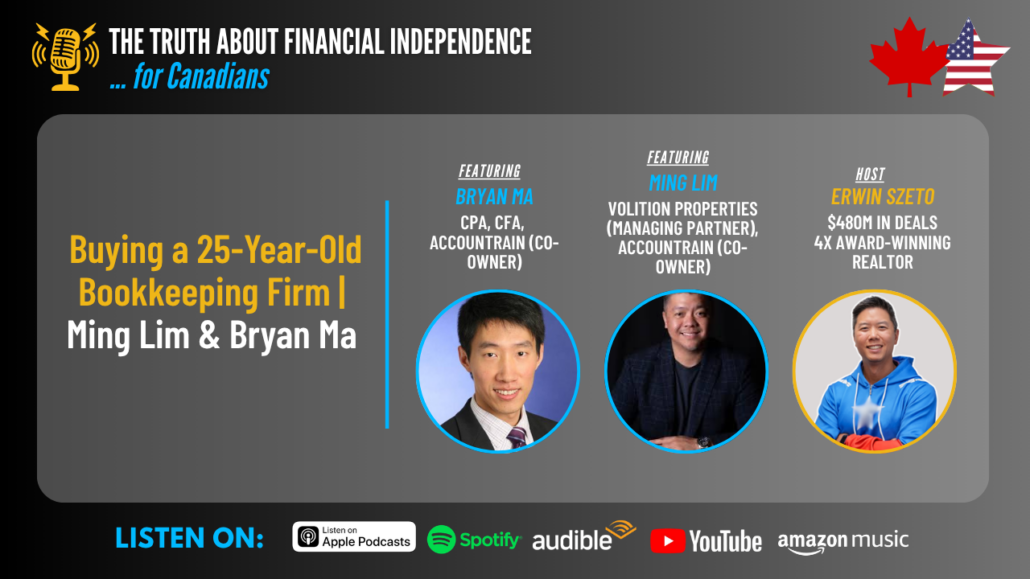
Buying a Boomer’s Business: Ming Lim and Bryan Ma on Acquiring a 25-Year-Old Bookkeeping Firm, Vendor Take-Backs, and the Great Wealth Transfer
By Erwin Szeto | Co-Founder, iWIN Wealth Planning
Recorded: June 2026
Host: Erwin Szeto, The Truth About Financial Independence for Canadians
Guests: Ming Lim, Managing Partner of Volition Properties and Co-Owner of AccounTrain; Bryan Ma, CPA, CFA, MBA, Co-Owner of AccounTrain
Ontario real estate investing is in a different place than it was three years ago.
Rent control, slowed appreciation, rising costs, and a Landlord and Tenant Board backlog that can stretch eviction timelines past a year have changed the economics for active operators. The investors who used to add another door to their portfolio every 12 months are now asking a different question: if not more rentals, then what?
In this episode of The Truth About Financial Independence for Canadians, Erwin sits down with Ming Lim and Bryan Ma, two friends who became business partners in January 2026 when they acquired AccounTrain, a 25-year-old bookkeeping firm based in Ottawa with clients across Canada. They beat out 5 other offers, paid 1.3 times annual revenue and they spent almost 2 years searching for the right deal.
About Ming Lim and Bryan Ma
Ming is the managing partner of Volition Properties, where his team has helped Canadians transact on more than $300 million in Toronto investment real estate. Bryan spent 20 years in Canadian financial services as a CPA, CFA, and MBA, with most of his recent work in mergers and acquisitions at Intact Insurance. Their conversation is a real-world picture of what buying a small business from a retiring boomer actually looks like for Canadian investors who have already built equity in real estate.
Why Active Real Estate Operators Are Looking at Small Business Acquisition
Ming has been investing in Toronto real estate since 2015. He has seen the market shift from one where adding more doors was the obvious move to one where the math demands a harder look. His team at Volition Properties has remained active, but he has spent the last 2 years exploring what comes next.
Bryan came at the question from a different angle. After 20 years in financial services, including roles at 3 of the largest professional services firms in Canada and most recently at Intact Insurance, he reached a moment of clarity that anyone in corporate finance will recognize. As he tells Erwin during the episode, he was doing 80-hour weeks on M&A files when he realized he had stopped enjoying the work.
The two had known each other for years before deciding to partner up. The thesis they landed on is one that has been gaining traction quietly in Canadian operator circles for the last 5 years: the great wealth transfer. Baby boomers built thousands of small Canadian businesses over the last 40 years, many of them profitable, durable, and unsexy. They are now reaching retirement age without succession plans. The opportunity is enormous, but it is also harder than it looks.
How They Found AccounTrain
Ming and Bryan spent close to 2 years looking before they found the right business. They worked through several channels: a buy-side community called Village Wealth, business brokers including Poe Group (which specializes in accounting firms), and direct outreach to owners of businesses that fit their criteria.
They tell Erwin the market is more competitive than most outside observers realize. Quality businesses with clean books and stable cash flow are often gone within 24 to 48 hours of listing. Buyers submit offers on businesses they have only partially reviewed, knowing they will lose the deal if they wait for full due diligence. Ming and Bryan estimate they looked at 1 to 2 businesses per day for almost a year before AccounTrain came up.
AccounTrain itself was sourced through Poe Group. The firm had been in business for 25 years, founded and run by a single operator who was approaching retirement. Initial interest came from 15 to 18 parties. By the time the bid deadline closed, there were 5 serious offers. Ming and Bryan’s offer was selected, they believe, partly because of Bryan’s M&A background, which signalled to the seller that the buyers understood the process and would be reliable to close.
Why Bookkeeping, Not a Full Accounting Practice
One of the most useful threads in the conversation is the deliberate decision to buy a bookkeeping firm rather than a full accounting practice. Most investors looking at the professional services space assume the bigger prize is an accounting firm with CPAs on staff, tax preparation engagements, and audit work.
Ming and Bryan went the other direction for a reason. Bookkeeping has fewer regulatory requirements. The owner does not need to be a CPA. The work is more systems-driven and less personality-driven, which means the business is less dependent on any single employee or partner. Pricing is more predictable. And the client relationship is recurring, which produces stable monthly revenue rather than the seasonal spikes accounting firms see around tax season.
The tradeoff is that bookkeeping firms typically sell at lower multiples than accounting firms. But Ming and Bryan argue that the lower entry price and the simpler operating model more than offset the lower exit multiple, especially for buyers who plan to hold and modernize rather than flip.
The Math of Buying a Bookkeeping Firm
Bookkeeping firms in Canada generally trade in a range of 1.2 to 2.5 times annual revenue. Where a specific firm lands within that range depends on several factors: client concentration, recurring versus one-time revenue mix, geographic distribution, technology stack, owner involvement, and the quality of the books themselves.
AccounTrain had approximately $1 million in annual revenue at the time of sale. Ming and Bryan paid 1.3 times revenue, putting the purchase price at approximately $1.3 million. They consider this on the low end of the range, in part because the firm was owner-operated with limited systems documentation, in part because the buyer pool was thinner than for a larger or more institutional firm.
The deal structure included a vendor take-back component, which Ming and Bryan describe as standard in business sales but uncommon in Canadian residential real estate. They paid a portion of the purchase price at closing, with the seller financing the balance over a defined term. The vendor take-back also functioned as a structural commitment from the seller to remain available during the transition period, which became important given how much institutional knowledge needed to transfer.
The Vendor Take-Back Mortgage as Industry Standard
One of the most counterintuitive points in the episode is how common vendor take-back financing is in business sales compared to residential real estate. In real estate, vendor take-backs are seen as a creative financing tool used in soft markets or for difficult-to-finance properties. In small business sales, they are the default.
The logic is simple. The seller knows the business better than the buyer ever will. A vendor take-back keeps the seller’s interests aligned with the buyer’s success during the critical transition period. If the business deteriorates after closing, the seller’s outstanding balance is at risk. That gives sellers an economic reason to stay engaged, answer questions, and help transfer relationships.
For active real estate investors looking at business acquisition for the first time, this is a meaningful structural shift to absorb. The seller is not just exiting. They are partially financing your deal and remaining a stakeholder in the outcome.
Twenty-Five Years of Knowledge in One Person’s Head
The previous owner of AccounTrain ran the firm for 25 years. By Ming and Bryan’s account, much of what made the business work was stored not in systems but in her memory. Client preferences, filing deadlines specific to non-profit clients, informal arrangements with longstanding customers, the rhythm of the work itself, all of it lived in one person’s head.
This is a recurring pattern in boomer-built businesses. The founder is the system. The business runs because the founder remembers everything. When the founder leaves, the institutional knowledge leaves with her unless the buyer captures it in time.
Ming and Bryan structured the transition period specifically to extract this knowledge. The previous owner is staying on in a transition role for an extended period, working with Ming and Bryan to document client relationships, encode informal processes into formal workflows, and modernize the technology stack. They are building the CRM and workflow management systems the firm never had. By the time the transition is complete, the business will run on systems rather than on memory.
The Lifestyle Case for a Business Over a Rental Portfolio
Ming and Bryan are both still active in real estate. Ming continues to run Volition Properties. But they make a specific lifestyle case for the business over more rentals.
A bookkeeping firm with stable monthly revenue and a small employee base does not call you at 11 p.m. when a pipe bursts. It does not require an LTB filing when a tenant stops paying rent. It does not get hit with a sudden 4-figure repair bill the same month a vacancy opens up. The variance is lower. The hours are more predictable. The work scales through systems and additional staff rather than through Erwin’s 7-day-a-week attention.
The episode is honest about the tradeoffs. A small business has its own demands, especially during the first 6 to 12 months after acquisition when the new owners are still learning the operation. But for an active real estate investor whose portfolio is consuming evenings and weekends, a bookkeeping firm is often a calmer use of operator energy.
How to Connect with Ming Lim and Bryan Ma
To follow Ming and Bryan, visit accountrain.com or connect with them on LinkedIn. Ming’s real estate brokerage is Volition Properties: https://www.volitionprop.com/
Quick Answers
Who are Ming Lim and Bryan Ma?
Ming Lim is the managing partner of Volition Properties, a Toronto-area real estate brokerage. Bryan Ma is a CPA, CFA, and MBA with 20 years in Canadian financial services. In January 2026 they jointly acquired AccounTrain, a 25-year-old Canadian bookkeeping firm.
What is AccounTrain?
AccounTrain is a bookkeeping firm based in Ottawa with clients across Canada. The firm was founded over 25 years ago and was acquired by Ming Lim and Bryan Ma in January 2026.
How much does a bookkeeping firm cost to buy in Canada?
Canadian bookkeeping firms typically trade at 1.2 to 2.5 times annual revenue, depending on factors like client concentration, recurring revenue, geography, and the quality of the books. Ming and Bryan paid 1.3 times revenue for AccounTrain, which they describe as the low end of the range.
What is a vendor take-back mortgage in a business sale?
A vendor take-back mortgage in a business sale is seller financing for a portion of the purchase price. The buyer pays a portion at closing, and the seller carries the balance as a loan over a defined term. Vendor take-backs are standard in Canadian small business sales because they keep the seller’s interests aligned with the buyer’s success during the transition period.
Where can you find Canadian small businesses for sale?
Buyers can source Canadian small businesses through business brokers (such as Poe Group, which specializes in accounting firms), buy-side communities (such as Village Wealth), direct outreach to retiring owners, and industry-specific listing services. The market is competitive, and quality deals can close within 24 to 48 hours of listing.
Why are some Canadian real estate investors moving to small business acquisition?
Several forces are pushing active Canadian real estate investors toward small business acquisition: rent control and LTB backlogs have made residential rentals harder to operate, retiring baby boomers are creating a large supply of profitable small businesses for sale, and the lifestyle profile of a small business is often more sustainable than managing a portfolio of rental properties.
The Bottom Line
Canadian real estate is not dead. But for active operators, the math that worked in 2018 doesn’t work the same way in 2026. The hours required to manage rentals through rent control and LTB delays have crowded out the time real estate investing was supposed to give back.
Ming and Bryan are part of a small but growing group of Canadian operators who are pointing at small business acquisition as the answer. Their experience is worth listening to because they are not selling you on it. They tell you exactly what it cost them in time, in cash, and in operator attention. Two years of searching. $1.3 million in capital. A vendor take-back commitment. A multi-month transition period extracting institutional knowledge from a 25-year operator’s memory.
If you are sitting on Ontario rentals and have started asking yourself what the next 10 years of operator energy should be spent on, this conversation is a real-world picture of one alternative. It is not the only path. But it is one worth understanding before you decide what your next move is.
Join Me Live: Free Training on the $100,000 Investment Loan Strategy
I’m hosting a free training on the strategy that produced the returns I mentioned above. It’s hybrid: in-person at the iWIN office in Oakville, or join on Zoom from anywhere.
Here is exactly what I will walk through in 90 minutes:
- The complete $100,000 investment loan structure
- The math — what $433 a month actually buys you over 5 and 10 years
- Every loss scenario — what happens when the market drops 20%, 30%, 40%
- How this fits alongside, not replacing, a real estate portfolio
- Live Q&A — bring your questions, bring your skepticism
Two dates to choose from. Both cover the same content — pick whichever fits your schedule.
Saturday June 27, Hybrid (Oakville + Zoom) — 9:00am ET, hard stop 10:30am. In-person seats are capped at 40 and they always go. If you want to be in the room, register today.
Tuesday July 7, Zoom only — 8:00pm ET
To Listen:
You’ve Built Wealth. Now It’s Time to Understand It.
You’ve Built Wealth. Now It’s Time to Understand It.
After dozens of consultations, I’ve noticed the same pattern again and again: most investors have built real wealth, but they’re not confident they can retire from it. They’re sitting on $2M–$5M in property but feel cash-flow poor. They’re paying more tax than they should because everything is held in personal names. They have no liquidity, no insurance strategy, and no clear plan for what happens if something happens to them. And almost every single client tells me the same thing: “I don’t actually know what retirement looks like for us.”
Real estate builds equity, but it doesn’t automatically build freedom. Without a coordinated plan for taxes, income, protection, and exit strategy, investors often end up working harder in retirement than they did in their 30s. That’s why I created the Wealth Freedom Blueprint – a simple, practical guide to help you understand where you stand today, what gaps are costing you money, and how to turn the wealth you’ve built into a life you can actually live.
Download your free Wealth Freedom Blueprint
Disclaimer:
As a committed advocate for transparent and responsible investing, I disclose that I am an Advisor to SHARE SFR (Single Family Rental). I hold equity in the company and earn referral commissions from clients I refer. I am also a licensed insurance agent with Open Concept Financial Group. The investment loan strategies discussed are for educational purposes only and are not a guarantee of approval or performance. Past performance is not indicative of future results. Every investor should do their own due diligence.
Final Thoughts
Whether you’re building wealth, protecting it, or preparing to transition it, you deserve a clear, tax-smart strategy that works in real life.
That’s what iWIN Wealth Planning is here for.
This is how we’re creating predictable, stress-free wealth for Canadian families…
so you can enjoy the life you’re building.
Book your Wealth Planning Call
Sponsored by… Me!
This episode isn’t sponsored—except by my wife Cherry and me. Real estate investing is our life. It’s helped us build wealth and achieve peace of mind about retirement and our children’s future.
Till next time—just do it. I believe in you.
Erwin Szeto
W: erwinszeto.com
FB: facebook.com/erwin.szeto
IG: @erwinszeto
Disclaimer
As a committed advocate for transparent and responsible investing, I want to disclose that I am an Advisor to SHARE SFR (Single Family Rental). I hold equity in the company and earn referral commissions from clients I refer.
My endorsement of their model—focusing on positive cash flow and direct ownership—is based on personal experience and belief. Still, every investor should do their own due diligence.


Leave a Reply
Want to join the discussion?Feel free to contribute!