
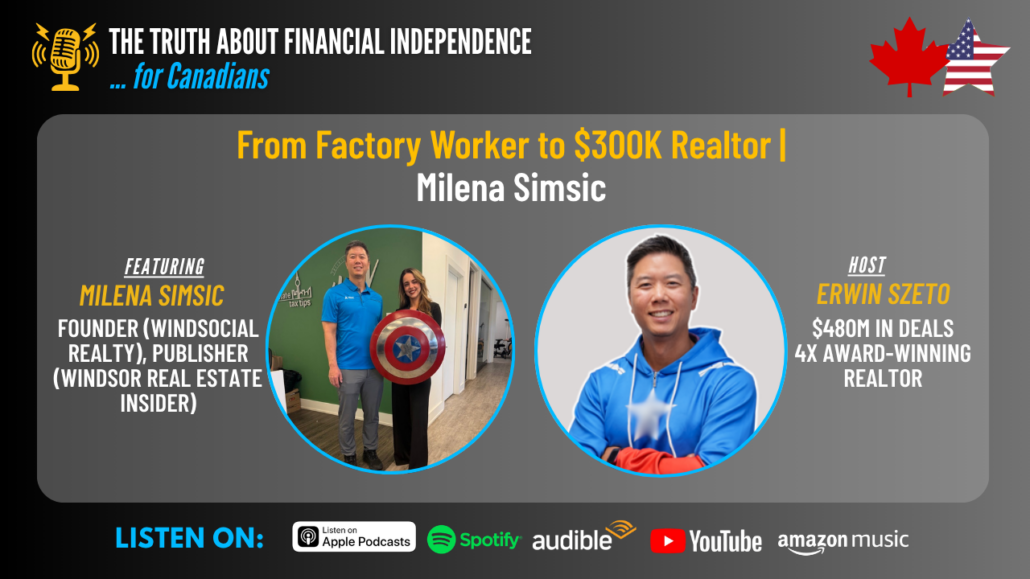
From Factory Worker to $300K Realtor: Milena Simsic on Windsor Real Estate, AI-Powered Marketing, and Building Wealth Without Landlord Headaches
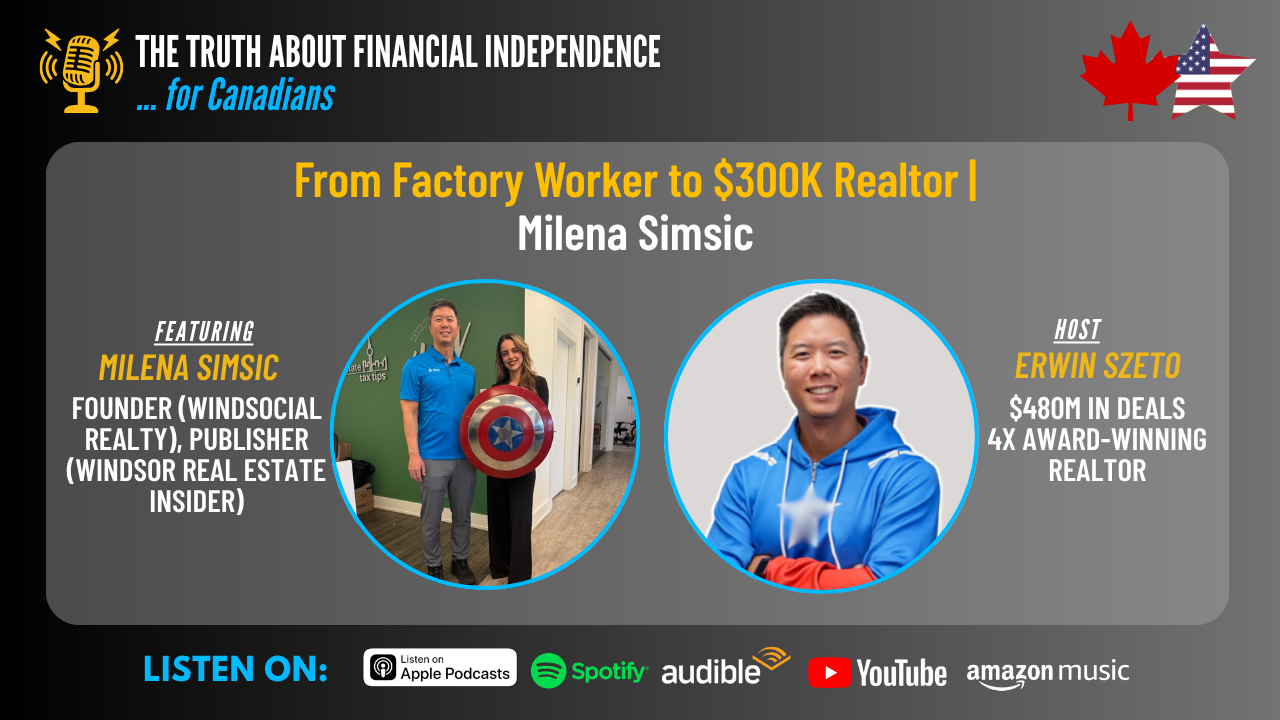
By Erwin Szeto | Co-Founder, iWIN Wealth Planning
Recorded: June 2026
Host: Erwin Szeto, The Truth About Financial Independence for Canadians
Guest: Milena Simsic, Founder, WindSocial Realty; Publisher, Windsor Real Estate Insider; Host, Windsor REI Social
Milena Simsic made $300,000 in commissions in her first year as a realtor. She had no prior real estate connections, no social media following, and no marketing budget. What she had was a willingness to show up on TikTok and Instagram before anyone else in her market was doing it, and a formula she figured out in public.
Three and a half years later, she runs Windsor’s most recognized investor-focused real estate team, publishes a newsletter with over 9,000 subscribers, and hosts a real estate investor community of 3,000 members that fills rooms with 100 to 200 people twice a year. She has also replaced her virtual assistant with Claude AI, built her CRM systems in an afternoon, and is now teaching other realtors how to do the same.
This is an episode about what financial independence actually looks like when you build it from scratch, in a mid-sized Canadian city, with no inherited advantages. It is also, quietly, one of the clearest illustrations of why TAFI rebranded: the path out of the rat race does not always run through a rental property.
The Windsor Market Right Now: What Is Holding and What Is Not
Windsor has always been the most affordable large city in Ontario, and that affordability has acted as a cushion during the broader Canadian real estate correction. According to Milena, single-family homes in Windsor have held relatively steady because demand for primary residences has not collapsed the way it has in markets dependent on investors or short-term renters.
The segments that have softened are student rentals and multi-unit investment properties. The immigration policy shifts of 2024 and 2025 hit student rental demand directly, and investment properties have followed. But for anyone buying a single-family home in Windsor, the fundamentals remain intact: low vacancy rates, a growing population, and a cost base that cannot be matched anywhere else in Ontario at the same level of amenity.
Milena made the comparison plainly: for an investor deciding between a Toronto condo and a Windsor house right now, she said the Toronto condo has really tanked. The Windsor house, by contrast, still has a tenant market and a price point that works.
The Growth Drivers: EV Plant, Gordy Howe Bridge, and a Billion-Dollar Downtown
Windsor’s economic story in 2026 is being written by 3 major developments. The EV battery plant is now operational and has brought thousands of jobs and thousands of new residents into the city. Traffic, which was always a non-issue in Windsor, has become a mild inconvenience, which Milena describes as a good problem to have.
The Gordy Howe International Bridge, which was expected to open in March 2026, has been delayed by political interference from the U.S. side. The delay has created uncertainty, but the bridge remains a long-term economic catalyst for cross-border movement and commerce.
The third driver is a billion-dollar downtown redevelopment announced by Farhee Development, with a major build expected to break ground in 2026. For a city the size of Windsor, a billion-dollar downtown investment is transformative. Milena notes that the timeline depends on when the developer wants to start, but the project is committed.
$300K in Year One: How She Did It With No Connections and No Prior Social Media
When Milena entered real estate, she made a decision that most new agents do not make: she treated the business like a marketing operation from day one. She had never used social media personally before getting her license, had no following, no network in real estate, and no referral base.
She went on TikTok and started posting Windsor real estate content before anyone else in her market was doing it consistently. By the end of her first year, she had made $300,000 in commissions, entirely from TikTok and Instagram leads. More than half her clientele came from the Greater Toronto Area, drawn to Windsor by the price differential and guided to her by the content she was publishing.
She attributes the result to spotting where the highest-leverage play was and going all in before the market caught up. The same logic has since driven her into AI. When she saw what AI could do for her business, she moved before most of her peers understood what they were looking at.
Windsor Real Estate Insider: From a Client Resource to 9,000 Subscribers
The Windsor Real Estate Insider started as a private resource for Milena’s clients, a document she called the Windsor Price Guide that helped investors understand the local market. The response from clients was strong enough that she decided to turn it into a proper publication.
Since launching the magazine last year, it has grown to over 9,000 subscribers, all organic, with no paid acquisition. When you search Windsor real estate on Instagram or TikTok, Milena is the first result. The newsletter feeds from that visibility, and the visibility feeds from the newsletter. The two surfaces compound each other.
Windsor REI Social, her investor community, operates on a similar logic. It began as monthly meetups that were drawing 30 to 70 people. She eventually moved to a biannual format and the events now draw 100 to 200 attendees, with guests traveling from outside Windsor including Toronto.
Replacing a Virtual Assistant With Claude AI: What She Built and How Long It Took
Milena’s AI implementation story is one of the most concrete in the episode. She was on the verge of hiring a second virtual assistant to handle CRM management, client responses, and backend administrative tasks. Instead, she set up Claude AI using the Cowork desktop tool and replicated the systems her VA had been running.
The result was faster turnaround, higher accuracy, and a significantly lower cost than any human hire she could have made. She notes that she did not need any coding experience to build the systems. She wrote out the processes the way she would have written them for a human assistant, step by step, and Claude ran them.
Her assessment of the competitive implications is direct: the top agents that implement AI are going to absorb all the business because no unassisted agent can compete with the response time and output volume that AI enables. She is now building a community for realtors who want to learn how to do what she did.
EXP to Real: Why She Switched and What It Means for Realtors Choosing a Brokerage
Milena announced on the show that she is leaving EXP for Real, an online brokerage that she describes as more focused on agent quality and community than on recruitment volume. Her critique of EXP is specific: many of the top earners in the EXP structure have never completed a real estate transaction. They joined to recruit, not to sell.
Real, she says, actively discourages the pyramid recruitment dynamic and instead focuses on building a quality agent community. For Milena, the brokerage is primarily a platform to operate her own brand underneath. She does not believe the brokerage matters much to an agent’s success in terms of leads or training, but she values the culture and cost structure at Real over what she had at EXP.
The Health Crisis That Doubled Her Business
Two years ago, Milena developed thyroid issues she attributes in part to the stress of her first years in real estate, which coincided with a market peak and then a correction, all while she was working 40 to 60 hour weeks. She describes reaching a point where her health was failing and she recognized she was the bottleneck in her own business.
The pivot started with salsa dancing, which she took up to feel better in her body after the autoimmune diagnosis. It cascaded from there into improved diet, therapy, changes in her sleep and work structure, and a recognition that working smarter and being present was more productive than grinding more hours. Since making those changes, her business has more than doubled.
She entered the Windsor pageant a second time in 2026, roughly 3 years after her first attempt in which she did not place. This time she placed first runner up. She frames the second attempt as a personal milestone to close the chapter from 3 years ago and measure how far she had come.
Advice for Young Canadians: Build Your Skill Set, Buy a Business, Stop Making Excuses
In the closing exchange, Milena’s advice for young Canadians under economic pressure is blunt and specific. Build your skill set. Learn continuously. If you can, find a way to acquire or start a business, because employment is becoming less reliable as AI and economic shifts reduce traditional job availability.
She notes the irony that while the economic environment is genuinely harder for young people, it has also never been cheaper or easier to acquire skills, start a business, or find a mentor. AI gives anyone access to expertise that previously required expensive professional services. The resources exist. The excuses are running out.
On the business acquisition side, she endorses the vendor take-back financing model, noting that a significant proportion of businesses listed for sale are prepared to offer seller financing, making zero-down acquisition genuinely possible for a prepared buyer.
Quick Answers
What market does Milena Simsic specialize in?
Windsor, Ontario. She focuses primarily on investor clients, more than half of whom come from the Greater Toronto Area.
How did Milena make $300K in her first year as a realtor?
Entirely through TikTok and Instagram content. She started posting Windsor real estate market content before any other agent in her market was doing it consistently, and built her lead pipeline from those platforms with no prior social media experience.
Is Windsor real estate a good investment in 2026?
Milena’s view is that single-family homes in Windsor have held up well. She says the Toronto condo has been harder hit than the Windsor house. Windsor has low vacancy rates, a growing population, and major economic development underway including an operational EV plant and a billion-dollar downtown redevelopment.
What is Windsor REI Social?
A real estate investor community of 3,000 members that Milena runs in Windsor. It hosts biannual events drawing 100 to 200 attendees, with speakers and networking focused on Windsor and southern Ontario real estate investing.
How is Milena using AI in her real estate business?
She replaced her virtual assistant with Claude AI using the Cowork desktop tool, which now handles CRM tasks, client responses, and backend administration. She built the systems herself in an afternoon with no coding experience.
Why is Milena switching from EXP to Real?
She says EXP’s culture prioritizes recruitment over agent quality, with many top earners having never completed a real estate transaction. Real actively discourages that dynamic and focuses on community and agent development instead.
Join Me Live: Free Training on the $100,000 Investment Loan Strategy
I’m hosting a free training on the strategy that produced the returns I mentioned above. It’s hybrid: in-person at the iWIN office in Oakville, or join on Zoom from anywhere.
Here is exactly what I will walk through in 90 minutes:
- The complete $100,000 investment loan structure
- The math — what $433 a month actually buys you over 5 and 10 years
- Every loss scenario — what happens when the market drops 20%, 30%, 40%
- How this fits alongside, not replacing, a real estate portfolio
- Live Q&A — bring your questions, bring your skepticism
Two dates to choose from. Both cover the same content — pick whichever fits your schedule.
Saturday June 27, Hybrid (Oakville + Zoom) — 9:00am ET, hard stop 10:30am. In-person seats are capped at 40 and they always go. If you want to be in the room, register today.
Tuesday July 7, Zoom only — 8:00pm ET
The Bottom Line
Milena Simsic did not start with a network, a marketing budget, or a family in real estate. She started with a willingness to show up consistently in public before anyone else in her market understood why that mattered. That instinct, which she applied first to TikTok and then to AI, is what separates her story from a hundred other first-year realtor stories.
What makes this episode particularly relevant for the TAFI audience is the portability of the model. Milena is not a real estate investor in the traditional sense. She is a business builder who happened to start in real estate. The leverage she used was not bank financing on a rental property. It was audience leverage, technology leverage, and the compounding effect of publishing consistently over time. Those tools are available to anyone.
For investors who are tired of the LTB, tired of rent control, and tired of carrying properties that no longer cash flow, Milena’s arc is a useful reminder that the rat race has more than one exit.
On Spotify: creators.spotify.com/pod/profile/erwinszeto/episodes/From-Factory-Worker-to-300K-Realtor–Milena-Si…
Audible: https://www.audible.ca/pd/B0H4VX8QJV?source_code=ASSGB149080119000H&share_location=pdp
You’ve Built Wealth. Now It’s Time to Understand It.
After dozens of consultations, I’ve noticed the same pattern again and again: most investors have built real wealth, but they’re not confident they can retire from it. They’re sitting on $2M–$5M in property but feel cash-flow poor. They’re paying more tax than they should because everything is held in personal names. They have no liquidity, no insurance strategy, and no clear plan for what happens if something happens to them. And almost every single client tells me the same thing: “I don’t actually know what retirement looks like for us.”
Real estate builds equity, but it doesn’t automatically build freedom. Without a coordinated plan for taxes, income, protection, and exit strategy, investors often end up working harder in retirement than they did in their 30s. That’s why I created the Wealth Freedom Blueprint – a simple, practical guide to help you understand where you stand today, what gaps are costing you money, and how to turn the wealth you’ve built into a life you can actually live.
Download your free Wealth Freedom Blueprint
Final Thoughts
Every guest on TAFI is here because they have done something worth studying. Milena Simsic did it faster, younger, and with less of a head start than most. Pay attention to the pattern, not just the result.
Disclaimer:
As a committed advocate for transparent and responsible investing, I disclose that I am an Advisor to SHARE SFR (Single Family Rental). I hold equity in the company and earn referral commissions from clients I refer. I am also a licensed insurance agent with Open Concept Financial Group. The investment loan strategies discussed are for educational purposes only and are not a guarantee of approval or performance. Past performance is not indicative of future results. Every investor should do their own due diligence.
Sponsored by… Me!
This episode isn’t sponsored—except by my wife Cherry and me. Real estate investing is our life. It’s helped us build wealth and achieve peace of mind about retirement and our children’s future.
Till next time—just do it. I believe in you.
Erwin Szeto
W: erwinszeto.com
FB: facebook.com/erwin.szeto
IG: @erwinszeto
Disclaimer
As a committed advocate for transparent and responsible investing, I want to disclose that I am an Advisor to SHARE SFR (Single Family Rental). I hold equity in the company and earn referral commissions from clients I refer.
My endorsement of their model—focusing on positive cash flow and direct ownership—is based on personal experience and belief. Still, every investor should do their own due diligence.


Leave a Reply
Want to join the discussion?Feel free to contribute!