
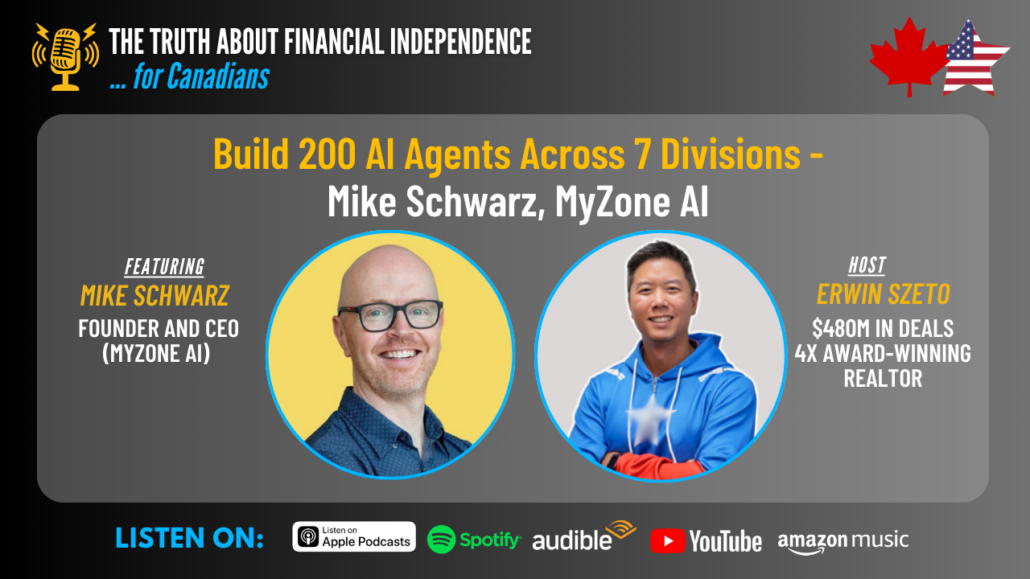
The guy who negotiated a hall pass to go all-in on AI
By Erwin Szeto | Co-Founder, iWIN Wealth Planning
Recorded: June 2026
Host: Erwin Szeto, The Truth About Financial Independence for Canadians
Guest: Mike Schwarz, founder and CEO of MyZone AI, a Vancouver-based AI solutions company.
Most people add AI to their workflow slowly.
They try ChatGPT for a week, find a few uses, and move on.
Mike Schwarz went another direction. The founder and CEO of MyZone AI, based in Vancouver, negotiated a hall pass from his wife, adjusted his medication to sustain the hours, and spent 3 to 4 months working from the time his family went to sleep until 2, 3, and sometimes 4 in the morning.
The goal was to go all-in on AI agents. What he built: more than 200 autonomous agents running across 7 divisions of his business.
Schwarz has 25 years in technology. He was building social networks in 1999, before Friendster and MySpace existed and he founded MyZone in 2000 as a web development studio. Schwarz has watched the dot com boom, the mobile transition, social media, and e-commerce. And he says this transition is different.
“I’m measuring the window in months,” he said on a recent episode of The Truth About Financial Independence for Canadians. “Not years.”
What is AI, actually
Schwarz breaks it down simply. AI is a learning system that has been developing since the 1960s and 1970s, built on the idea that a machine can be trained to recognize patterns and predict outcomes. The early versions were basic: is this a cat? Yes or no. Each correct answer reinforced the model. Over millions of repetitions, it got good at predicting.
The breakthrough moment that most people experienced was November 2022 when ChatGPT went public. But underneath, the technology had been building for decades. TikTok and Instagram feeds were early AI. GPS systems used basic machine learning. Search autocomplete was an early form of prediction.
The version most people use today, a chatbot interface, is just one way to access the intelligence inside these models. Schwarz calls it a harness. It is a window into something much larger.
What is an agent, and why it’s different from ChatGPT
Most people think of AI as a conversation. You type something, it responds. One request, one reply.
An agent is different. Agents are designed for long-running autonomous tasks. You give them an objective: book me a flight, go through my inbox, reorganize my project management system. And they work toward that objective without needing step-by-step direction.
Schwarz describes the difference as how long they can run and whether they can make decisions on their own within defined guardrails.
His first real agent moment happened while preparing for a conference in Montreal. Claude Cowork had just launched the night before. He tested it by asking it to open his browser, go through his LinkedIn, and categorize his 183 unread messages. He left it running and came back 5 minutes later. It had sorted all 183 messages into categories and drafted responses for each one. He gave it some context about his relationships and told it to go ahead. Within 30 minutes, it had replied to every message except the 19 personal ones, which it had starred for him.
“I built a math game for my son in an hour,” he said. “Confetti, sound effects, an iPhone lockbox. He couldn’t get his screen time until he finished the exercise. He loved it.”
Why legacy software companies are struggling
Adobe, SAP, Oracle, and other major SaaS companies have seen their stock prices fall 50 to 60 percent over the past year. Schwarz has a theory about why.
The public narrative is that AI means smaller teams, which means fewer software licenses. Schwarz doesn’t buy that as the full story. His view: every business will eventually run its own custom software, built and maintained by agents. A custom CRM. Custom task management. Custom accounting. The future he sees is full ownership of software and data, not subscription to someone else’s platform.
“Every business built below this new operating system is essentially obsolete, they just haven’t realized it yet.”
Browser control vs. API connections: the speed and cost difference
When people see AI agents demonstrated for the first time, they often see browser control: an agent moving a cursor, clicking through a website, doing what a human would do manually.
Schwarz says browser control is the last resort. It is slow, expensive, and uses a lot of tokens (the unit of cost for AI model usage). The faster, cheaper option is an API connection: a direct plug into the software’s back end. Same task: an hour via browser control versus 4 minutes via API, at roughly 1/50th the cost.
He pointed out that 99% of software has a public API. For business owners wondering if their existing tools can be automated, the answer is almost certainly yes.
Where non-developers should start
For anyone with no technical background, Schwarz recommends starting with Claude Cowork. It is a safe playground that doesn’t require coding. For those with some technical ambition, Claude Code is another entry point. For building websites and simple software, Lovable is the most accessible tool in that space.
He makes an important distinction between vibe coding and agentic development. Vibe coding, a term coined by AI researcher Andrej Karpathy, means telling an AI to build something and letting it do whatever it wants. The results can look impressive but are often fragile, insecure, or hard to maintain.
Agentic development follows the same discipline as traditional software development: requirements, scoping, quality assurance. The difference is that a non-developer can now navigate this process with the right tools and agents. The coding is abstracted away. The thinking required is architectural and systemic, not syntactical.
“Any entrepreneur who has experience with systems and processes is already learning the skills they need to be an agentic leader,” Schwarz said. “The software developers are having to learn completely new skills. The architects are laughing.”
The 3 biggest mistakes businesses make adopting AI
Schwarz has coached hundreds of business leaders through AI adoption. He sees the same mistakes repeatedly.
The first is dismissal. Treating AI as a chatbot that hallucinates and makes mistakes, and stopping there. He estimates roughly 42% of Canadian employees are actively working against AI adoption in their organizations. Many leaders share the same instinct. The result is that companies fall further behind while their competitors build a structural advantage.
The second is moving too fast with too big an idea. Coming in with a plan to automate 80% of customer support in the first month triggers what Schwarz calls the immune system of a company. Culture pushes back. Change management collapses.
His recommendation: start with small, quick wins that have high ROI and visible impact. Those wins build the internal case for further adoption.
The third mistake is ignoring shadow AI. If a company has no official AI tools and no AI policy, employees are already using free consumer versions without anyone knowing. Free plans mean data is being shared with the AI provider. Client information, internal strategies, proprietary processes are leaving the building every day. “If you don’t have an official plan, they’re paying with your data,” Schwarz said.
How AI is changing education
Schwarz pulled his son out of school for a full year when AI began accelerating in 2023. He was building what he describes as a private AI school, influenced by models like Alpha School, which claims to deliver the core curriculum in 2 to 3 hours a day using adaptive AI instruction.
The key, he says, is hyperpersonalization. When AI instruction adapts to a child’s learning level, pace, and interests in real time, retention improves by 5 to 10 times compared to traditional classroom instruction. His example: teaching fractions using baking ratios for a child who loves to bake. The same math concepts, anchored to something the child already cares about.
Sal Khan, founder of Khan Academy, wrote a book on this topic called Brave New Words. Schwarz recommends it for anyone thinking seriously about AI in education.
The one thing
At the end of every episode, Erwin asks his guests for the one thing a listener should do this weekend.
Schwarz’s answer: master the art of learning.
“It’s not about being technical. It’s about being a sponge. Being adaptive. Being flexible. That is the skill.”
His method: consistent, scheduled repetitions in short sessions. 10 minutes in the morning, 10 minutes before bed. The same principle he used to go from a C minus to an A student in university. Small daily exposure keeps the brain processing in the background. The learning compounds.
“You’re not going to the gym on Friday for 12 hours,” he said. “You need a consistent schedule. Measure it. Build on it.”
Where to find Mike Schwarz
Mike Schwarz runs free monthly workshops at myzone.ai. Upcoming sessions include a workshop on becoming an agentic developer without coding experience (July 9). All previous workshop recordings, transcripts, and slides are available free on his website.
Quick Answers
What is the difference between an AI chatbot and an AI agent?
A chatbot handles one request at a time and waits for your next input. An agent can be given an objective and work toward it independently over a longer period, making decisions along the way within defined limits. Agents can use tools, access external systems, and complete multi-step tasks without hand-holding.
Do I need to know how to code to use AI agents?
No. Mike Schwarz recommends Claude Cowork as a starting point for non-developers. Agentic development, which is building more complex automated systems, can also be learned without writing code. The skills required are more architectural: understanding processes, defining requirements, and directing agents toward outcomes.
What is shadow AI?
Shadow AI refers to AI tools that employees use without company knowledge or approval. Because free AI plans often share user data with the AI provider, employees using these tools on personal accounts may unknowingly expose company information. A formal AI policy and approved tools prevent this.
What is vibe coding, and why is it risky?
Vibe coding means telling an AI to build something and accepting whatever it produces without following a structured development process. The results can look functional but may contain security vulnerabilities, expose private data, or break when updated. Agentic development follows the same quality assurance steps as traditional software development, just without the coding.
Join Me Live: Free Training on the $100,000 Investment Loan Strategy
I’m hosting a free training on the strategy that produced the returns I mentioned above. It’s hybrid: in-person at the iWIN office in Oakville, or join on Zoom from anywhere.
Here is exactly what I will walk through in 90 minutes:
- The complete $100,000 investment loan structure
- The math — what $433 a month actually buys you over 5 and 10 years
- Every loss scenario — what happens when the market drops 20%, 30%, 40%
- How this fits alongside, not replacing, a real estate portfolio
- Live Q&A — bring your questions, bring your skepticism
Two dates to choose from. Both cover the same content — pick whichever fits your schedule.
Saturday June 27, Hybrid (Oakville + Zoom) — 9:00am ET, hard stop 10:30am. In-person seats are capped at 40 and they always go. If you want to be in the room, register today.
Tuesday July 7, Zoom only — 8:00pm ET
To Listen
Audible: https://www.audible.ca/pd/B0H6B7MCYV?source_code=ASSGB149080119000H&share_location=pdp
You’ve Built Wealth. Now It’s Time to Understand It.
After dozens of consultations, I’ve noticed the same pattern again and again: most investors have built real wealth, but they’re not confident they can retire from it. They’re sitting on $2M–$5M in property but feel cash-flow poor. They’re paying more tax than they should because everything is held in personal names. They have no liquidity, no insurance strategy, and no clear plan for what happens if something happens to them. And almost every single client tells me the same thing: “I don’t actually know what retirement looks like for us.”
Real estate builds equity, but it doesn’t automatically build freedom. Without a coordinated plan for taxes, income, protection, and exit strategy, investors often end up working harder in retirement than they did in their 30s. That’s why I created the Wealth Freedom Blueprint – a simple, practical guide to help you understand where you stand today, what gaps are costing you money, and how to turn the wealth you’ve built into a life you can actually live.
Download your free Wealth Freedom Blueprint
Final Thoughts
Every guest on TAFI is here because they have done something worth studying. Milena Simsic did it faster, younger, and with less of a head start than most. Pay attention to the pattern, not just the result.
Disclaimer:
As a committed advocate for transparent and responsible investing, I disclose that I am an Advisor to SHARE SFR (Single Family Rental). I hold equity in the company and earn referral commissions from clients I refer. I am also a licensed insurance agent with Open Concept Financial Group. The investment loan strategies discussed are for educational purposes only and are not a guarantee of approval or performance. Past performance is not indicative of future results. Every investor should do their own due diligence.
Sponsored by… Me!
This episode isn’t sponsored—except by my wife Cherry and me. Real estate investing is our life. It’s helped us build wealth and achieve peace of mind about retirement and our children’s future.
Till next time—just do it. I believe in you.
Erwin Szeto
W: erwinszeto.com
FB: facebook.com/erwin.szeto
IG: @erwinszeto
Disclaimer
As a committed advocate for transparent and responsible investing, I want to disclose that I am an Advisor to SHARE SFR (Single Family Rental). I hold equity in the company and earn referral commissions from clients I refer.
My endorsement of their model—focusing on positive cash flow and direct ownership—is based on personal experience and belief. Still, every investor should do their own due diligence.


Leave a Reply
Want to join the discussion?Feel free to contribute!