He Worked 60 Hours a Week for 25 Years. Then He Installed a System and Sold for an 8-Figure Exit.
By Erwin Szeto | Co-Founder, iWIN Wealth Planning
Recorded: June 2026
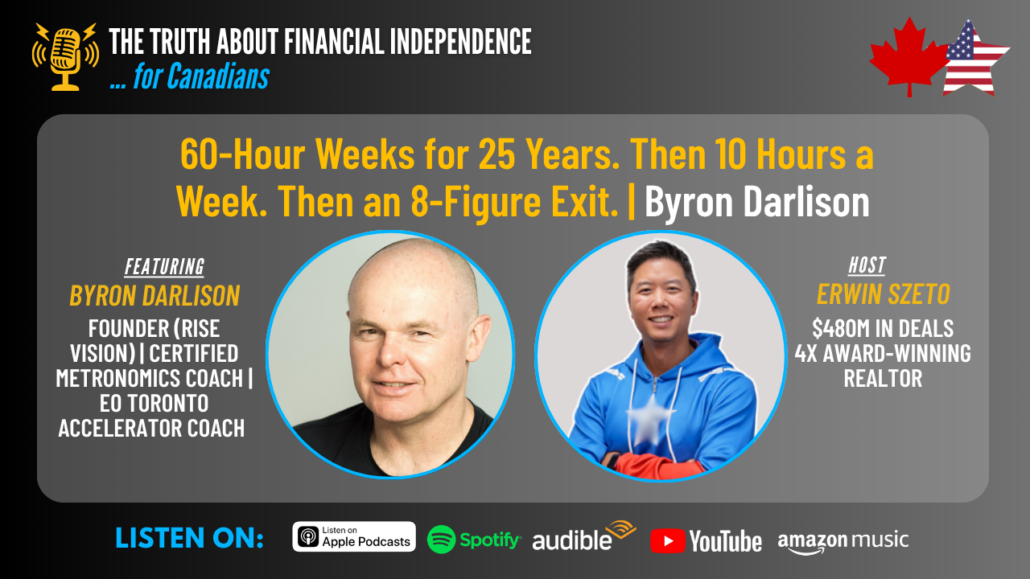
Host: Erwin Szeto, The Truth About Financial Independence for Canadians
Guest: Byron Darlison, Founder Rise Vision, Certified Metronomics Coach, Accelerator Coach EO Toronto
He Worked 60 Hours a Week for 25 Years. Then He Installed a System and Sold for an 8-Figure Exit.
Byron Darlison on Business Operating Systems, the Great Wealth Transfer, and What Financial Independence Actually Looks Like.
Byron Darlison started Rise Vision in Toronto in 1992. He ran it for 30 years without raising a dollar of outside equity. For 25 of those years, he worked 60-plus-hour weeks, watched the business oscillate between good years and terrible years, and never fully understood what was making it unpredictable.
In year 25, he hired a business coach and installed Metronomics as his operating system. In the 5 years that followed, profits went from break-even to 20% sustained net margins. Revenue growth went from low single digits to 15 to 20% per year. His personal work week dropped from 60-plus hours to under 10. He promoted his COO to run the company and stepped back to chairperson. In year 30, he sold Rise Vision to AUO Display Plus for an 8-figure exit, with no earn-out and no employment clause. His team still runs and grows the business today.
He now coaches a small number of founders privately using Metronomics and serves as Mentorship Chair and Accelerator Coach at Entrepreneurs’ Organization Toronto. He publishes free frameworks, AI prompts, and tools at darlison.com.
This is a conversation about what it actually takes to build a business that works without you, why most founders never get there, and why the next decade may be the best buying opportunity for small businesses in Canadian history.
25 Years of Hard Work, Inconsistent Results
Rise Vision did not start as a digital signage company. Byron spent years building software for Reuters to power LED screens on trading floors, then moved into banks, retail, and gradually what the industry started calling digital signage. For most of those years, the company was spread across 117 different industries. It had good years and bad years. The team was talented and deeply loyal, with some people staying more than 20 years. But consistency was elusive.
Byron describes the dynamic bluntly: the team was exceptional at fighting fires. Nobody was in charge of fire prevention. There was no clear accountability structure, no defined priorities, and no rhythm that held the business to a standard quarter over quarter.
He tried to fix it himself. He worked through Scaling Up, the Great Game of Business, Scrum, Basecamp, and lean startup principles. He spent a year attempting to self-implement a business operating system and made limited progress. Looking back, he identifies 4 reasons why it did not work. He was simultaneously the person building the accountability system and the person the system was supposed to hold accountable. When you are a player on the field, you cannot see the whole field. The team had watched him launch initiatives before and learned to wait them out. And without someone who had visibly done it before, there was nothing to counter the quiet skepticism that this time would be any different.
What a Business Operating System Actually Is
Byron defines a business operating system simply: a set of rituals at a specific cadence, captured in artifacts, that becomes religion.
Not a framework you run for a quarter and then move on from. A rhythm that becomes so embedded that breaking it is unthinkable. Meetings that happen at the same time every week. Scorecards that are updated and reviewed in every session. Accountability structures where every person knows their domain, their critical number, and exactly what a good day looks like for them.
The key insight he shares: the founder has to be the first to demonstrate the discipline. If the founder shows up late, everyone shows up late. If the founder skips meetings, everyone skips meetings. The system only works if the leader makes it non-negotiable for themselves first.
For a company with a long history of operating in a loose way, he warns it takes about a year before the system starts to stick. The tell is when team members start self-correcting each other, saying we do not do it like that, we do it like this, before the founder has to say it. At that point, the organization has internalized the rhythm and it starts to compound.
5 Years That Changed Everything
The results Byron describes after installing Metronomics are specific and verifiable: 20% sustained net margins for 5 consecutive years, revenue growth of 15 to 20% per year, and a work week that dropped from 60-plus hours to under 10. Cash reserves built to many multiples of annual operating spend.
At some point during this period, Byron realized something that very few founders are willing to admit: he was no longer the right person to be running the business day to day. His COO was. He promoted his COO to head of company, stepped back to coach the executive team, and found that running the business in under 10 hours a week, he was actually running it better than he ever had at 60.
The return on the coaching investment, calculated conservatively over 5 years, was approximately 270 times its cost.
How He Sold With No Earn-Out and No Employment Clause
When Byron went to sell Rise Vision, the business was already operating without him in any active role. He was chairperson in name. The company had a proven operating system, predictable recurring revenue, a leadership team that ran and grew the business independently, and cash reserves exceeding a year of operating costs.
That combination made the negotiating position straightforward. The company did not need to drop in revenue during a drawn-out acquisition process because Byron had no active role to distract from operations. He could devote full time to the negotiations without the business suffering. By the time the deal closed, revenue had grown by approximately 20% from where negotiations started.
His advice for founders approaching an exit: the business needs to look like a machine to any acquirer. Predictable, self-running, not dependent on the founder. If it does, you can set your terms. If it does not, you are selling a job, and the buyer will price it accordingly.
The Owner’s Outcome Framework
One of the most practically useful frameworks Byron shares is what he calls the owner’s outcome: the exercise of getting precise about what you actually built the business to give you, before you make any strategic decision.
He observes that most founders have a vague idea of freedom when they start, but never translate that into specific terms. How many hours do you want to work? What income do you need? What is your risk tolerance? What does your life look like at the 3-year mark if the business is working?
Without that clarity, the business wanders. Every shiny object looks like an opportunity. Every crisis demands a response. There is no benchmark to measure whether the company is actually serving the founder’s goals or drifting away from them.
This framework resonates particularly strongly in real estate. Erwin makes the connection in the conversation: he has coached real estate investors since 2010 and regularly encounters people whose stated why is more time with family, but who have bought a small business, in the form of a rental property, an hour from home, with a customer, the tenant, who has more rights than most business clients. The two do not reconcile. Byron’s response: they haven’t done the homework.
The Definition of Strategy Is the Word No
Byron’s framing of strategy is one of the cleanest distillations of the concept: if you know exactly what you want, 90% of what you see is noise by definition. Strategy is the discipline to say no to that noise, over and over, until what you are building becomes so specific and so well-understood that you win your market almost by default.
Rise Vision’s pivot to K-12 digital signage in North America came from data, not instinct. After years of serving 117 different industries, the team looked at where the growth was consistent, where they won competitive deals, and where customers stayed forever. Education kept coming up. It was not glamorous. The procurement process was slow. The revenue per customer was not large. But the fit was undeniable.
Focusing on that single market, with a single core customer, is what allowed the business to stop being spread across everything and start building genuine expertise. Once the product was built for one specific buyer, the sales and marketing costs dropped, the product team had clarity, and the competitive moat deepened every year.
The Founder’s Dilemma
Byron names the thing that kills most founder-led businesses before they ever reach an exit: the founder who is the hero. The one who jumps into every problem, gives the answer, and then wonders why the team never develops the capacity to solve problems without them.
His reframe is simple and memorable. Instead of solving problems, ask: what do you recommend? Instead of giving the answer, ask by what date and how will you know it’s working? The goal is to make the person who owns the problem also own the solution, the measurement, and the learning. The founder becomes an editor and a mentor, not a firefighter.
For anyone buying a business from a retiring founder, this is a critical due diligence signal. If the current owner is involved in everything, is the hero of every story, and cannot name a single decision the team makes without them, the buyer is not acquiring a business. They are acquiring a job. Byron puts the implication plainly: the team will not be able to independently execute once that founder exits.
The Great Wealth Transfer and Why Boomer Businesses Are the Buying Opportunity
Byron spent a day with Keith Cunningham, author of The Road Less Stupid, in Austin, and came away with a view he shares directly: there has never been an opportunity like this in our history. More businesses are coming up for sale right now than has ever happened before. Supply is high. Qualified buyers are scarce. Valuations reflect that.
His sharper point is this: many of these businesses are badly run. Not terminal, not broken, but operating well below their potential because the founder never installed accountability, never defined a core customer, never built a system. That means the stated EBITDA is artificially low, the multiple is priced off that artificially low number, and a competent buyer who can install the missing infrastructure can earn back the purchase price in a fraction of the typical cycle.
Cherry’s acquisition of a second accounting practice from 2 retiring owners in 2024 is a version of exactly this. The practice was well-established, the clients were loyal, and the owners were ready to exit. The opportunity came not despite the transition, but because of it.
AI Running a 14-Agent Software Pipeline While Byron Sleeps
Byron’s current project is a software development operation running entirely on AI agents. 14 agents, an orchestrator that manages the work queue, and a process where Byron tells the system what is in the backlog before he goes to bed and reviews the completed work at 6 a.m. The cost in human terms: approximately $300,000 a month in traditional development resources. His actual cost: a fraction of that.
His advice for founders exploring AI: the one-off experiments are easy. Creating something reliable, scalable, and secure is not. The hard work is thinking through the architecture, defining the roles each agent plays, and building the methodology that makes the whole system trustworthy before you depend on it.
He has published AI prompts on darlison.com that compress the time required to work through his core frameworks, including owner’s outcome, core customer analysis, and company values discovery, from days of consulting time to under an hour of structured AI-guided work.
FAQ
What is Rise Vision?
Rise Vision is a cloud-based digital signage software company founded in Toronto in 1992 by Byron Darlison. It grew to serve organizations in over 100 countries, including schools, hotels, and universities. In 2022, it was acquired by AUO Display Plus, a Taiwanese industrial display manufacturer.
What is Metronomics?
Metronomics is a business operating system developed by Shannon Susko. It combines strategy, execution, and team alignment into a quarterly rhythm of meeting cadences, scorecards, and accountability structures. Byron Darlison used it to transform Rise Vision from a break-even company into a profitable, self-running business before selling.
What is the owner’s outcome framework?
The owner’s outcome is a framework Byron uses with every founder he coaches. It asks the founder to define precisely what they want their business to give them, in terms of income, hours, risk tolerance, and life design, before making any strategic decision. Without this clarity, businesses tend to drift toward whatever is urgent rather than whatever is important.
What is the great wealth transfer and why does it matter for Canadian investors?
Baby boomers own a massive number of privately held businesses in Canada. As they retire, those businesses need buyers. Because many of these businesses are poorly systemized and priced off artificially low earnings, buyers who can identify and fix the operational shortcomings can acquire businesses at significant discounts to their real earning potential.
How is Byron using AI in his business?
Byron is running a 14-agent AI software development pipeline from his home. He briefs the orchestrator each evening on the work backlog, the agents process tasks overnight, and he reviews output in the morning. He estimates the traditional human cost of equivalent output at approximately $300,000 per month. He has also published free AI-guided prompts at darlison.com for working through business frameworks.
Join Me Live: Free Training on the $100,000 Investment Loan Strategy
I’m hosting a free training on the strategy that produced the returns I mentioned above. It’s hybrid: in-person at the iWIN office in Oakville, or join on Zoom from anywhere.
Here is exactly what I will walk through in 90 minutes:
- The complete $100,000 investment loan structure
- The math — what $433 a month actually buys you over 5 and 10 years
- Every loss scenario — what happens when the market drops 20%, 30%, 40%
- How this fits alongside, not replacing, a real estate portfolio
- Live Q&A — bring your questions, bring your skepticism
Two dates to choose from. Both cover the same content — pick whichever fits your schedule.
Saturday June 27, Hybrid (Oakville + Zoom) — 9:00am ET, hard stop 10:30am. In-person seats are capped at 40 and they always go. If you want to be in the room, register today.
Tuesday July 7, Zoom only — 8:00pm ET
The Bottom Line
Byron Darlison spent 25 years running his company the hard way. Not because he was not smart, not because the team was not talented, but because he never installed the structure that would have let the business work without him carrying it. Once he did, everything changed: the margins, the growth rate, the work week, and ultimately the exit.
The lesson is not specific to SaaS companies or digital signage or Toronto tech founders. It applies to any business, including real estate portfolios that have turned into jobs, rental operations that never scaled, and accounting practices changing hands in Ottawa. The question underneath all of it is Byron’s question: what did you build this for, and is it delivering that?
If the answer is no, the system is the fix. And the system is learnable.
To Listen
You’ve Built Wealth. Now It’s Time to Understand It.
After dozens of consultations, I’ve noticed the same pattern again and again: most investors have built real wealth, but they’re not confident they can retire from it. They’re sitting on $2M–$5M in property but feel cash-flow poor. They’re paying more tax than they should because everything is held in personal names. They have no liquidity, no insurance strategy, and no clear plan for what happens if something happens to them. And almost every single client tells me the same thing: “I don’t actually know what retirement looks like for us.”
Real estate builds equity, but it doesn’t automatically build freedom. Without a coordinated plan for taxes, income, protection, and exit strategy, investors often end up working harder in retirement than they did in their 30s. That’s why I created the Wealth Freedom Blueprint – a simple, practical guide to help you understand where you stand today, what gaps are costing you money, and how to turn the wealth you’ve built into a life you can actually live.
Download your free Wealth Freedom Blueprint
Final Thoughts
Every guest on TAFI is here because they have done something worth studying. Milena Simsic did it faster, younger, and with less of a head start than most. Pay attention to the pattern, not just the result.
Disclaimer:
As a committed advocate for transparent and responsible investing, I disclose that I am an Advisor to SHARE SFR (Single Family Rental). I hold equity in the company and earn referral commissions from clients I refer. I am also a licensed insurance agent with Open Concept Financial Group. The investment loan strategies discussed are for educational purposes only and are not a guarantee of approval or performance. Past performance is not indicative of future results. Every investor should do their own due diligence.
Sponsored by… Me!
This episode isn’t sponsored—except by my wife Cherry and me. Real estate investing is our life. It’s helped us build wealth and achieve peace of mind about retirement and our children’s future.
Till next time—just do it. I believe in you.
Erwin Szeto
W: erwinszeto.com
FB: facebook.com/erwin.szeto
IG: @erwinszeto
Disclaimer
As a committed advocate for transparent and responsible investing, I want to disclose that I am an Advisor to SHARE SFR (Single Family Rental). I hold equity in the company and earn referral commissions from clients I refer.
My endorsement of their model—focusing on positive cash flow and direct ownership—is based on personal experience and belief. Still, every investor should do their own due diligence.


Leave a Reply
Want to join the discussion?Feel free to contribute!