From Factory Worker to $300K Realtor: Milena Simsic on Windsor Real Estate, AI-Powered Marketing, and Building Wealth Without Landlord Headaches 

By Erwin Szeto | Co-Founder, iWIN Wealth Planning 

Recorded: June 2026 

Host: Erwin Szeto, The Truth About Financial Independence for Canadians 

Guest: Milena Simsic, Founder, WindSocial Realty; Publisher, Windsor Real Estate Insider; Host, Windsor REI Social 

Milena Simsic made $300,000 in commissions in her first year as a realtor. She had no prior real estate connections, no social media following, and no marketing budget. What she had was a willingness to show up on TikTok and Instagram before anyone else in her market was doing it, and a formula she figured out in public. 

Three and a half years later, she runs Windsor’s most recognized investor-focused real estate team, publishes a newsletter with over 9,000 subscribers, and hosts a real estate investor community of 3,000 members that fills rooms with 100 to 200 people twice a year. She has also replaced her virtual assistant with Claude AI, built her CRM systems in an afternoon, and is now teaching other realtors how to do the same. 

This is an episode about what financial independence actually looks like when you build it from scratch, in a mid-sized Canadian city, with no inherited advantages. It is also, quietly, one of the clearest illustrations of why TAFI rebranded: the path out of the rat race does not always run through a rental property. 

The Windsor Market Right Now: What Is Holding and What Is Not 

Windsor has always been the most affordable large city in Ontario, and that affordability has acted as a cushion during the broader Canadian real estate correction. According to Milena, single-family homes in Windsor have held relatively steady because demand for primary residences has not collapsed the way it has in markets dependent on investors or short-term renters. 

The segments that have softened are student rentals and multi-unit investment properties. The immigration policy shifts of 2024 and 2025 hit student rental demand directly, and investment properties have followed. But for anyone buying a single-family home in Windsor, the fundamentals remain intact: low vacancy rates, a growing population, and a cost base that cannot be matched anywhere else in Ontario at the same level of amenity. 

Milena made the comparison plainly: for an investor deciding between a Toronto condo and a Windsor house right now, she said the Toronto condo has really tanked. The Windsor house, by contrast, still has a tenant market and a price point that works. 

🎙️ Listen to the podcast 

The Growth Drivers: EV Plant, Gordy Howe Bridge, and a Billion-Dollar Downtown 

Windsor’s economic story in 2026 is being written by 3 major developments. The EV battery plant is now operational and has brought thousands of jobs and thousands of new residents into the city. Traffic, which was always a non-issue in Windsor, has become a mild inconvenience, which Milena describes as a good problem to have. 

The Gordy Howe International Bridge, which was expected to open in March 2026, has been delayed by political interference from the U.S. side. The delay has created uncertainty, but the bridge remains a long-term economic catalyst for cross-border movement and commerce. 

The third driver is a billion-dollar downtown redevelopment announced by Farhee Development, with a major build expected to break ground in 2026. For a city the size of Windsor, a billion-dollar downtown investment is transformative. Milena notes that the timeline depends on when the developer wants to start, but the project is committed. 

$300K in Year One: How She Did It With No Connections and No Prior Social Media 

When Milena entered real estate, she made a decision that most new agents do not make: she treated the business like a marketing operation from day one. She had never used social media personally before getting her license, had no following, no network in real estate, and no referral base. 

She went on TikTok and started posting Windsor real estate content before anyone else in her market was doing it consistently. By the end of her first year, she had made $300,000 in commissions, entirely from TikTok and Instagram leads. More than half her clientele came from the Greater Toronto Area, drawn to Windsor by the price differential and guided to her by the content she was publishing. 

She attributes the result to spotting where the highest-leverage play was and going all in before the market caught up. The same logic has since driven her into AI. When she saw what AI could do for her business, she moved before most of her peers understood what they were looking at. 

Windsor Real Estate Insider: From a Client Resource to 9,000 Subscribers 

The Windsor Real Estate Insider started as a private resource for Milena’s clients, a document she called the Windsor Price Guide that helped investors understand the local market. The response from clients was strong enough that she decided to turn it into a proper publication. 

Since launching the magazine last year, it has grown to over 9,000 subscribers, all organic, with no paid acquisition. When you search Windsor real estate on Instagram or TikTok, Milena is the first result. The newsletter feeds from that visibility, and the visibility feeds from the newsletter. The two surfaces compound each other. 

Windsor REI Social, her investor community, operates on a similar logic. It began as monthly meetups that were drawing 30 to 70 people. She eventually moved to a biannual format and the events now draw 100 to 200 attendees, with guests traveling from outside Windsor including Toronto. 

Replacing a Virtual Assistant With Claude AI: What She Built and How Long It Took 

Milena’s AI implementation story is one of the most concrete in the episode. She was on the verge of hiring a second virtual assistant to handle CRM management, client responses, and backend administrative tasks. Instead, she set up Claude AI using the Cowork desktop tool and replicated the systems her VA had been running. 

The result was faster turnaround, higher accuracy, and a significantly lower cost than any human hire she could have made. She notes that she did not need any coding experience to build the systems. She wrote out the processes the way she would have written them for a human assistant, step by step, and Claude ran them. 

Her assessment of the competitive implications is direct: the top agents that implement AI are going to absorb all the business because no unassisted agent can compete with the response time and output volume that AI enables. She is now building a community for realtors who want to learn how to do what she did. 

EXP to Real: Why She Switched and What It Means for Realtors Choosing a Brokerage 

Milena announced on the show that she is leaving EXP for Real, an online brokerage that she describes as more focused on agent quality and community than on recruitment volume. Her critique of EXP is specific: many of the top earners in the EXP structure have never completed a real estate transaction. They joined to recruit, not to sell. 

Real, she says, actively discourages the pyramid recruitment dynamic and instead focuses on building a quality agent community. For Milena, the brokerage is primarily a platform to operate her own brand underneath. She does not believe the brokerage matters much to an agent’s success in terms of leads or training, but she values the culture and cost structure at Real over what she had at EXP. 

The Health Crisis That Doubled Her Business 

Two years ago, Milena developed thyroid issues she attributes in part to the stress of her first years in real estate, which coincided with a market peak and then a correction, all while she was working 40 to 60 hour weeks. She describes reaching a point where her health was failing and she recognized she was the bottleneck in her own business. 

The pivot started with salsa dancing, which she took up to feel better in her body after the autoimmune diagnosis. It cascaded from there into improved diet, therapy, changes in her sleep and work structure, and a recognition that working smarter and being present was more productive than grinding more hours. Since making those changes, her business has more than doubled. 

She entered the Windsor pageant a second time in 2026, roughly 3 years after her first attempt in which she did not place. This time she placed first runner up. She frames the second attempt as a personal milestone to close the chapter from 3 years ago and measure how far she had come. 

Advice for Young Canadians: Build Your Skill Set, Buy a Business, Stop Making Excuses 

In the closing exchange, Milena’s advice for young Canadians under economic pressure is blunt and specific. Build your skill set. Learn continuously. If you can, find a way to acquire or start a business, because employment is becoming less reliable as AI and economic shifts reduce traditional job availability. 

She notes the irony that while the economic environment is genuinely harder for young people, it has also never been cheaper or easier to acquire skills, start a business, or find a mentor. AI gives anyone access to expertise that previously required expensive professional services. The resources exist. The excuses are running out. 

On the business acquisition side, she endorses the vendor take-back financing model, noting that a significant proportion of businesses listed for sale are prepared to offer seller financing, making zero-down acquisition genuinely possible for a prepared buyer. 

Quick Answers 

What market does Milena Simsic specialize in? 

Windsor, Ontario. She focuses primarily on investor clients, more than half of whom come from the Greater Toronto Area. 

How did Milena make $300K in her first year as a realtor? 

Entirely through TikTok and Instagram content. She started posting Windsor real estate market content before any other agent in her market was doing it consistently, and built her lead pipeline from those platforms with no prior social media experience. 

Is Windsor real estate a good investment in 2026? 

Milena’s view is that single-family homes in Windsor have held up well. She says the Toronto condo has been harder hit than the Windsor house. Windsor has low vacancy rates, a growing population, and major economic development underway including an operational EV plant and a billion-dollar downtown redevelopment. 

What is Windsor REI Social? 

A real estate investor community of 3,000 members that Milena runs in Windsor. It hosts biannual events drawing 100 to 200 attendees, with speakers and networking focused on Windsor and southern Ontario real estate investing. 

How is Milena using AI in her real estate business? 

She replaced her virtual assistant with Claude AI using the Cowork desktop tool, which now handles CRM tasks, client responses, and backend administration. She built the systems herself in an afternoon with no coding experience. 

Why is Milena switching from EXP to Real? 

She says EXP’s culture prioritizes recruitment over agent quality, with many top earners having never completed a real estate transaction. Real actively discourages that dynamic and focuses on community and agent development instead. 

Join Me Live: Free Training on the $100,000 Investment Loan Strategy

I’m hosting a free training on the strategy that produced the returns I mentioned above. It’s hybrid: in-person at the iWIN office in Oakville, or join on Zoom from anywhere.

Here is exactly what I will walk through in 90 minutes:

  1. The complete $100,000 investment loan structure
  2. The math — what $433 a month actually buys you over 5 and 10 years
  3. Every loss scenario — what happens when the market drops 20%, 30%, 40%
  4. How this fits alongside, not replacing, a real estate portfolio
  5. Live Q&A — bring your questions, bring your skepticism

Two dates to choose from. Both cover the same content — pick whichever fits your schedule.

Saturday June 27, Hybrid (Oakville + Zoom) — 9:00am ET, hard stop 10:30am. In-person seats are capped at 40 and they always go. If you want to be in the room, register today.

Tuesday July 7, Zoom only — 8:00pm ET

The Bottom Line 

Milena Simsic did not start with a network, a marketing budget, or a family in real estate. She started with a willingness to show up consistently in public before anyone else in her market understood why that mattered. That instinct, which she applied first to TikTok and then to AI, is what separates her story from a hundred other first-year realtor stories. 

What makes this episode particularly relevant for the TAFI audience is the portability of the model. Milena is not a real estate investor in the traditional sense. She is a business builder who happened to start in real estate. The leverage she used was not bank financing on a rental property. It was audience leverage, technology leverage, and the compounding effect of publishing consistently over time. Those tools are available to anyone. 

For investors who are tired of the LTB, tired of rent control, and tired of carrying properties that no longer cash flow, Milena’s arc is a useful reminder that the rat race has more than one exit. 

On Spotify: creators.spotify.com/pod/profile/erwinszeto/episodes/From-Factory-Worker-to-300K-Realtor–Milena-Si… 

Amazon Music: https://music.amazon.ca/podcasts/40fe627d-dec7-4f5d-b7e5-90a550fffe46/episodes/897f73b2-6d14-46d0-ab11-1ba2ab39a0f3/the-truth-about-financial-independence-for-canadians-from-factory-worker-to-300k-realtor-milena-simsic

Apple: https://podcasts.apple.com/ca/podcast/from-factory-worker-to-%24300k-realtor-milena-simsic/id1100488294?i=1000772208538

Audible: https://www.audible.ca/pd/B0H4VX8QJV?source_code=ASSGB149080119000H&share_location=pdp

You’ve Built Wealth. Now It’s Time to Understand It. 

After dozens of consultations, I’ve noticed the same pattern again and again: most investors have built real wealth, but they’re not confident they can retire from it. They’re sitting on $2M–$5M in property but feel cash-flow poor. They’re paying more tax than they should because everything is held in personal names. They have no liquidity, no insurance strategy, and no clear plan for what happens if something happens to them. And almost every single client tells me the same thing: “I don’t actually know what retirement looks like for us.” 

Real estate builds equity, but it doesn’t automatically build freedom. Without a coordinated plan for taxes, income, protection, and exit strategy, investors often end up working harder in retirement than they did in their 30s. That’s why I created the Wealth Freedom Blueprint – a simple, practical guide to help you understand where you stand today, what gaps are costing you money, and how to turn the wealth you’ve built into a life you can actually live. 

Download your free Wealth Freedom Blueprint 

Final Thoughts 

Every guest on TAFI is here because they have done something worth studying. Milena Simsic did it faster, younger, and with less of a head start than most. Pay attention to the pattern, not just the result.

Disclaimer: 

As a committed advocate for transparent and responsible investing, I disclose that I am an Advisor to SHARE SFR (Single Family Rental). I hold equity in the company and earn referral commissions from clients I refer. I am also a licensed insurance agent with Open Concept Financial Group. The investment loan strategies discussed are for educational purposes only and are not a guarantee of approval or performance. Past performance is not indicative of future results. Every investor should do their own due diligence. 


Sponsored by… Me!

This episode isn’t sponsored—except by my wife Cherry and me. Real estate investing is our life. It’s helped us build wealth and achieve peace of mind about retirement and our children’s future.

Till next time—just do it. I believe in you.

Erwin Szeto
W: erwinszeto.com
FB: facebook.com/erwin.szeto
IG: @erwinszeto


Disclaimer

As a committed advocate for transparent and responsible investing, I want to disclose that I am an Advisor to SHARE SFR (Single Family Rental). I hold equity in the company and earn referral commissions from clients I refer.

My endorsement of their model—focusing on positive cash flow and direct ownership—is based on personal experience and belief. Still, every investor should do their own due diligence.
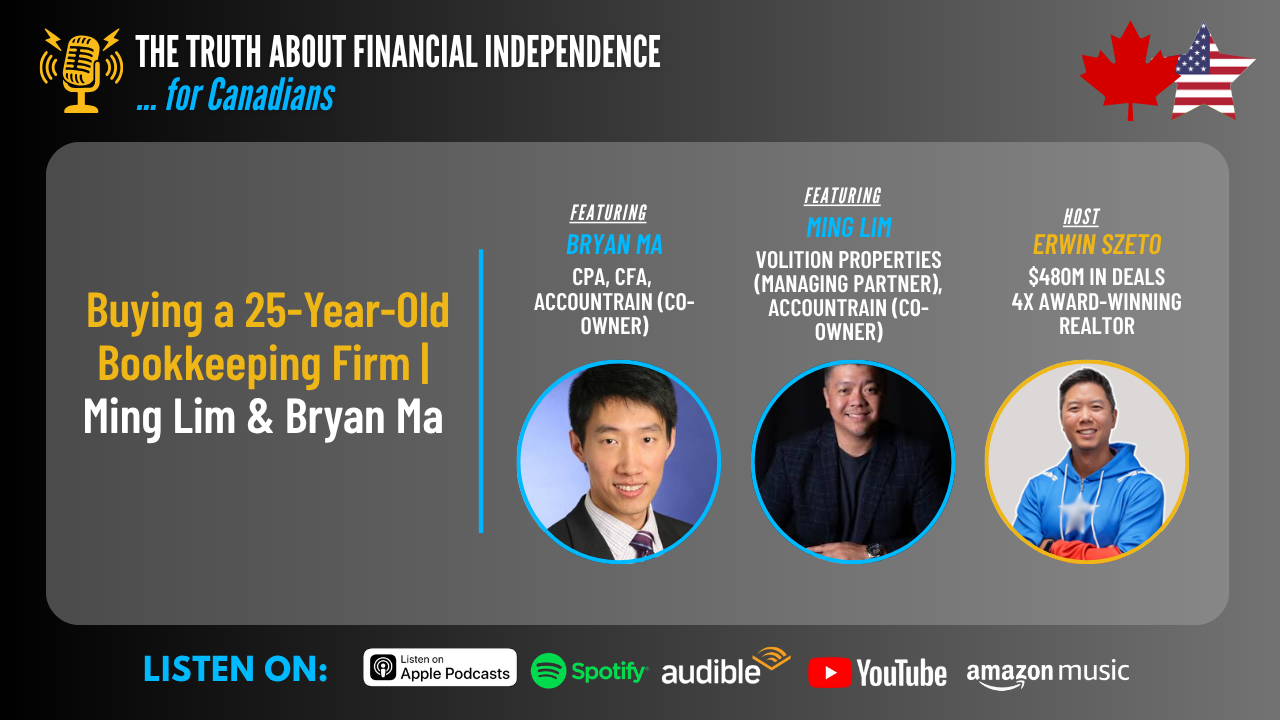

Buying a Boomer’s Business: Ming Lim and Bryan Ma on Acquiring a 25-Year-Old Bookkeeping Firm, Vendor Take-Backs, and the Great Wealth Transfer 

By Erwin Szeto | Co-Founder, iWIN Wealth Planning 

Recorded: June 2026 

Host: Erwin Szeto, The Truth About Financial Independence for Canadians 

Guests: Ming Lim, Managing Partner of Volition Properties and Co-Owner of AccounTrain; Bryan Ma, CPA, CFA, MBA, Co-Owner of AccounTrain 

Ontario real estate investing is in a different place than it was three years ago.

Rent control, slowed appreciation, rising costs, and a Landlord and Tenant Board backlog that can stretch eviction timelines past a year have changed the economics for active operators. The investors who used to add another door to their portfolio every 12 months are now asking a different question: if not more rentals, then what? 

In this episode of The Truth About Financial Independence for Canadians, Erwin sits down with Ming Lim and Bryan Ma, two friends who became business partners in January 2026 when they acquired AccounTrain, a 25-year-old bookkeeping firm based in Ottawa with clients across Canada. They beat out 5 other offers, paid 1.3 times annual revenue and they spent almost 2 years searching for the right deal. 

About Ming Lim and Bryan Ma

Ming is the managing partner of Volition Properties, where his team has helped Canadians transact on more than $300 million in Toronto investment real estate. Bryan spent 20 years in Canadian financial services as a CPA, CFA, and MBA, with most of his recent work in mergers and acquisitions at Intact Insurance. Their conversation is a real-world picture of what buying a small business from a retiring boomer actually looks like for Canadian investors who have already built equity in real estate. 

Why Active Real Estate Operators Are Looking at Small Business Acquisition 

Ming has been investing in Toronto real estate since 2015. He has seen the market shift from one where adding more doors was the obvious move to one where the math demands a harder look. His team at Volition Properties has remained active, but he has spent the last 2 years exploring what comes next. 

Bryan came at the question from a different angle. After 20 years in financial services, including roles at 3 of the largest professional services firms in Canada and most recently at Intact Insurance, he reached a moment of clarity that anyone in corporate finance will recognize. As he tells Erwin during the episode, he was doing 80-hour weeks on M&A files when he realized he had stopped enjoying the work. 

The two had known each other for years before deciding to partner up. The thesis they landed on is one that has been gaining traction quietly in Canadian operator circles for the last 5 years: the great wealth transfer. Baby boomers built thousands of small Canadian businesses over the last 40 years, many of them profitable, durable, and unsexy. They are now reaching retirement age without succession plans. The opportunity is enormous, but it is also harder than it looks. 

How They Found AccounTrain 

Ming and Bryan spent close to 2 years looking before they found the right business. They worked through several channels: a buy-side community called Village Wealth, business brokers including Poe Group (which specializes in accounting firms), and direct outreach to owners of businesses that fit their criteria. 

They tell Erwin the market is more competitive than most outside observers realize. Quality businesses with clean books and stable cash flow are often gone within 24 to 48 hours of listing. Buyers submit offers on businesses they have only partially reviewed, knowing they will lose the deal if they wait for full due diligence. Ming and Bryan estimate they looked at 1 to 2 businesses per day for almost a year before AccounTrain came up. 

AccounTrain itself was sourced through Poe Group. The firm had been in business for 25 years, founded and run by a single operator who was approaching retirement. Initial interest came from 15 to 18 parties. By the time the bid deadline closed, there were 5 serious offers. Ming and Bryan’s offer was selected, they believe, partly because of Bryan’s M&A background, which signalled to the seller that the buyers understood the process and would be reliable to close. 

Why Bookkeeping, Not a Full Accounting Practice 

One of the most useful threads in the conversation is the deliberate decision to buy a bookkeeping firm rather than a full accounting practice. Most investors looking at the professional services space assume the bigger prize is an accounting firm with CPAs on staff, tax preparation engagements, and audit work. 

Ming and Bryan went the other direction for a reason. Bookkeeping has fewer regulatory requirements. The owner does not need to be a CPA. The work is more systems-driven and less personality-driven, which means the business is less dependent on any single employee or partner. Pricing is more predictable. And the client relationship is recurring, which produces stable monthly revenue rather than the seasonal spikes accounting firms see around tax season. 

The tradeoff is that bookkeeping firms typically sell at lower multiples than accounting firms. But Ming and Bryan argue that the lower entry price and the simpler operating model more than offset the lower exit multiple, especially for buyers who plan to hold and modernize rather than flip. 

The Math of Buying a Bookkeeping Firm 

Bookkeeping firms in Canada generally trade in a range of 1.2 to 2.5 times annual revenue. Where a specific firm lands within that range depends on several factors: client concentration, recurring versus one-time revenue mix, geographic distribution, technology stack, owner involvement, and the quality of the books themselves. 

AccounTrain had approximately $1 million in annual revenue at the time of sale. Ming and Bryan paid 1.3 times revenue, putting the purchase price at approximately $1.3 million. They consider this on the low end of the range, in part because the firm was owner-operated with limited systems documentation, in part because the buyer pool was thinner than for a larger or more institutional firm. 

The deal structure included a vendor take-back component, which Ming and Bryan describe as standard in business sales but uncommon in Canadian residential real estate. They paid a portion of the purchase price at closing, with the seller financing the balance over a defined term. The vendor take-back also functioned as a structural commitment from the seller to remain available during the transition period, which became important given how much institutional knowledge needed to transfer. 

The Vendor Take-Back Mortgage as Industry Standard 

One of the most counterintuitive points in the episode is how common vendor take-back financing is in business sales compared to residential real estate. In real estate, vendor take-backs are seen as a creative financing tool used in soft markets or for difficult-to-finance properties. In small business sales, they are the default. 

The logic is simple. The seller knows the business better than the buyer ever will. A vendor take-back keeps the seller’s interests aligned with the buyer’s success during the critical transition period. If the business deteriorates after closing, the seller’s outstanding balance is at risk. That gives sellers an economic reason to stay engaged, answer questions, and help transfer relationships. 

For active real estate investors looking at business acquisition for the first time, this is a meaningful structural shift to absorb. The seller is not just exiting. They are partially financing your deal and remaining a stakeholder in the outcome. 

Twenty-Five Years of Knowledge in One Person’s Head 

The previous owner of AccounTrain ran the firm for 25 years. By Ming and Bryan’s account, much of what made the business work was stored not in systems but in her memory. Client preferences, filing deadlines specific to non-profit clients, informal arrangements with longstanding customers, the rhythm of the work itself, all of it lived in one person’s head. 

This is a recurring pattern in boomer-built businesses. The founder is the system. The business runs because the founder remembers everything. When the founder leaves, the institutional knowledge leaves with her unless the buyer captures it in time. 

Ming and Bryan structured the transition period specifically to extract this knowledge. The previous owner is staying on in a transition role for an extended period, working with Ming and Bryan to document client relationships, encode informal processes into formal workflows, and modernize the technology stack. They are building the CRM and workflow management systems the firm never had. By the time the transition is complete, the business will run on systems rather than on memory. 

The Lifestyle Case for a Business Over a Rental Portfolio 

Ming and Bryan are both still active in real estate. Ming continues to run Volition Properties. But they make a specific lifestyle case for the business over more rentals. 

A bookkeeping firm with stable monthly revenue and a small employee base does not call you at 11 p.m. when a pipe bursts. It does not require an LTB filing when a tenant stops paying rent. It does not get hit with a sudden 4-figure repair bill the same month a vacancy opens up. The variance is lower. The hours are more predictable. The work scales through systems and additional staff rather than through Erwin’s 7-day-a-week attention. 

The episode is honest about the tradeoffs. A small business has its own demands, especially during the first 6 to 12 months after acquisition when the new owners are still learning the operation. But for an active real estate investor whose portfolio is consuming evenings and weekends, a bookkeeping firm is often a calmer use of operator energy. 

How to Connect with Ming Lim and Bryan Ma 

To follow Ming and Bryan, visit accountrain.com or connect with them on LinkedIn. Ming’s real estate brokerage is Volition Properties: https://www.volitionprop.com/ 

Quick Answers 

Who are Ming Lim and Bryan Ma? 

Ming Lim is the managing partner of Volition Properties, a Toronto-area real estate brokerage. Bryan Ma is a CPA, CFA, and MBA with 20 years in Canadian financial services. In January 2026 they jointly acquired AccounTrain, a 25-year-old Canadian bookkeeping firm. 

What is AccounTrain? 

AccounTrain is a bookkeeping firm based in Ottawa with clients across Canada. The firm was founded over 25 years ago and was acquired by Ming Lim and Bryan Ma in January 2026. 

How much does a bookkeeping firm cost to buy in Canada? 

Canadian bookkeeping firms typically trade at 1.2 to 2.5 times annual revenue, depending on factors like client concentration, recurring revenue, geography, and the quality of the books. Ming and Bryan paid 1.3 times revenue for AccounTrain, which they describe as the low end of the range. 

What is a vendor take-back mortgage in a business sale? 

A vendor take-back mortgage in a business sale is seller financing for a portion of the purchase price. The buyer pays a portion at closing, and the seller carries the balance as a loan over a defined term. Vendor take-backs are standard in Canadian small business sales because they keep the seller’s interests aligned with the buyer’s success during the transition period. 

Where can you find Canadian small businesses for sale? 

Buyers can source Canadian small businesses through business brokers (such as Poe Group, which specializes in accounting firms), buy-side communities (such as Village Wealth), direct outreach to retiring owners, and industry-specific listing services. The market is competitive, and quality deals can close within 24 to 48 hours of listing. 

Why are some Canadian real estate investors moving to small business acquisition? 

Several forces are pushing active Canadian real estate investors toward small business acquisition: rent control and LTB backlogs have made residential rentals harder to operate, retiring baby boomers are creating a large supply of profitable small businesses for sale, and the lifestyle profile of a small business is often more sustainable than managing a portfolio of rental properties. 

The Bottom Line 

Canadian real estate is not dead. But for active operators, the math that worked in 2018 doesn’t work the same way in 2026. The hours required to manage rentals through rent control and LTB delays have crowded out the time real estate investing was supposed to give back. 

Ming and Bryan are part of a small but growing group of Canadian operators who are pointing at small business acquisition as the answer. Their experience is worth listening to because they are not selling you on it. They tell you exactly what it cost them in time, in cash, and in operator attention. Two years of searching. $1.3 million in capital. A vendor take-back commitment. A multi-month transition period extracting institutional knowledge from a 25-year operator’s memory. 

If you are sitting on Ontario rentals and have started asking yourself what the next 10 years of operator energy should be spent on, this conversation is a real-world picture of one alternative. It is not the only path. But it is one worth understanding before you decide what your next move is. 

Join Me Live: Free Training on the $100,000 Investment Loan Strategy

I’m hosting a free training on the strategy that produced the returns I mentioned above. It’s hybrid: in-person at the iWIN office in Oakville, or join on Zoom from anywhere.

Here is exactly what I will walk through in 90 minutes:

  1. The complete $100,000 investment loan structure
  2. The math — what $433 a month actually buys you over 5 and 10 years
  3. Every loss scenario — what happens when the market drops 20%, 30%, 40%
  4. How this fits alongside, not replacing, a real estate portfolio
  5. Live Q&A — bring your questions, bring your skepticism

Two dates to choose from. Both cover the same content — pick whichever fits your schedule.

Saturday June 27, Hybrid (Oakville + Zoom) — 9:00am ET, hard stop 10:30am. In-person seats are capped at 40 and they always go. If you want to be in the room, register today.

Tuesday July 7, Zoom only — 8:00pm ET

To Listen:

On Spotify: https://creators.spotify.com/pod/profile/erwinszeto/episodes/Buying-a-25-Year-Old-Bookkeeping-Firm–Ming-Lim–Bryan-Ma-e3kbo9a 

Amazon Music: https://music.amazon.ca/podcasts/40fe627d-dec7-4f5d-b7e5-90a550fffe46/episodes/71792264-c2b6-474d-b540-762219a96aee/the-truth-about-financial-independence-for-canadians-buying-a-25-year-old-bookkeeping-firm-ming-lim-bryan-ma

Apple: https://podcasts.apple.com/ca/podcast/buying-a-25-year-old-bookkeeping-firm-ming-lim-bryan-ma/id1100488294?i=100077131575

You’ve Built Wealth. Now It’s Time to Understand It. 

You’ve Built Wealth. Now It’s Time to Understand It. 

After dozens of consultations, I’ve noticed the same pattern again and again: most investors have built real wealth, but they’re not confident they can retire from it. They’re sitting on $2M–$5M in property but feel cash-flow poor. They’re paying more tax than they should because everything is held in personal names. They have no liquidity, no insurance strategy, and no clear plan for what happens if something happens to them. And almost every single client tells me the same thing: “I don’t actually know what retirement looks like for us.” 

Real estate builds equity, but it doesn’t automatically build freedom. Without a coordinated plan for taxes, income, protection, and exit strategy, investors often end up working harder in retirement than they did in their 30s. That’s why I created the Wealth Freedom Blueprint – a simple, practical guide to help you understand where you stand today, what gaps are costing you money, and how to turn the wealth you’ve built into a life you can actually live. 

Download your free Wealth Freedom Blueprint 

Disclaimer: 

As a committed advocate for transparent and responsible investing, I disclose that I am an Advisor to SHARE SFR (Single Family Rental). I hold equity in the company and earn referral commissions from clients I refer. I am also a licensed insurance agent with Open Concept Financial Group. The investment loan strategies discussed are for educational purposes only and are not a guarantee of approval or performance. Past performance is not indicative of future results. Every investor should do their own due diligence. 

Final Thoughts

Whether you’re building wealth, protecting it, or preparing to transition it, you deserve a clear, tax-smart strategy that works in real life. 

That’s what iWIN Wealth Planning is here for. 

This is how we’re creating predictable, stress-free wealth for Canadian families… 
so you can enjoy the life you’re building. 

Book your Wealth Planning Call 


Sponsored by… Me!

This episode isn’t sponsored—except by my wife Cherry and me. Real estate investing is our life. It’s helped us build wealth and achieve peace of mind about retirement and our children’s future.

Till next time—just do it. I believe in you.

Erwin Szeto
W: erwinszeto.com
FB: facebook.com/erwin.szeto
IG: @erwinszeto


Disclaimer

As a committed advocate for transparent and responsible investing, I want to disclose that I am an Advisor to SHARE SFR (Single Family Rental). I hold equity in the company and earn referral commissions from clients I refer.

My endorsement of their model—focusing on positive cash flow and direct ownership—is based on personal experience and belief. Still, every investor should do their own due diligence.

Why a 20-Year Canadian Finance Pro Drives 4.5 Hours to Buy $70,000 Cleveland Duplexes 

By Erwin Szeto | Co-Founder, iWIN Wealth Planning 

Recorded: May 2026

Host: Erwin Szeto, Truth About Financial Independence for Canadians

Guest: Carlos Rodriguez

Quick story before we get into this week’s guest. 

Back at our September 2025 iWIN Wealth Summit, I walked through what I’ve been calling the 4-to-1 strategy. The idea is straightforward: $100,000 of investor capital combined with a $300,000 investment loan from the bank for a total of $400,000 deployed into professionally managed and index stock funds, including S&P 500 exposure. 

Since that September presentation, the market has appreciated more than 13%. After management fees and borrowing costs at 5.2%, that translates into an estimated 40.6% return on the investor’s original $100,000. Leverage cuts both ways, of course, and suitability matters tremendously. But if you’re a real estate investor or someone pursuing FIRE, you already understand this principle intuitively. We’ve all used prudent leverage in real estate for decades. 

Speaking of how leverage cuts both ways, Canadian real estate is in decline. Hamilton in particular is down 9% year-over-year, leading the entire country, as reported in the Globe and Mail. I’m glad I sold some Hamilton properties when I did. I wish I’d sold more. 

Especially our Hamilton duplex. The tenant stopped paying rent. The LTB hearing got postponed, then postponed again. Seven months in, I’m $12,000 deep in lost rent, a couple thousand more in paralegal bills, and still waiting. Even with all the best screening practices, I couldn’t have foreseen the tenant’s health failing and his white-collar tech job laying him off in the same year. I’m holding the bag as a private social safety net at my own expense. 

This is the world I’m operating in. And it’s the context that makes today’s guest worth your time. 

Meet Carlos Rodrigues 

Carlos Rodrigues spent 20 years in Canadian financial services. He holds licenses in mutual funds, life insurance both levels, and was a full mortgage broker, not just an agent, running four to five agents under him. He even started building out his own investment fund before the Canadian compliance costs shut that plan down. 

So when somebody with that résumé tells me the math in Ontario doesn’t work anymore, I pay attention. 

Today, Carlos is an active real estate investor focused on Cleveland, Ohio. He’s on the tools, on site, and driving four and a half hours each way from Hamilton to do it. He runs BRRRRs, joint ventures, and Section 8 rentals. He’s bought houses for as little as $70,000 that now appraise for over $170,000. 

This isn’t a fantasy pitch. Carlos is honest about what active cross-border investing actually looks like. 

The $70,000 Duplex Near the Cleveland Clinic 

The headline deal in this episode is a 3,000-square-foot duplex Carlos bought for roughly $70,000, including a $24,000 wholesale fee. The property sits within a two-minute drive of the Cleveland Clinic, one of the largest hospitals in the United States, in a zip code that’s actively gentrifying. 

The condition was rough. The main-floor toilet was on a diagonal and falling through the floor. But the bones were there. After renovations, the duplex appraised at $170,000. 

This is the kind of math that doesn’t exist in the Golden Horseshoe anymore. 

Section 8 Economics That Don’t Exist in Canada 

One of the most eye-opening parts of the conversation was Carlos’s breakdown of how Section 8 (US government rental assistance) works for landlords. 

He’s getting 20 to 30 percent above market rent through the program. He shared one tenant in the Coventry area, a retired nurse, who rents from him for around $1,400 per month. Of that, she pays $14. The federal voucher covers the rest. 

“We’re considered the socialist country,” I said to him at one point, “but we don’t have anything like this in Canada.” 

His strategy intentionally targets Section 8 because it builds a strong rent base. If the broader economy turns down and tenants in other rental classes start losing jobs, his voucher-backed rent keeps flowing. 

There’s risk on this side too. Federal funding can change. But compared to my Hamilton duplex, where a job loss meant seven months of zero income and a paralegal bill, the contrast is hard to ignore. 

What the US Lending Market Is Doing Right Now 

Carlos shared an email he just received from a US broker offering 100% loan-to-cost financing. That’s 100% of the purchase price plus the full renovation budget, lent against the after-repair value. 

This is the kind of headline that triggers 2008 comparisons. Both of us went out of our way to address that. As Carlos put it, in 2008 lenders were putting a mirror in front of borrowers’ faces and lending if it fogged. That isn’t what’s happening now. These loans go through proper appraisals, lead-safe certifications, rental licensing inspections, and the rest of the US regulatory apparatus. But the credit is loose, and that’s worth knowing. 

For context, just a few weeks before that email, brokers were quoting Carlos 90% loan-to-cost. The market is moving. 

The Joint Venture Partner Who Panicked 

Carlos didn’t sugar-coat the operator headaches. His most painful recent story involved a joint venture partner who, between Carlos leaving the site for a Home Depot run and returning, expanded the renovation scope from $65,000 to over $100,000. 

“The unfortunate thing with joint venture partners,” Carlos said, “is when people start to get uncomfortable, they start trying to shift to alleviate that pain. And sometimes they do things that, well, over-renovate.” 

It’s a useful warning for anyone considering JV deals across a border, especially when one partner has Ontario-market mental models and the other partner is dealing with Cleveland-market realities. The numbers in Cleveland support a different finish level, different price points, and different exit timelines. Mismatched expectations cost real money. 

The Contractor Problem 

Cleveland is busy. Contractors are scarce. Carlos’s contractor ghosted him a week before closing on his current project. 

He also raised a less-discussed reality: the immigration crackdown in the US is hitting the construction labor pool. Many of the most reliable workers in his market are of South American descent, and ICE enforcement has made them cautious about advertising their services publicly. Phone numbers are gone. Contractors now communicate through Instagram DMs and voice-over-IP. Even legal workers are wary. 

That tightens the supply of skilled trades. If you’re going into Cleveland for active renovation work, this is a real cost you need to budget around. 

Cleveland Appreciation: Real Numbers 

Carlos was disciplined about underwriting. His own deals assume 1.5 to 2 percent annual appreciation. He expects 2 to 4 percent over the next five years. 

Recent actual appreciation in Cleveland: 7 percent year over year. 

The gap between what he underwrites and what he’s actually getting is what builds margin of safety into his deals. This is the same lesson Sarah Coupland made last week, working backward from conservative resale values rather than chasing the optimistic case. 

The Side Yard Program 

One small detail that stuck with me: Cleveland has a side yard program where if your principal residence sits next to a vacant lot owned by the land bank, you can buy that lot for $100. If your investment property sits next to it, you can buy the lot for $500. 

Compare that to the Golden Horseshoe, where lots run hundreds of thousands of dollars. These are different markets with different math. The strategy you use in one doesn’t transfer to the other. 

The Bottom Line 

Canadian real estate isn’t dead. But the conditions that made it a passive vehicle for the average investor aren’t like they used to be. If you want to be an active operator, treat real estate as a business, and drive four and a half hours each way to do it, the Carlos Rodrigues path is open to you. 

If you want passive, you need to look elsewhere. Landlord-friendly US markets through the right partners. Leveraged stock-market positions through investment loans. Small-business acquisition. These are the paths the show will keep covering. 

Diversify. Pacify. Get your time and your peace of mind back. 

That’s the next chapter.

Want the Whole Investment Loan Strategy Walked Through Live? 

This Saturday, May 30, 2026, I’m hosting a free training on the strategy that produced the 40.6% return I mentioned at the top of this post. It’s hybrid: in-person at the iWIN office in Oakville, or join on Zoom from anywhere. Hard start at 9:00am Eastern, hard stop at 10:30am. 

In those 90 minutes, I’m walking through: 

  1. The complete $100,000 investment loan structure 
  1. The math, what $433 a month actually buys you over 5 and 10 years 
  1. Every loss scenario, what happens when the market drops 20%, 30%, 40% 
  1. How this fits alongside, not replacing, a real estate portfolio 
  1. Live Q&A, bring questions, bring skepticism 

In-person seats are capped at 40 and they always go. If you want to be in the room, register today. 

Saturday May 30, Hybrid (Oakville + Zoom): infinitywealth.ca/20260530 

Tuesday June 2, Zoom only at 8pm Eastern: infinitywealth.ca/20260602 

Both events cover the same content. Pick whichever fits your schedule. 

To Listen:

On Spotify: https://creators.spotify.com/pod/profile/erwinszeto/episodes/20-Years-in-Canadian-Finance–Now-He-Only-Buys-70K-Cleveland-Duplexes–Carlos-Rodrigues-e3k0v4j

Amazon Music: https://music.amazon.ca/podcasts/40fe627d-dec7-4f5d-b7e5-90a550fffe46/episodes/d6ad4f99-c233-4397-884a-d8d94e54b29f/the-truth-about-financial-independence-for-canadians-20-years-in-canadian-finance-now-he-only-buys-70k-cleveland-duplexes-carlos-rodrigues

Apple: https://podcasts.apple.com/ca/podcast/20-years-in-canadian-finance-now-he-only-buys-%2470k/id1100488294?i=1000770024019

You’ve Built Wealth. Now It’s Time to Understand It. 

You’ve Built Wealth. Now It’s Time to Understand It. 

After dozens of consultations, I’ve noticed the same pattern again and again: most investors have built real wealth, but they’re not confident they can retire from it. They’re sitting on $2M–$5M in property but feel cash-flow poor. They’re paying more tax than they should because everything is held in personal names. They have no liquidity, no insurance strategy, and no clear plan for what happens if something happens to them. And almost every single client tells me the same thing: “I don’t actually know what retirement looks like for us.” 

Real estate builds equity, but it doesn’t automatically build freedom. Without a coordinated plan for taxes, income, protection, and exit strategy, investors often end up working harder in retirement than they did in their 30s. That’s why I created the Wealth Freedom Blueprint – a simple, practical guide to help you understand where you stand today, what gaps are costing you money, and how to turn the wealth you’ve built into a life you can actually live. 

Download your free Wealth Freedom Blueprint 

Disclaimer: 

As a committed advocate for transparent and responsible investing, I disclose that I am an Advisor to SHARE SFR (Single Family Rental). I hold equity in the company and earn referral commissions from clients I refer. I am also a licensed insurance agent with Open Concept Financial Group. The investment loan strategies discussed are for educational purposes only and are not a guarantee of approval or performance. Past performance is not indicative of future results. Every investor should do their own due diligence. 

Final Thoughts

Whether you’re building wealth, protecting it, or preparing to transition it, you deserve a clear, tax-smart strategy that works in real life. 

That’s what iWIN Wealth Planning is here for. 

This is how we’re creating predictable, stress-free wealth for Canadian families… 
so you can enjoy the life you’re building. 

Book your Wealth Planning Call 


Sponsored by… Me!

This episode isn’t sponsored—except by my wife Cherry and me. Real estate investing is our life. It’s helped us build wealth and achieve peace of mind about retirement and our children’s future.

Till next time—just do it. I believe in you.

Erwin Szeto
W: erwinszeto.com
FB: facebook.com/erwin.szeto
IG: @erwinszeto


Disclaimer

As a committed advocate for transparent and responsible investing, I want to disclose that I am an Advisor to SHARE SFR (Single Family Rental). I hold equity in the company and earn referral commissions from clients I refer.

My endorsement of their model—focusing on positive cash flow and direct ownership—is based on personal experience and belief. Still, every investor should do their own due diligence.

How an Ontario Investor Built Two Apps for $800 With AI 

By Erwin Szeto | Co-Founder, iWIN Wealth Planning 

Recorded: May 2026

Host: Erwin Szeto, Truth About Financial Independence for Canadians

Guest: Greg Kowalczyk, former design engineer turned full-time entrepreneur.

If you’d told me a year ago that a guy I’ve known for over a decade, an engineer with almost no coding background, would build two fully functional iPhone apps for the price of a nice dinner for four, I’d have nodded politely and changed the subject. This week’s guest on The Truth About Financial Independence for Canadians is Greg Kowalczyk. Greg’s a former design engineer who became an Ontario landlord, then an Amazon brand builder, and over the last twelve months has quietly become one of the most practical AI users I know.

The numbers he’s putting up aren’t theoretical. They’re real, they’re his, and they should change how you think about what’s possible in your own business and your own portfolio. 

The $800 question 

Greg built two apps that are live on the Apple App Store today. RunMate Pro tracks runs and the mileage on your running shoes. The other is a sun-protection index app for his e-commerce brand Gear Top, which tells you how long it’s safe to be outside. 

Built the old way, with a developer? Greg’s estimate: fifty to seventy thousand dollars. Months of meetings. Revisions. Scope creep. 

Built the new way, with Greg talking to AI while walking his dog? About eight hundred dollars in tokens. A few months of his time, mostly evenings and weekends, while still running his businesses. 

“If you paid developers, you’d probably spend $50,000 to $70,000 just to design those two apps. I calculated what it actually cost me, without my time, at about $800.” 

That isn’t a one-off. It’s a pattern that runs through everything Greg’s been doing. 

Replacing a $5,000 photo shoot 

Greg’s e-commerce brand Gear Top sells sun-protection apparel. Hats, gloves, balaclavas. His original product, a balaclava launched in 2014, still has nearly 7,000 reviews on Amazon. Another hat in the lineup has over 26,000 reviews. To get the product photography for these listings, Greg used to do what every serious Amazon seller does. Rent a studio downtown. Book a photographer. Hire models, sometimes four or five of them at once, including kids. Shoot all day. The going rate? Three to five thousand dollars per session. Plus the photographer’s processing fees. Plus, the time to organize everyone in one place for the twelve hours of shooting. 

Today, Greg generates almost all of his product imagery with AI. He uses Gemini’s Nano Banana model for stills and Veo for video. He’ll create a character once, then have the AI reproduce that same character across multiple scenes for a cohesive look. For a recent product launch on a new line of nasal strips, his cousin in Poland used the same approach to produce a thirty-five second animated commercial. Five clips of about eight seconds each, stitched together. 

The packaging design for the kids’ version of those nasal strips? Designed with AI. The mascot characters in the videos? AI-generated. The fifteen-second hero clip you’d have paid an agency four or five figures for? Generated overnight. 

“We used to pay $3,000 to $5,000 a session for a photographer and models. Now I just talk to AI and get what I want.” 

For an Amazon seller, that’s not a productivity gain. That’s a margin expansion. 

A website built while you sleep 

Greg owns the domain gregkowalczyk.com. He registered it back in 2013. For over a decade, the site sat dormant because building a personal site felt like too much work. Hire a developer, pay them, manage them, get something he didn’t really love, repeat.

One weekend last year, he decided to try something different. He wrote a script telling the AI what he wanted. A personal site with all his projects, all his links, all his work. Then he let it run in a loop, what’s called a “Ralph loop,” overnight. He woke up the next morning to a finished website. 

He uses the same approach for the Bronte Harbour Classic, the inaugural 5k race he’s putting on in Oakville this year. The website, the sponsor pages, the registration integrations, all of it built by Greg with AI assistance. When I asked him last week to add a clearer age-range explanation to the kids’ race, he made the change from his desk in about ten minutes. The AI updated multiple pages and even created a new one to host additional details. It also logged into the third-party registration platform and made the matching changes there. 

A web developer would have taken a week to do that work and probably missed a spot or two. 

Dashboards instead of software subscriptions 

Here’s the part that should make your ears perk up if you own any SaaS stocks. 
Greg used to pay for QuickBooks’ mileage-logging module. He found it overcomplicated, frustrating, and a bad fit for how he actually wanted to log mileage. So he built his own. Voice-driven, simple, designed around his workflow. He’s already cancelled QuickBooks’ module. 

He used to pay for analytics dashboards for his e-commerce businesses. Now he builds his own dashboards. He gets direct access to the underlying data source, pulls the metrics he cares about, and lays them out exactly the way he wants to see them.

“I don’t have to build software anymore. I build dashboards. I just get direct access to the software I need the numbers from, pull out the analytics, and put them the way I want to see them. Once I build it, that’s my software.” 

This is a small business owner replacing line items on his monthly P&L with custom-built tools that fit his business better than the off-the-shelf product ever did. Multiply that across millions of small businesses and you start to understand why some software companies are watching their stock prices come down hard from the peak. A lot of my friends I trust think we’re nowhere near the bottom for legacy SaaS. 

The Ontario landlord chapter 

The real estate sub-thread on this episode is just as interesting, and just as practical. Greg’s been an Ontario landlord since 2012. His first property was an RTO deal in Cambridge that I covered the home inspection on, before I really knew him. He’s owned student rentals in Hamilton and Kitchener, single-family rentals in St. Catharines, and converted two properties into legal duplexes in 2022 and 2023. 

Why convert? Cash flow. When his mortgage renewals hit just after COVID, the math on a property charging $1,800 in rent stopped working. So instead of selling, he refinanced two properties and used the equity to build two basement suites. The Hamilton conversion cost about $220,000 because it was a full gut job, complete with the famous (now) discovery of a backyard marijuana plantation he had to chop down and put out with the lawn waste. 
He’s still holding the portfolio. But he’s also realistic about the experience. 

“Nothing can challenge me anymore. We had eviction, we had flooding, we had fire. Flooded toilet? That’s just Tuesday.” 

If you’ve been a Canadian landlord through the last few years, that line lands a little too hard. 
His current AI-related side project in the real estate space? Auto-populating LTB forms. Anyone who’s filled out a Landlord and Tenant Board application by hand knows exactly how big a win this would be. 

What Greg told the listener who hasn’t started 

I asked Greg my standard close-of-show question. If somebody listening hasn’t done anything with AI yet, where should they start? 
His answer was characteristically practical. Three steps. 

  • Step one: install one of the tools. ChatGPT, Claude, Gemini, doesn’t really matter. The regular chat is fine. 
  • Step two: go deeper than chat. Use the research modes. If there’s a topic you’ve been curious about, ask the AI to do a deep research run on it. Read the result. 
  • Step three: turn the research into a deliverable. A summary. A slide deck. A one-page PDF. A landing page. The point isn’t the deliverable itself. The point is that by going from raw output to finished asset, you discover the real range of what these tools can do. 

“You have almost the smartest agent in the world in your pocket. He’s like a PhD professor, available 24/7. Just ask him whatever you like.” 

That’s the soundbite I want every podcast listener to walk away with. Not “AI is the future” in the abstract. Just: there’s a tool in your pocket that knows almost everything, and most people are barely using it. 

Where this fits into the bigger picture 

The TAFI thesis is that there’s more than one path out of the rat race. Real estate is one. Building or buying a business is another. The stock market is another. Investment loans are another. AI is now one of the most powerful tools you can lay across any of those paths to accelerate the math. 

Greg’s the proof. He didn’t pick AI as a new asset class. He picked it as a tool to make every asset class he already plays in cheaper and faster to operate. His e-commerce business runs at a fraction of its previous photo and video budget. and his race event runs with a one-person marketing team. His real estate portfolio is about to have an LTB form filler that none of his competitors will have built for themselves. 

If you’re an Ontario investor who’s tired of the landlord life and looking for what’s next, here’s a model: keep what’s still working, get creative on the rest, and use AI to compound everything you build from here. And if part of “what’s next” for you is growing wealth beyond the rentals without buying another property, that’s exactly what I cover in my next free training. 

Join the next free training 

This Saturday — May 30, 2026 — I’m hosting a free training called the Zero-Down Wealth Strategy. It’s hybrid: in-person at the iWIN office in Oakville, or join on Zoom from anywhere. Hard start at 9:00am Eastern, hard stop at 10:30am. 

In those 90 minutes, I’m walking through: 

  1. The complete $100,000 investment loan structure 
  1. The math — what $433/month actually buys you over 5 and 10 years 
  1. Every loss scenario — what happens when the market drops 20%, 30%, 40% 
  1. How this fits alongside (not replacing) a real estate portfolio 
  1. Live Q&A — bring questions, bring skepticism 

In-person seats are capped at 40 people and they always go. If you want to be in the room, register today. 

Saturday May 30 — Hybrid (Oakville + Zoom): infinitywealth.ca/20260530 

Tuesday June 2 — Zoom only at 8pm Eastern: infinitywealth.ca/2026060

Both events cover the same content. Pick whichever fits your schedule. 

To Listen:

On Spotify: https://creators.spotify.com/pod/profile/erwinszeto/episodes/He-Talks-to-AI-While-Walking-the-Dog–Grek-Kowalczyk-e3josig

Amazon Music: https://music.amazon.ca/podcasts/40fe627d-dec7-4f5d-b7e5-90a550fffe46/episodes/a320b735-bb19-499b-81e3-945d396adacc/the-truth-about-financial-independence-for-canadians-he-talks-to-ai-while-walking-the-dog-grek-kowalczyk

Audible: https://www.audible.ca/pd/B0H2W56826?source_code=ASSGB149080119000H&share_location=pdp 

Apple: https://podcasts.apple.com/ca/podcast/he-talks-to-ai-while-walking-the-dog-grek-kowalczyk/id1100488294?i=1000769484484

You’ve Built Wealth. Now It’s Time to Understand It. 

You’ve Built Wealth. Now It’s Time to Understand It. 

After dozens of consultations, I’ve noticed the same pattern again and again: most investors have built real wealth, but they’re not confident they can retire from it. They’re sitting on $2M–$5M in property but feel cash-flow poor. They’re paying more tax than they should because everything is held in personal names. They have no liquidity, no insurance strategy, and no clear plan for what happens if something happens to them. And almost every single client tells me the same thing: “I don’t actually know what retirement looks like for us.” 

Real estate builds equity, but it doesn’t automatically build freedom. Without a coordinated plan for taxes, income, protection, and exit strategy, investors often end up working harder in retirement than they did in their 30s. That’s why I created the Wealth Freedom Blueprint – a simple, practical guide to help you understand where you stand today, what gaps are costing you money, and how to turn the wealth you’ve built into a life you can actually live. 

Download your free Wealth Freedom Blueprint 

Final Thoughts

Whether you’re building wealth, protecting it, or preparing to transition it, you deserve a clear, tax-smart strategy that works in real life. 

That’s what iWIN Wealth Planning is here for. 

This is how we’re creating predictable, stress-free wealth for Canadian families… 
so you can enjoy the life you’re building. 

Book your Wealth Planning Call 


Sponsored by… Me!

This episode isn’t sponsored—except by my wife Cherry and me. Real estate investing is our life. It’s helped us build wealth and achieve peace of mind about retirement and our children’s future.

Till next time—just do it. I believe in you.

Erwin Szeto
W: erwinszeto.com
FB: facebook.com/erwin.szeto
IG: @erwinszeto


Disclaimer

As a committed advocate for transparent and responsible investing, I want to disclose that I am an Advisor to SHARE SFR (Single Family Rental). I hold equity in the company and earn referral commissions from clients I refer.

My endorsement of their model—focusing on positive cash flow and direct ownership—is based on personal experience and belief. Still, every investor should do their own due diligence.
Rebuilding Wealth After Divorce: Sarah Coupland on Ontario Multifamily, Distressed Properties, and Creative Financing 

By Erwin Szeto | Co-Founder, iWIN Wealth Planning 

Recorded: May 2026

Host: Erwin Szeto, Truth About Financial Independence for Canadians

Guest: Sara Coupland, Real Estate Investor

Real estate investing is easy to talk about when markets are rising, financing is available, and the portfolio is growing. It gets much harder when life changes, assets must be sold, and the market no longer supports yesterday’s valuations. 

In this episode, Erwin sits down with Sarah Coupland, a long-time Ontario real estate investor, coach, construction operator, and owner of TAG Property Management. Sarah has been investing since 2007, built a personal portfolio of more than 60 doors, and manages about 300 units for herself and other investors. 

She also specializes in the kinds of properties most investors avoid: distressed multifamily buildings, mixed-use assets, older properties, and renovation-heavy projects that banks often will not finance. Now, as she works through the sale of her portfolio during divorce, she is also rebuilding from the other side using joint ventures, private money, and a more intentional strategy. 

Selling a Portfolio in a Difficult Ontario Market 

Sarah’s portfolio once included more than 60 doors. Today, because of her divorce, she is liquidating assets she had expected to keep long term. That process has forced her to reassess market values, buyer psychology, and the emotional side of letting go. 

One of her biggest lessons is corporate structure. Most of her properties were owned in corporations where she and her spouse were 50/50 shareholders, but Sarah held the controlling shares. That made the disposition process smoother because she could deal with lawyers, realtors, and purchasers without every decision becoming a back-and-forth negotiation. 

For investors building portfolios with spouses, partners, or joint venture investors, this is a major lesson: ownership and control are not always the same thing. The structure you set up when times are good can determine how manageable things become when life changes. 

Distressed Multifamily Is Not for Beginners 

Sarah specializes in highly distressed properties. One featured example is her 12-unit mixed-use building at 144 King Street West in Cobourg. The property had major deferred maintenance, a fire order against the third floor, wildlife inside the building, and units that were not suitable for habitation. 

The project was massive. Sarah purchased the building for approximately $700,000, structured an 80% to 85% vendor take-back mortgage, capitalized the interest into the purchase price, used private money and deferred payments, and ultimately ended up with about $1.7 million invested after a renovation budget of roughly $1 million. 

The property is now listed around $2.6 million, with roughly $21,000 per month in rent and a cap rate around seven, according to Sarah’s estimate during the conversation. Tenants pay utilities, the building has been extensively renovated, and much of the heavy lifting has already been done. 

The story is a strong example of forced appreciation, but it also highlights why these deals are not simple. Heritage requirements delayed the project by roughly six months over window requirements. An engineering miscalculation created an additional $80,000 electrical issue. The renovation took about two and a half years instead of the expected year and a half. 

That is the reality of distressed real estate investing: the upside can be significant, but the execution risk is real. 

Why Old Buildings and Mixed-Use Properties Can Work 

Many investors avoid old buildings, heritage districts, commercial units, and tertiary markets. Sarah often leans into them because lower competition can create better pricing. 

Her strategy is not to buy anything old blindly. It is to understand what can be fixed, what needs to be budgeted, what the market will support, and whether the numbers still work after realistic contingencies. She has also found that commercial tenants can add stability, and that commercial landlord-tenant issues are often simpler than residential issues under Ontario’s Landlord and Tenant Board system. 

That said, financing can be difficult. Mixed-use properties often do not fit neatly into standard CMHC or bank financing boxes. Sarah has used private lenders, vendor take-backs, seconds, and non-bank financing to make projects work when traditional lenders would not. 

Investor Appetite Is Returning, but Discipline Still Matters 

One of the most interesting parts of the conversation was Sarah’s take on today’s Ontario real estate market. On the sales side, she is seeing buyers still searching for discounts and often not believing the market has bottomed. On the acquisition side, however, she is also seeing aggressive activity. 

One off-market property she analyzed received 11 offers in three days and sold about $60,000 over asking. Another rough Peterborough triplex from a wholesaler sold over asking despite needing extensive work. 

Sarah’s conclusion is balanced: investors are starting to come back, but she refuses to chase deals. She works backward from conservative resale values, renovation budgets, investor return requirements, and contingency buffers. If the numbers do not work, she lets the deal go. 

That discipline matters in a market where comparable values can move quickly. Sarah shared a recent flip where expected resale values dropped from about $550,000 to $530,000 during the renovation period, and the property ultimately sold for $505,000. The deal still made money, but only because the numbers had enough room. 

LTB Challenges, Renovictions, and the Reality of Bad Buildings 

Sarah also spoke directly about Ontario’s landlord environment, including renovation-related bylaws and the pressure placed on private landlords to carry low-rent or non-performing assets. 

Her view is pragmatic. She respects housing needs, but believes governments should not expect private landlords to subsidize low-income housing indefinitely, especially when mortgage costs, repairs, insurance, and taxes continue rising. 

In distressed projects, Sarah says she often approaches tenants honestly. If the building is unsafe, she explains the work required, offers compensation, helps with moving, and documents the process properly. She is not evicting for sport; she is trying to fix buildings that may have water pouring down walls, electrical problems, structural issues, or unsafe conditions. 

For Landlord and Tenant Board matters, her advice is simple: communicate clearly, document everything, be honest, and bring evidence. If you made a mistake, admit it and move on. If you are at the board, make sure you are there for a valid reason and can support your position. 

Becoming a Full-Time Investor Is Not Retirement 

Sarah offered one of the most honest answers in the episode about becoming a full-time real estate investor. Too many people market it as “retire today” or “quit your job and become financially free.” Sarah’s reality was different. 

She worked as a financial advisor at CIBC, renovated after work, ate on the go, and spent evenings and weekends doing the hard labour. When she eventually left her job, she did not simply jump into the unknown. She created supplemental income through property management, bought a fourplex, and worked with joint venture partners and private money. 

Her warning is important: becoming a full-time investor is not retirement. Often, it is trading one job for another. The key is to build systems, income streams, a team, and a business that can eventually give you time back. 

Sarah’s personal goal was to be off when her daughter was off during the summer. With coaching and intentional planning, she eventually built rules around her acquisitions. If she did not have an offer accepted by the end of March, she stopped buying until after summer. That discipline helped her protect the life she was investing for in the first place. 

Education, Action, and Coaching 

Sarah credits much of her growth to education and community. She mentioned Durham REI and Quinton de Souza as important influences, especially in learning about RRSP mortgages, joint ventures, flips, BRRRRs, and vendor take-back mortgages. 

Her final advice for investors is straightforward: get educated, build your network, take action, and consider coaching when you are ready to move beyond basic investing. Her coaching is not aimed at complete beginners. It is better suited for investors who already own properties and want to move into multifamily, renovations, portfolio strategy, and more intentional investing. 

Sarah’s story is a reminder that financial freedom is not always a straight line. Sometimes the portfolio changes. Sometimes the market changes. Sometimes life changes. But with the right structure, conservative numbers, strong relationships, and the willingness to rebuild, real estate can still be a powerful path to wealth for Canadian investors. 

How to Connect with Sarah Coupland 

Sarah can be reached through her website at SarahCoupland.ca or by email at Sarah@TAGProperties.ca. Investors interested in her listed properties can also connect with Anita Bongers-Lewis and Chris Lewis at Doors to Wealth Real Estate. 

Quick Answers 

  • How many units does Sarah Coupland manage? 
    Sarah Coupland manages about 300 units through TAG Property Management, including properties for other real estate investors. 
  • How many doors did Sarah Coupland own? 
    Sarah’s personal real estate portfolio was over 60 doors before she began liquidating assets during her divorce. 
  • What type of real estate does Sarah Coupland specialize in? 
    She specializes in distressed multifamily, mixed-use, and older Ontario rental properties where value can be created through renovations and better management. 
  • Why does Sarah Coupland use private money and joint ventures? 
    She uses private money and joint ventures because many distressed or mixed-use properties do not fit traditional bank financing, especially during construction or major renovations. 
  • What is Sarah Coupland’s opinion on the Ontario real estate market? 
    Sarah believes Ontario still has real estate investing opportunities, especially in small multifamily properties, but investors must be conservative with numbers and contingencies. 
  • What advice does Sarah give about becoming a full-time real estate investor? 
    She says becoming a full-time investor is not retirement; it is often trading one job for another unless you build income, systems, and a team. 

Want the Whole $100,000 Strategy Walked Through Live? 

This Saturday — May 30, 2026 — I’m hosting a free training called the Zero-Down Wealth Strategy. It’s hybrid: in-person at the iWIN office in Oakville, or join on Zoom from anywhere. Hard start at 9:00am Eastern, hard stop at 10:30am. 

In those 90 minutes, I’m walking through: 

  1. The complete $100,000 investment loan structure 
  1. The math — what $433/month actually buys you over 5 and 10 years 
  1. Every loss scenario — what happens when the market drops 20%, 30%, 40% 
  1. How this fits alongside (not replacing) a real estate portfolio 
  1. Live Q&A — bring questions, bring skepticism 

In-person seats are capped at 40 people and they always go. If you want to be in the room, register today. 

Saturday May 30 — Hybrid (Oakville + Zoom): infinitywealth.ca/20260530 

Tuesday June 2 — Zoom only at 8pm Eastern: infinitywealth.ca/2026060

Both events cover the same content. Pick whichever fits your schedule. 

The Bottom Line 

Canadian real estate isn’t dead. But the conditions that made it a passive vehicle for the average investor are gone. If you want to be an active operator and treat real estate as a business, more power to you. If you want passive, you have to look elsewhere — landlord-friendly U.S. markets, leveraged stock-market positions, small-business acquisition, and a few other paths the show will keep covering. 

Diversify. Pacify. Get your time and your peace of mind back. 

That’s the next chapter.

To Listen:

On Spotify: https://creators.spotify.com/pod/profile/erwinszeto/episodes/Rebuilding-Wealth-After-Divorce-Sarah-Coupland-on-Ontario-Multifamily–Distressed-Properties–and-Creative-Financing-e3je3l3 

Amazon Music: https://music.amazon.ca/podcasts/40fe627d-dec7-4f5d-b7e5-90a550fffe46/episodes/44dcec71-076a-479c-99c2-720b8f10a5aa/the-truth-about-real-estate-investing-for-canadians-rebuilding-wealth-after-divorce-sarah-coupland-on-ontario-multifamily-distressed-properties-and-creative-financing

Audible: https://www.audible.ca/podcast/ITEM-NAME/B0H1V3FMG2?source_code=ASSGB149080119000H&share_location=pdp

Apple: https://podcasts.apple.com/ca/podcast/rebuilding-wealth-after-divorce-sarah-coupland-on-ontario/id1100488294?i=1000768392581

You’ve Built Wealth. Now It’s Time to Understand It. 

You’ve Built Wealth. Now It’s Time to Understand It. 

After dozens of consultations, I’ve noticed the same pattern again and again: most investors have built real wealth, but they’re not confident they can retire from it. They’re sitting on $2M–$5M in property but feel cash-flow poor. They’re paying more tax than they should because everything is held in personal names. They have no liquidity, no insurance strategy, and no clear plan for what happens if something happens to them. And almost every single client tells me the same thing: “I don’t actually know what retirement looks like for us.” 

Real estate builds equity, but it doesn’t automatically build freedom. Without a coordinated plan for taxes, income, protection, and exit strategy, investors often end up working harder in retirement than they did in their 30s. That’s why I created the Wealth Freedom Blueprint – a simple, practical guide to help you understand where you stand today, what gaps are costing you money, and how to turn the wealth you’ve built into a life you can actually live. 

Download your free Wealth Freedom Blueprint 

Final Thoughts

Whether you’re building wealth, protecting it, or preparing to transition it, you deserve a clear, tax-smart strategy that works in real life. 

That’s what iWIN Wealth Planning is here for. 

This is how we’re creating predictable, stress-free wealth for Canadian families… 
so you can enjoy the life you’re building. 

Book your Wealth Planning Call 


Sponsored by… Me!

This episode isn’t sponsored—except by my wife Cherry and me. Real estate investing is our life. It’s helped us build wealth and achieve peace of mind about retirement and our children’s future.

Till next time—just do it. I believe in you.

Erwin Szeto
W: erwinszeto.com
FB: facebook.com/erwin.szeto
IG: @erwinszeto


Disclaimer

As a committed advocate for transparent and responsible investing, I want to disclose that I am an Advisor to SHARE SFR (Single Family Rental). I hold equity in the company and earn referral commissions from clients I refer.

My endorsement of their model—focusing on positive cash flow and direct ownership—is based on personal experience and belief. Still, every investor should do their own due diligence.
I’ve Been Telling Investors to Diversify Out of Ontario Since 2023. Here’s What I’m Actually Buying Now

By Erwin Szeto | Co-Founder, iWIN Wealth Planning 

Recorded: May 2026

Host: Erwin Szeto, Truth About Financial Independence for Canadians

If you’ve been around me for the last couple of years, you’ve heard me talking about diversification. Specifically, diversifying out of Canadian real estate concentration. I’ve been making this case publicly since I met SHARE in 2023. The math in Ontario stopped working for the average passive investor a while ago, and I’ve been saying so. 

So this article isn’t another version of that case. You’ve heard it. I’ve made it. Cherry and I have been quietly walking the talk — slowly unwinding our Hamilton rentals as tenants naturally turn over, redeploying that capital methodically. None of that is news. 

What I want to spend this article on is the *what next* — the specific places that capital is going, and especially the one strategy I haven’t talked about much publicly until now. 

Three threads, briefly: U.S. landlord-friendly real estate (we’ve covered that on the show since 2022). Business acquisition — including the one Cherry quietly pulled off two years ago, which has been a game-changer for our family. And then the third piece, which is where this article wants to spend most of its time: real-estate-style leverage applied to the stock market. Twenty-five percent down. The other 75% borrowed through an institutional investment loan. Same structural math we’ve used in real estate for thirty years — applied to the index instead of a duplex. 

If you’ve been quietly wondering whether there’s a way to put your money to work that isn’t another mutual fund and isn’t another Ontario rental — keep reading. This is for you. 

Quick Context: Why I’ve Been Saying What I’ve Been Saying 

Brief recap, for anyone newer to my work. 

I’m not saying real estate is dead in Canada. I’m saying the conditions that made it easy for the average passive investor are gone. Population growth has slowed. Cap rates are compressed. Capital requirements have ballooned. Rent control plus anti-renoviction bylaws plus inflation have squeezed the math to the point where professional property management costs more than the math supports. The infrastructure that made passive Canadian real estate actually passive — particularly the affordable third-party manager — is disappearing. 

That’s the death of passive — not in theory, in practice. The infrastructure that made passive Canadian real estate investing actually passive isn’t there anymore. 

Active operators are still making it work. People running real estate as a real business — teams, systems, scale, the discipline to handle the LTB. They’ve earned it. I cheer for them. I send them clients. They will be guests on my show. 

But for the client who wanted passive — who wanted cash flow without the second job — that option here in Canada has largely closed. So I’ve been pointing them somewhere else. 

Where Passive Real Estate Investing Went: South 

Passive real estate investing for Canadians didn’t disappear. It moved south. 

Landlord-friendly U.S. markets — places where tenant laws aren’t stacked against owners, cap rates pencil, and you can hire institutional-grade property management that handles everything — are where the math now lives. We’ve covered this on the show since 2022, partnered with SHARE in 2023, and it’s been the through-line of the diversification message I’ve been making publicly for two and a half years. 

Quick example, in case you’re new. A client of ours just closed on a single-family home in South Carolina. Two-hundred-and-thirty-five thousand U.S. dollars. House built in 1996. Almost 2,400 square feet. Twenty-two-minute drive from the BMW plant that employs 11,000 people. Cap rate? 7.3 percent. Closing? 30 to 60 days. 

Try finding that combination in Ontario today. The math doesn’t exist here anymore. 

That’s leg one of where Cherry and I are redeploying capital from the Hamilton sell-down. If that’s the part you came for — that’s the part. Now let’s talk about the other things diversification looks like in our actual household, before we get to the strategy this article wants to spend its time on. 

ICYMI: We Bought a Business Two Years Ago. It Changed Everything. 

Two years ago, Cherry acquired another accounting firm. The previous owners? Two retiring boomers ready to step away from their practice. At the time it was a meaningful capital deployment and a meaningful operational bet. With the benefit of hindsight, it was perfectly timed. 

A boring, cash-flowing professional services business — landed right as the Canadian real estate market was decelerating. It became the counterweight to the slowdown. As real estate transaction volume softened across our realtor business at iWIN Real Estate, Cherry’s accounting practice was doing the opposite — quietly compounding, generating recurring cash flow, completely uncorrelated with the housing market. 

And here’s the bigger point. Cherry didn’t just acquire a business. She executed the textbook version of what’s about to be the largest small business ownership transfer in Canadian history. Two retiring boomers, no internal succession, a profitable practice that needed a new owner. Cherry stepped in. Buyer wins, sellers win. That exact transaction is going to happen tens of thousands of times across this country over the next decade — and most retail investors aren’t even thinking about it as an investment category. 

That’s diversification working the way it’s supposed to. 

A boring, cash-flowing business to offset the slowdown of the real estate market. That’s diversification working the way it’s supposed to. 

And we’re not alone.

If you’ve been listening to the show, you’ve heard me say this — more and more real estate investors are pivoting into adjacent services. Becoming realtors, mortgage agents, general contractors and accountants. My paralegal friend Andrew switched into HVAC. The pattern is everywhere once you start looking for it: people who built wealth in real estate are moving toward businesses that own the cash flow rather than the property. 

Some have tried hospitality — short-term rentals, AirBnB — and got squeezed when municipalities started shutting it down. The boutique operators with proper licensing and unique product are still doing well, but it’s no longer the easy retail-investor play it was five years ago. 

The bigger trend behind all of this — the one most retail investors are sleeping on — is exactly what Cherry just did. Boomer business owners are retiring. Many have no transition plan. No kid taking over the shop. No succession. Which means the next generation has an enormous opportunity to acquire profitable, cash-flowing businesses at fair, sometimes generous, prices. And there’s a lifetime capital gains exemption in Canada that makes selling a qualifying business incredibly tax-efficient — meaning sellers are often willing to negotiate creatively. Buyer wins, seller wins. 

Boring HVAC company. Landscaping route. Dental practice. Accounting firm. The cash-on-cash returns on these things, when you bought them right, are not in the same league as a duplex in Hamilton. And nobody’s bidding the prices up the way they do on real estate, because most people don’t know how to value or finance a small business. 

Cherry and I are living proof of the strategy. It’s one of the pillars the new show is going to spend serious time on. 

Now the Piece I Haven’t Talked About Much: 25% Down on the Stock Market 

Here’s the part of my personal playbook I haven’t talked about publicly nearly as much as the U.S. real estate or business acquisition pieces — and it’s the one I think is the bigger missing puzzle piece for most of the investors in my audience. 

Almost no Canadian retail investor knows this option exists, but you can take real-estate-style leverage and apply it to the stock market. Here’s the structure: a creditworthy Canadian can access a $100,000 investment loan with no money down. Monthly cost of carry is roughly $433 per month. The investment vehicle has principal protection built in. The interest may be tax-deductible. And if you have a spouse with good credit, you can stack a second $100,000 the same way. 

In real estate terms, this is a 25% down deal — except there’s no down payment. It’s leverage applied to the broad index, not to a duplex. 

If that sounds aggressive, stay with me — because it’s actually the same expected-return math you’ve been doing on Ontario rentals for years. You just haven’t seen it applied this way. 

The 2005 framework, applied to 2026 

Back in 2005, when I was running my expected-return math on a real estate investment, the standard assumption was 20% down, 80% mortgage, and roughly 3% appreciation per year. Run that math through, factor in the leverage, and your expected return on the cash you actually put in lands around 15% per year. That’s the math that built the Canadian real estate investing industry. The leverage did the work. 

Now apply the same framework to the stock market. Twenty-five percent down. Borrow the other 75% through an investment loan. Assume the stock market’s long-run historic average — call it around 10% per year. Run the math the same way. Factor in your cost of carry on the borrowed portion. Expected ROI on your equity? Around 40%. 

Now, before anyone yells at me — yes, the past does not predict the future. Yes, leverage cuts both ways. Yes, 10% is an assumption, not a guarantee. We will walk through every loss scenario at the live training. 

Even if the stock market only does 6% — way below average — I still get a respectable return on my equity. And I get zero landlord headaches. 

That’s the trade. Just a deposit, a wire transfer, and quarterly statements. For the lazy investor — the one protective of their time and mental health — it’s the easiest yes I’ve ever signed. 

Why this fits the audience I serve 

Most of my clients are over-concentrated in Canadian real estate. They wanted passive. They got an active job they didn’t ask for. They’ve been looking for a way to diversify without dumping properties at the bottom of the cycle. 

This strategy was built for that exact person. It’s the second leg of what Cherry and I are doing personally — pulling capital from Ontario as it naturally frees up, and putting some of it into a leveraged equity position that gives us index exposure with the same kind of leverage real estate already taught us to use. 

It’s not magic. It’s not a shortcut. It’s just the same math you already understand, applied to a different asset class. 

Important Context: This Isn’t My Whole Portfolio 

Before anyone takes the wrong message from this article, let me be clear about something. 

This isn’t my whole portfolio. Not even close. Cherry and I still hold significant Canadian real estate. We have active businesses generating cash flow. We carry insurance and we have a properly diversified picture across asset classes, income sources, and time horizons. The leveraged stock market position I’m describing is one leg of that. Not the whole table. 

And I’m not telling you to put your last dollar into this either. I’m telling you it deserves a seat at the table — alongside whatever else you’re already doing. Diversification is the whole point. Don’t put all your eggs in this basket. Or any basket. 

A Quick Note on the Show — and Why This Is Actually Going Back to Roots 

If you’ve been listening to my podcast for any length of time, you know it as The Truth About Real Estate Investing for Canadians. Almost five hundred episodes over nearly a decade. 

Starting now, the show is becoming The Truth About Financial Independence for Canadians. TAFI for short. Find it at tafipod.ca. 

Here’s the thing about this rebrand that I want you to understand. It might look like a departure. It’s actually the opposite. It’s a return to the original idea that started me down this path twenty years ago. 

In 2005 I read Rich Dad Poor Dad. Like a lot of you. The whole point of that book — the whole reason it changed how millions of people think about money — was that there is no single path out of the rat race. Real estate is one path. Owning a business is another. Investing in paper assets is another. Kiyosaki was clear about it. Most of us who started with real estate just got so good at it that we forgot the rest of the framework existed. 

Like all entrepreneurs, we have to pivot. This change is the show going back to its roots — exiting the rat race the way Kiyosaki actually wrote about. Multiple paths. Not just real estate. 

So the rebrand isn’t the show changing direction. It’s the show finally living up to what it was always supposed to be about. Career and income optimization. U.S. real estate. Leveraged stock-market investing. Buying small businesses from retiring boomers. Lifestyle design. Canadian tax strategy. AI as a wealth-creation tool. Multiple paths. Same Rich Dad philosophy. 

Like all entrepreneurs, we pivot. This is ours. 

Want the Whole $100,000 Strategy Walked Through Live? 

This Saturday — May 30, 2026 — I’m hosting a free training called the Zero-Down Wealth Strategy. It’s hybrid: in-person at the iWIN office in Oakville, or join on Zoom from anywhere. Hard start at 9:00am Eastern, hard stop at 10:30am. 

In those 90 minutes, I’m walking through: 

  1. The complete $100,000 investment loan structure 
  1. The math — what $433/month actually buys you over 5 and 10 years 
  1. Every loss scenario — what happens when the market drops 20%, 30%, 40% 
  1. How this fits alongside (not replacing) a real estate portfolio 
  1. Live Q&A — bring questions, bring skepticism 

In-person seats are capped at 40 people and they always go. If you want to be in the room, register today. 

Saturday May 30 — Hybrid (Oakville + Zoom): infinitywealth.ca/20260530 

Tuesday June 2 — Zoom only at 8pm Eastern: infinitywealth.ca/2026060

Both events cover the same content. Pick whichever fits your schedule. 

The Bottom Line 

Canadian real estate isn’t dead. But the conditions that made it a passive vehicle for the average investor are gone. If you want to be an active operator and treat real estate as a business, more power to you. If you want passive, you have to look elsewhere — landlord-friendly U.S. markets, leveraged stock-market positions, small-business acquisition, and a few other paths the show will keep covering. 

Diversify. Pacify. Get your time and your peace of mind back. 

That’s the next chapter.

To Listen:

On Spotify: https://creators.spotify.com/pod/profile/erwinszeto/episodes/Welcome-to-the-Truth-About-Financial-Independence-e3j379d 

Amazon Music: https://music.amazon.ca/podcasts/40fe627d-dec7-4f5d-b7e5-90a550fffe46/episodes/46779809-e913-42b2-8984-b5e0dc7f30d5/the-truth-about-real-estate-investing-for-canadians-welcome-to-the-truth-about-financial-independence

Audible: https://www.audible.ca/podcast/ITEM-NAME/B0GYKNM4JR?source_code=ASSGB149080119000H&share_location=pdp

Apple: https://podcasts.apple.com/ca/podcast/welcome-to-the-truth-about-financial-independence/id1100488294?i=1000766797099

YouTube: https://youtu.be/ibBWxozAre8

You’ve Built Wealth. Now It’s Time to Understand It. 

You’ve Built Wealth. Now It’s Time to Understand It. 

After dozens of consultations, I’ve noticed the same pattern again and again: most investors have built real wealth, but they’re not confident they can retire from it. They’re sitting on $2M–$5M in property but feel cash-flow poor. They’re paying more tax than they should because everything is held in personal names. They have no liquidity, no insurance strategy, and no clear plan for what happens if something happens to them. And almost every single client tells me the same thing: “I don’t actually know what retirement looks like for us.” 

Real estate builds equity, but it doesn’t automatically build freedom. Without a coordinated plan for taxes, income, protection, and exit strategy, investors often end up working harder in retirement than they did in their 30s. That’s why I created the Wealth Freedom Blueprint – a simple, practical guide to help you understand where you stand today, what gaps are costing you money, and how to turn the wealth you’ve built into a life you can actually live. 

Download your free Wealth Freedom Blueprint 

Final Thoughts

Whether you’re building wealth, protecting it, or preparing to transition it, you deserve a clear, tax-smart strategy that works in real life. 

That’s what iWIN Wealth Planning is here for. 

This is how we’re creating predictable, stress-free wealth for Canadian families… 
so you can enjoy the life you’re building. 

Book your Wealth Planning Call 


Sponsored by… Me!

This episode isn’t sponsored—except by my wife Cherry and me. Real estate investing is our life. It’s helped us build wealth and achieve peace of mind about retirement and our children’s future.

Till next time—just do it. I believe in you.

Erwin Szeto
W: erwinszeto.com
FB: facebook.com/erwin.szeto
IG: @erwinszeto


Disclaimer

As a committed advocate for transparent and responsible investing, I want to disclose that I am an Advisor to SHARE SFR (Single Family Rental). I hold equity in the company and earn referral commissions from clients I refer.

My endorsement of their model—focusing on positive cash flow and direct ownership—is based on personal experience and belief. Still, every investor should do their own due diligence.
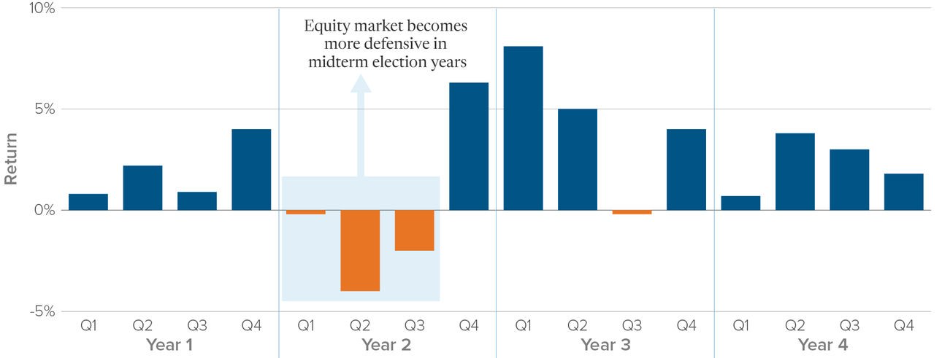
The Zero-Down Wealth Strategy: Why Smart Canadians Are Getting Positioned Now 

Why Smart Canadians Are Getting Positioned Now 

By Erwin Szeto | Host of The Truth About Real Estate Investing for Canadians 

Recorded: April 2026

Host: Erwin Szeto, The Truth About Real Estate Investing for Canadians Podcast

I’ve been doing this podcast since 2016. Almost 10 years, approaching 500 episodes. And in all that time, I’ve rarely recorded a solo episode — because this strategy is so important, and so few people are talking about it, that I needed to speak directly to you, my precious 17 listeners. 

I call it the Zero-Down Wealth Strategy. And if you’re a Canadian real estate investor who’s tired of tenant headaches, over-concentrated in local real estate, and wondering what comes next — this might be the most important thing you read this year. 

The $433 Question 

Let me ask you something. 

Would you rather invest $100,000 — or $433 a month? 

Most people hear $100,000 and immediately think: I don’t have that sitting around. But $433 a month? That’s a car payment. Most of us spend or invest that without blinking. 

Here’s the thing — they’re the same investment. 

$433 is the monthly interest cost of a $100,000 investment loan (from an institutional lender — none of that private lending crap) at today’s rate of 5.2%. One credit check. One self-reported loan application. Zero of your own capital required. No property or property appraisal. No lender fees, mortgage broker and full underwriting. 

That’s it. 

Why Canadian Real Estate Investors Are Stuck 

Before I explain the strategy, I want to acknowledge something most of us feel but rarely say out loud. 

We’re stuck. 

Inflation is real. In March 2026, Canada’s inflation rate hit 3.3% — well above the Bank of Canada’s 2% target. Just look at what it cost to build the Eglinton LRT if you want a concrete example. Money sitting idle loses real purchasing power every single month. 

We’re over-concentrated. Almost every real estate investor I meet with to discuss their investments has 80 to 90% of their wealth tied up in local Canadian real estate — all in Canadian currency. That’s not diversification. That’s concentration risk. 

Demand is weakening. Immigration restrictions, rising unemployment, softening rental demand — the outlook for Canadian investment property has changed materially. This is not 2015. 

The landlord nightmare is real. I say this as someone who’s lived it. I had a tenant deliberately flood my basement causing $10,000 worth of damage. The police couldn’t do anything. I’m currently nine months into a Landlord Tenant Board hearing just for non-payment of rent. Non-payment. Vandalism. LTB backlogs. Ontario is one of the most difficult places in the world to be a landlord right now. 

So why are we still playing the same game? 

2026: A Critical Window 

Here’s what makes this moment particularly important. 

2026 is a US midterm election year — and history has a very clear pattern: 

  • 4.7% — Average S&P 500 return in midterm election years (vs. 9.5% in all other years) 
  • 18% — Average intra-year market drawdown before the November election 
  • 15.4% — Average S&P 500 return in the year after a midterm election 

Quarterly average S&P 500 price returns by presidential cycle (1961-2024) 

Source: Strategas Research  

We are in Q2 of Year 2 RIGHT NOW and this year should be especially volatile with this November’s midterm election deciding if Trump controls Congress or not. 

The market already dropped 9% earlier this year and bounced back 12% — exactly the kind of volatility midterm years are known for. 

The dip before November isn’t the danger. It’s the setup. 

The question isn’t whether a correction is coming. The question is whether you’ll be positioned to benefit from the rebound when it does. 

You Already Believe in Leverage 

If you’re a real estate investor, you already understand this concept — you’ve just been applying it to the wrong vehicle. 

Nobody buys investment property with cash. We put 20 to 25% down and borrow the rest. We call that smart investing. 

Around 2010 — right after the financial crisis — zero down and 5% down mortgages were everywhere in the investor community. Nobody called that reckless. We called it getting ahead. And everyone I know who took advantage of that leverage in 2010 did extremely well. 

This is the same principle. Just applied to a better vehicle — one with no landlord headaches, no appraisals, no LTB hearings, and no midnight calls. 

Two Yale Professors Proved It 

In 2010 — right after one of the worst decades in stock market history — two Yale professors published a book called: 

Lifecycle Investing: A New, Safe, and Audacious Way to Improve the Performance of Your Retirement Portfolio

— Barry Nalebuff & Ian Ayres, Yale University 

Their conclusion, backed by rigorous mathematical proof: leveraged investing, done correctly, outperforms conventional portfolios over a lifetime. 

They weren’t writing from the comfort of a bull market. They ran the math through the pain — through the dot-com crash, through 2008 — and the conclusion was the same every time. 

We real estate investors already know this intuitively. We leveraged into real estate and built wealth over the long term. This is no different in principle. It’s just a different asset class. 

The Stress Test Results 

I ran my own stress test — comparing a leveraged non-registered investment against three alternatives most Canadians swear by: 

Strategy Result 
RRSP — pre-tax dollars, tax-deferred growth ✗ Underperforms 
TFSA — after-tax dollars, tax-free growth ✗ Underperforms 
Non-registered, unleveraged ✗ Underperforms 
Non-registered, leveraged ✅ Wins 

Yes — including the TFSA. The leveraged non-registered strategy beats them all. 

I know that’s counterintuitive. We’ve been conditioned to think TFSAs and RRSPs are the gold standard. And for most people, they are excellent choices. But real estate investors aren’t most people. We walk to a different drummer. We’re looking for outsized returns — and the math confirms this strategy delivers them. 

You can verify this yourself — run the numbers in ChatGPT or Claude and it will confirm: a non-registered leveraged investment outperforms registered fund vehicles over the long term. 

How It Actually Works 

Here’s the practical breakdown: 

Step 1 — Qualify  One credit check. One self-reported loan application. No property, appraisal, mortgage broker and no full underwriting involved.

Step 2 — Borrow $100,000  100% loan to value. Zero of your own capital required. Your only cost is $433/month in interest at 5.2%. If structured correctly, that interest is tax-deductible — speak to your accountant. 

Step 3 — Invest  The $100,000 goes into a segregated fund account — think of it as a mutual fund from the insurance industry.  

Step 4 — Principal protection  This is the key difference from simply putting borrowed money into the stock market. Segregated funds come with built-in principal protection. The downside is covered. The upside belongs to you. That’s why institutional lenders are willing to lend against this — the risk is contained. 

The accounts belong to you. You sign off on everything. We coordinate the paperwork and movement of funds at iWIN Wealth Planning — but it’s your money, your account, your decision. 

Is This Right for You? 

Leveraged investing isn’t for everyone. Before you consider this strategy, ask yourself these questions — and discuss them honestly with your advisor. 

Do you have a specific financial goal in mind? 

This strategy works best when you know what you’re building toward. Retirement income? Diversification away from Canadian real estate? Getting off the landlord treadmill? Get clear on your goal before you start. 

How long are you planning to invest? 

Leveraged investing is typically more suitable for a long-term investment horizon of 10 years or more. Just like real estate — the longer you hold, the more you de-risk. This is not a short-term play. 

How much other debt are you carrying? 

Keep your debt manageable. Make sure your current debt load is under control before adding an investment loan. A good rule of thumb: your total monthly borrowing costs — including the $433/month investment loan interest — should not exceed 36% of your before-tax income. 

How stable is your income? 

A steady income helps you make the required interest payments every month without stress. If your income is unpredictable, this may not be the right time. 

What is your tolerance for risk? 

Are you comfortable with potential fluctuations in your investment value? And with the possibility that in some scenarios, leveraged investing may not outperform traditional investing? If market volatility keeps you up at night, this is not the right vehicle for you. 

Let’s talk if you answered these questions honestly and still feel confident

If I Could Do It All Again 

I want to be honest with you. 

I made the decision in 2005 — 11 years before this podcast started — to go all-in on real estate investing instead of the stock market. And I’ve built a great business from it. Nearly $500 million in investment property transactions. Four-time Realtor of the Year to investors in Ontario. 

But if I could do it all again? I would have deployed leverage earlier — into vehicles without the landlord baggage. 

Less grey hair. More money. No tenant nightmares. More time with our families. 

I think about my clients too. The ones I’ve worked with for years. We would have all made more money. We would have all been happier. That’s not a small thing. 

These are the same strategies I’m now teaching my own kids — and recommending to every client I meet. Because I don’t want non-payment of rent or tenant vandalism stealing anyone’s time away from what actually matters. My future grandchildren deserve parents who aren’t fighting about money because they have to feed the real estate’s bank account — because a tenant stopped paying or a basement flooded, which is happening ever more frequently with climate change. 

The Midterms Are November. You Have 6 Months. 

The US midterm elections are November 2026. History says markets dip before then — and then deliver some of the strongest returns of the four-year presidential cycle in the year that follows. 

You have roughly six months to get positioned. 

I’m doing a free live training where I walk through the full strategy, show you the stress test results side by side, and answer your questions directly. 

Two ways to join: 

📍  Saturday May 30, 2026 — Hybrid (In-Person + Zoom)  Doors open 8:30am · Hard start 9:00am · Hard stop 10:30am · iWIN Office, Oakville · Limited to 40 in-person 

[Register here → Wealth Planning for Canadians] 

💻  Tuesday June 2, 2026 — Webinar Only  8:00pm Eastern · Zoom · 90 minutes 

Same content both sessions. Pick what works for you. 

[Register here → Wealth Planning for Canadians] 

In-person spots fill fast. Don’t wait.

To Listen:

On Spotify: https://creators.spotify.com/pod/profile/erwinszeto/episodes/The-Zero-Down-Wealth-Strategy-How-Canadians-Use-Leverage-to-Beat-Inflation-e3il08o

Amazon Music: https://music.amazon.ca/podcasts/40fe627d-dec7-4f5d-b7e5-90a550fffe46/episodes/ac823c8a-fca9-4be5-aebe-e266c178f86a/the-truth-about-real-estate-investing-for-canadians-the-zero-down-wealth-strategy-how-canadians-use-leverage-to-beat-inflation

Audible: https://www.audible.ca/pd/B0GYYHMYXG?source_code=ASSGB149080119000H&share_location=pdp

Apple Music: https://podcasts.apple.com/ca/podcast/the-zero-down-wealth-strategy-how-canadians-use/id1100488294?i=1000764468055

YouTube: https://youtu.be/ibBWxozAre8

You’ve Built Wealth. Now It’s Time to Understand It. 

You’ve Built Wealth. Now It’s Time to Understand It. 

After dozens of consultations, I’ve noticed the same pattern again and again: most investors have built real wealth, but they’re not confident they can retire from it. They’re sitting on $2M–$5M in property but feel cash-flow poor. They’re paying more tax than they should because everything is held in personal names. They have no liquidity, no insurance strategy, and no clear plan for what happens if something happens to them. And almost every single client tells me the same thing: “I don’t actually know what retirement looks like for us.” 

Real estate builds equity, but it doesn’t automatically build freedom. Without a coordinated plan for taxes, income, protection, and exit strategy, investors often end up working harder in retirement than they did in their 30s. That’s why I created the Wealth Freedom Blueprint – a simple, practical guide to help you understand where you stand today, what gaps are costing you money, and how to turn the wealth you’ve built into a life you can actually live. 

Download your free Wealth Freedom Blueprint 

Final Thoughts

Whether you’re building wealth, protecting it, or preparing to transition it, you deserve a clear, tax-smart strategy that works in real life. 

That’s what iWIN Wealth Planning is here for. 

This is how we’re creating predictable, stress-free wealth for Canadian families… 
so you can enjoy the life you’re building. 

Book your Wealth Planning Call 


Sponsored by… Me!

This episode isn’t sponsored—except by my wife Cherry and me. Real estate investing is our life. It’s helped us build wealth and achieve peace of mind about retirement and our children’s future.

Till next time—just do it. I believe in you.

Erwin Szeto
W: erwinszeto.com
FB: facebook.com/erwin.szeto
IG: @erwinszeto


Disclaimer

As a committed advocate for transparent and responsible investing, I want to disclose that I am an Advisor to SHARE SFR (Single Family Rental). I hold equity in the company and earn referral commissions from clients I refer.

My endorsement of their model—focusing on positive cash flow and direct ownership—is based on personal experience and belief. Still, every investor should do their own due diligence.

The $600,000 Penalty. Why I recommend against Private Lending

By Erwin Szeto | Host of The Truth About Real Estate Investing for Canadians 

Recorded: April 2026

Host: Erwin Szeto, The Truth About Real Estate Investing for Canadians Podcast

Three Real Estate Stories the Headlines Are Missing in 2026 

Three stories crossed my desk in the last few weeks that every Canadian real estate investor needs to hear about — together, not separately. Because when you put them side by side, they tell one story, and it’s the story the headlines are missing. 

Story one: Ontario’s HST rebate on new-build homes launched April 1st, and sales surged at major builders. Story two: Alberta’s new-build market — the province everyone has been telling you to buy into — is showing real cracks. And story three: a regulatory ruling from FSRA that hit close to home for me personally, and that carries a lesson every private investor needs to absorb. 

Here’s what they have in common. The headline is never the whole story. The loudest voices in a market are rarely the most informed. And your job as an investor is to do your own work. 

Let’s get into it. 

Story 1: Ontario’s HST Rebate Sparks a Sales Surge — But the Investor Window Has Already Closed 

On April 12th, the Globe and Mail reported that new-build home sales in Ontario surged in the first week of the province’s new HST rebate. Major homebuilder Minto sold nearly 120 new homes in Ottawa and the Toronto region. Branthaven Homes sold more homes in one week than they did in all of 2025. The industry trade group BILD called it a “jolt.” 

If you’re an Ontario landlord or investor, the question is obvious: is this the bottom? Is preconstruction back? Should I jump in? 

Before you do, you need to understand what the rebate actually covers — and what it doesn’t. 

How the Ontario HST New-Build Rebate Works 

Effective April 1st, 2026, Ontario buyers can claim a rebate on the 13% HST on new-build homes. The transaction window runs until March 31st, 2027. The rules differ depending on whether you’re buying to live in the home or to rent it out. 

For end-users (people buying a home to live in), construction has to start before December 31st, 2028 to qualify. That’s a meaningful window. 

For investors (people buying to rent the unit out), the rules are dramatically tighter. Construction must already have been started by March 31st, 2026 — a date that has already passed. In other words, the investor version of this rebate only applies to product that’s already in the ground. There is no path for an investor to buy a brand-new project and qualify. 

It’s also worth noting that the rebate is not yet ratified in legislation. Buyers and developers are transacting as if it is, but the federal Department of Finance told the Globe it cannot speculate on timelines. 

The Case for Optimism 

Let’s give the rebate its fair due. Thirteen per cent off a new home is real money. On a $700,000 townhome, that’s $91,000 — a meaningful down payment, not a marketing gimmick. 

The volume is undeniable. Branthaven sold 120 townhomes in Milton and Mississauga and another 20 condos in Oakville in a single week. Construction jobs are coming back — Branthaven’s president told the Globe he expects to rehire up to 30 staff and put dozens of subcontractors back to work. And it begins to clear out the more than 10,700 cancelled GTA and Hamilton condo units that have hung over the market since 2022. 

The Case for Caution 

Not every builder is sharing in the surge. Fernbrook Homes — a 45-year veteran developer — told the Globe they had “many calls and inquiries” but the result was “no sales. Zero.” CEO Joe Salvatore said buyers are “100,000 per cent gun shy” after years of economic upheaval and the U.S. trade war. 

Minto’s own CEO openly questioned whether the surge would last: “Is this a short spurt that will peter out, or will it be sustained?” Pauline Lierman of Zonda Urban — a leading preconstruction researcher — was even more direct: “Demand and confidence is not all there.” 

And the underlying affordability problem hasn’t moved. Solmar Development just cancelled its large Bristol Place condo project in Brampton and converted it to rentals. Their executive vice-president told the Globe the issue was simple: buyers can’t qualify for mortgages and can’t come up with the down payments. “Affordability continues to be an issue, regardless of the rebates.” 

What This Means for Investors 

If you’re a first-time buyer or end-user, the rebate is genuinely worth a serious look. The math on your primary residence is different than the math on a rental, and you have a meaningful window to act. 

If you’re an investor hoping the rebate unlocks Ontario rentals, slow down. The investor cutoff has already passed. Anything you buy now does not qualify for the investor rebate. And Ontario’s underlying landlord economics — rent control, tenant board wait times, eviction process, capped annual increases — have not changed. A one-time purchase discount does not fix ongoing negative cash flow. 

If you’re an existing Ontario landlord whose properties are not cash-flowing, this rebate may actually create a window for you to exit. If new-build sales pick up broadly, the resale market tends to follow with a lag. That could be your opportunity to redeploy capital into something that actually cash-flows. 

Which leads us to where many Ontario investors have been looking for the past few years. 

🎧 Listen to the full podcast

Story 2: Why Toronto Investors Are Walking Away from Their Calgary Preconstruction Deals 

For the last three or four years, the loudest advice in Canadian real estate investing circles has been some version of: “Sell your Ontario rental, buy in Alberta.” I get it. Landlord-friendly legislation, no rent control, lower provincial taxes, a growing population, better affordability than the GTA or the Lower Mainland. On paper, it’s everything Ontario isn’t. 

Then on April 2nd, the Globe and Mail published a piece titled “Glut of new build homes starts to unhinge the Alberta market.” Every Canadian investor with Alberta exposure — or who is considering it — needs to read it carefully. 

The Calgary Townhouse Glut, By the Numbers 

According to Altus Group data cited in the Globe, unsold new-build townhome inventory in Calgary hovered below 1,000 units from mid-2023 through early 2025. By the end of 2025, it climbed past 1,030 — and rising. The share of new-build townhomes priced at or above $500,000 jumped from 40 per cent to 72 per cent in the same period, putting them out of reach of many local first-time buyers. 

Here’s the line every investor needs to absorb. Edward Jegg, Altus’s research manager of data solutions, told the Globe: “Many projects started in the early 2020s were targeted to Toronto investors,” and “a number of those sales to out-of-town investors are not going through, so they are coming back to the market.” 

Translation: the Toronto investors who bought Calgary preconstruction in 2021, 2022, and 2023 — when everyone was telling you Alberta was the next big thing — those deals aren’t closing. Investors are walking away or can’t qualify, and the inventory is landing back on the market and piling up. 

The Cash-Flow Story Has Changed 

Calgary agent Michael Ferianec of Urban Upgrade & New Infills explained why investor demand has dried up: “The cash flow that once made new-build townhomes an attractive investment has dwindled, as a healthy supply of purpose-built rentals, combined with slower population growth, drives down asking rents.” He’s also seeing “more flip-over from rental to sale. Because the rental market already has a lot of listings.” 

That’s a feedback loop. When rents soften, landlords list for sale instead of rent. That adds to for-sale inventory. That softens prices. Meanwhile, Calgary’s unemployment is still elevated, and oil prices are squeezing local cost of living. Three buyer segments — local first-timers, local renters, out-of-town investors — are all soft at the same time. 

The Long-Term Alberta Case Is Still Real 

I want to be fair here. The structural case for Alberta is still intact. Landlord-friendly legislation remains among the most landlord-friendly in the country. There is still no rent control. The eviction process is faster and more predictable than Ontario’s tenant board. Provincial tax burden is lower. Long-term population trajectory — interprovincial migration, international immigration — remains a tailwind, even if it has slowed. 

This isn’t a story about Alberta being broken. It’s a story about cycles. Calgary in 2026 looks different from Calgary in 2022. The investors who made money on Alberta over the last few years didn’t do it because Alberta is magic — they did it because they bought at the right part of the cycle, at the right price point, in the right sub-market, with the right financing. 

The Bigger Lesson — Stop Chasing Narratives 

The narrative that moves through Canadian investor circles is always one or two steps behind the data. In 2020 and 2021 it was “Toronto condos forever.” From 2022 through 2024 it was “get out of Ontario, buy Alberta.” And a lot of investors bought Calgary townhomes from a floor plan, sight unseen, in a sub-market they had never visited, based on a spreadsheet a promoter handed them at a free seminar. Now those units are completing, the rents aren’t where the pro-forma said they would be, the values aren’t where the pro-forma said they would be, and the investors are either walking or holding something that doesn’t cash-flow. 

This isn’t an Alberta problem. It’s a chasing-the-narrative problem. I’ve watched the same pattern in Toronto, Hamilton, Barrie — and now Calgary. 

Where the Real Opportunity Is Right Now 

Many of my recent podcast guests — active investors, builders, experienced operators — have told me the same thing. Deals are hard to come by right now. Construction costs are inflated. Property values, even in softer markets, haven’t collapsed the way some expected. The spread between what it costs to build and what you can sell or rent for has narrowed. That’s a tough environment to find a great deal in. The consistent message from those guests has been: be patient, underwrite quality, and don’t force a deal just to be in the market. 

With that context, here’s the opportunity I’d actually be paying attention to. A glut of unsold new-build inventory and small developers under real pressure — softening rents, oversupply, carrying costs, nervous lenders — is motivated-seller territory. 

Think about it. Why take on financing risk, development risk, construction risk, timing risk, and pay today’s inflated build costs — when there’s a small developer who has already carried all of that risk, has a finished building, and needs to move it? You can potentially buy turnkey, at a discount, with actual rent history and actual expense data. No pro-forma guessing. That’s a fundamentally better risk-adjusted position than buying preconstruction from a floor plan. The patient buyer with cash or pre-approved financing is the one who gets paid in this cycle. 

Story 3: FSRA’s $600,000 Penalty Against Claire Drage — and Three Lessons Every Investor Must Absorb 

The third story is the hardest one for me to write. Because it isn’t about a market or a policy — it’s about a person, and many in the Ontario real estate investing community knew her, including me. 

What FSRA Found 

On March 11th, 2026, the Financial Services Regulatory Authority of Ontario (FSRA) announced six administrative monetary penalties totalling $600,000 against Claire Drage, formerly a licensed mortgage broker in Guelph. The full release is available on FSRA’s website, and I encourage you to read it directly. 

FSRA’s findings, in their words: Drage “engaged in a prolonged and extensive pattern of misconduct, exposed investors to significant losses, failed to mitigate those losses, and derived significant economic benefit from her contraventions.” 

FSRA states she brokered hundreds of mortgages and other loans for a group of real estate developers, raising over $100 million from the investing public. The cited regulatory breaches include failing to disclose material risks, failing to disclose conflicts of interest, providing inaccurate valuations, failing to take reasonable steps to ensure mortgages were suitable, and failing to address inaccuracies in mortgage applications. The real estate companies behind those loans became insolvent and were granted CCAA creditor protection on January 23rd, 2024, exposing investors to real losses. Drage did not contest FSRA’s proposal, and the order was issued as-is. 

Why I Have to Disclose My Own History Here 

I knew Claire personally. She was a sponsor of my investor conference back in 2019. We referred clients to each other. She was, for a period, someone I considered a respected peer in this industry. 

At a certain point — years before any of this became public — something came up in my own network that concerned me. Out of fairness, and because there was a regulatory process that has only just concluded, I’m not going to get into specifics. But after that experience, I quietly made the decision to stop referring clients, and I took down the podcast episode I had recorded with her. I didn’t go public or issue a statement but I pulled back. 

I have to be honest with myself here. Almost three years passed between when I pulled back and when this all became public with the CCAA filing in January 2024. In that time, Claire continued to speak at other podcasts, sponsor other meetups, and appear at industry events. I wasn’t the gatekeeper for an entire industry. But I do sometimes ask myself whether I should have said more, sooner. It isn’t a clean answer. I had a hunch. I acted on it for myself and my direct clients but I didn’t broadcast it. Reasonable people can disagree about whether that was the right call. 

To the Investors Who Were Hurt 

Behind that one paragraph from FSRA about penalties are real people. Retail investors — often mom-and-pop lenders, sometimes retirees putting RRSP or TFSA money into what they thought was a safe, secured, first-mortgage investment — who lost money or had their capital tied up in an insolvency that may take years to resolve. 

If that’s you, I’m truly sorry. Nothing in the rest of this article is meant to lecture anyone already hurt. You did what a lot of smart, well-intentioned people did — you trusted someone licensed by the province, endorsed by the community, on stages with people you respected. That isn’t naive. That’s human. The rest of this is for everyone else who hasn’t yet made a similar decision and can still learn from what happened. 

Lesson 1 — Do Diligence on the Person, Not Just the Deal 

When you invest in a private mortgage, a syndicated mortgage, a Mortgage Investment Corporation (MIC), or any real estate syndication, you are not just investing in a property. You are investing in the people running the deal — their integrity, their processes, their disclosures, their willingness to tell you bad news when bad news happens. The property is a commodity. The operator is not. 

Concrete steps to do diligence on a person: check their licence status on the regulator’s website (FSRA for Ontario mortgage brokers, OSC for exempt market dealers). Search the regulatory enforcement database. Search their name with terms like “lawsuit,” “complaint,” “FSRA,” “OSC,” and “CCAA.” Ask for references from past investors on deals that went badly, not just deals that paid out — anyone can give you a happy reference. Ask about the deals that didn’t go well: How were they handled? How was the communication? Were losses disclosed and mitigated, or papered over? 

Pay particular attention to conflicts of interest. If the same person is the broker, the promoter, a connected party to the developer, and the recipient of transaction fees — that’s a stack of conflicts. It does not automatically disqualify the deal, but it has to be disclosed clearly and accounted for in how you size your investment. FSRA specifically cited failure to disclose conflicts of interest in this case. That isn’t a technicality. That’s the whole game. 

Lesson 2 — Private Lending Is Risk Capital, Not GIC Capital 

A lot of retail investors have been sold on private mortgages and MICs over the last decade as a “safe, secured, high-yield” alternative to GICs. That framing oversimplifies the actual risk. 

A first mortgage on real property is secured — yes. But secured against what? An appraisal value the broker provided? A property in a small town with a thin resale market? A development project where the value only materializes if construction finishes and lease-up succeeds? A borrower who may be connected to the broker arranging the loan? “Secured” is not the same as “safe,” and “high yield” exists for a reason: it is compensation for risk that’s real, even if you can’t see it on the pitch deck. 

When these deals go bad, they don’t go gently. They tend to go via CCAA filings or receiverships, and by the time you hear about it your capital is frozen for years while lawyers work through the priority stack. That isn’t a bond. It’s a fundamentally different risk profile, and it has to be sized in your portfolio accordingly. 

Well-structured private lending, with a trustworthy operator, genuine arm’s-length underwriting, and a property in a liquid market, absolutely has a place in a portfolio. What it doesn’t have is a place in your GIC bucket. If losing it would be devastating, it doesn’t belong here. 

Lesson 3 — Trust Your Gut, and Act on It 

When something feels off, act on it. Don’t wait for proof. Don’t wait for the regulator to catch up. Don’t wait until you can articulate the concern well enough to convince other people. Just protect your people. 

I pulled back years before any of this was public. I had no proof — just a hunch from one interaction that didn’t sit right with me. A lot of voices in our industry would have told me I was being paranoid, being unfair, burning a bridge with a successful operator for no reason. I pulled back anyway. Today I don’t regret that — I only regret not being louder about it earlier. 

If you’re a referrer — a realtor, a planner, a coach, a podcaster — the people who trust you are extending your reputation to the people you refer them to. That is a real responsibility. The stage someone stands on, the sponsorships they buy, the podcasts they appear on — those things confer credibility. All of us in this industry who platform people owe our audiences more diligence than we often do. 

The Common Thread 

Three stories. One thread. Ontario’s HST rebate surge is real but narrower for investors than the headlines suggest, and the investor cutoff has already passed. Alberta’s structural case is still intact, but the short-term picture is softer than the pitch decks say, and the real opportunity is patient capital buying turnkey from motivated sellers — not chasing preconstruction. And the FSRA ruling on Claire Drage is a reminder that in this industry, the people pitching you a deal deserve at least as much diligence as the deal itself. 

The headline is never the whole story. The loudest voices in a market are rarely the most informed. Your job as an investor is to do your own work — check the numbers, check the operator, trust your gut, underwrite on what is actually happening, not what a spreadsheet says could happen. 

Want Help Working Through This? 

If you’re trying to figure out whether to hold an Ontario rental, exit into Alberta, redeploy into the U.S., or stress-test a private lending position someone just pitched you — that’s exactly the conversation we have at iWIN Wealth Planning every week. 

I built this practice with my wife Cherry — a CPA who specializes in real estate tax — so our clients don’t have to navigate decisions like these alone, based on whoever had the shiniest pitch at the last meetup. We bring together real estate strategy, U.S. investment access through SHARE, tax planning, and estate and insurance planning into one coordinated plan. 

Reach out through iWIN Wealth Planning to start the conversation. 

Listen to the Full Episode 

The full audio version of this analysis is available on this week’s episode of The Truth About Real Estate Investing for Canadians.

🎧 Listen here

Until next week — invest wisely. 

Want to stay ahead of what’s happening in real estate and the economy? 

Subscribe free at www.truthaboutrealestateinvesting.ca — get new episodes delivered straight to your inbox. 

Thinking about your next move as a real estate investor? 

Book a free strategy call with the iWIN team: Apply here

Subscribe to The Truth About Real Estate Investing for Canadians — ranked #81 business podcast on iTunes. 

To Listen:

On iTunes: https://podcasts.apple.com/ca/podcast/ontario-hst-rebate-surge-alberta-cracks-%24600k-fsra/id1100488294?i=1000763729945

On Spotify: https://creators.spotify.com/pod/profile/erwinszeto/episodes/Ontario-HST-Rebate-SURGE–Alberta-CRACKS–600K-FSRA-Fine–Canadian-Real-Estate-2026-e3ie90u

Amazon Music: https://music.amazon.ca/podcasts/40fe627d-dec7-4f5d-b7e5-90a550fffe46/episodes/cce7c607-9892-4548-b23a-dfa531d911db/the-truth-about-real-estate-investing-for-canadians-ontario-hst-rebate-surge-alberta-cracks-600k-fsra-fine-canadian-real-estate-2026

Audible: https://www.audible.ca/pd/B0GYMKW9HY?source_code=ASSGB149080119000H&share_location=pdp

YouTube: https://youtu.be/ibBWxozAre8

You’ve Built Wealth. Now It’s Time to Understand It. 

You’ve Built Wealth. Now It’s Time to Understand It. 

After dozens of consultations, I’ve noticed the same pattern again and again: most investors have built real wealth, but they’re not confident they can retire from it. They’re sitting on $2M–$5M in property but feel cash-flow poor. They’re paying more tax than they should because everything is held in personal names. They have no liquidity, no insurance strategy, and no clear plan for what happens if something happens to them. And almost every single client tells me the same thing: “I don’t actually know what retirement looks like for us.” 

Real estate builds equity, but it doesn’t automatically build freedom. Without a coordinated plan for taxes, income, protection, and exit strategy, investors often end up working harder in retirement than they did in their 30s. That’s why I created the Wealth Freedom Blueprint – a simple, practical guide to help you understand where you stand today, what gaps are costing you money, and how to turn the wealth you’ve built into a life you can actually live. 

Download your free Wealth Freedom Blueprint 

Final Thoughts

Whether you’re building wealth, protecting it, or preparing to transition it, you deserve a clear, tax-smart strategy that works in real life. 

That’s what iWIN Wealth Planning is here for. 

This is how we’re creating predictable, stress-free wealth for Canadian families… 
so you can enjoy the life you’re building. 

Book your Wealth Planning Call 


Sponsored by… Me!

This episode isn’t sponsored—except by my wife Cherry and me. Real estate investing is our life. It’s helped us build wealth and achieve peace of mind about retirement and our children’s future.

Till next time—just do it. I believe in you.

Erwin Szeto
W: erwinszeto.com
FB: facebook.com/erwin.szeto
IG: @erwinszeto


Disclaimer

As a committed advocate for transparent and responsible investing, I want to disclose that I am an Advisor to SHARE SFR (Single Family Rental). I hold equity in the company and earn referral commissions from clients I refer.

My endorsement of their model—focusing on positive cash flow and direct ownership—is based on personal experience and belief. Still, every investor should do their own due diligence.

The landlord toolkit for 2026: tenant screening, AI reference checks, and the Alberta opportunity

SingleKey’s Mackenzie Wilson breaks down what every Canadian landlord needs to know right now — and shares product features that haven’t even launched yet.

Recorded: April 2026

Host: Erwin Szeto, The Truth About Real Estate Investing for Canadians Podcast

Guest: Mackenzie Wilson

Before we get into this week’s episode, I want to share something that stuck with me.

My family attended a talk last week by Shannon Lee Simmons — CFP, bestselling author of Making Bank, and founder of the New School of Finance. The talk was put on by EO Toronto and I brought my kids. Shannon shared that many of the teenagers she works with have already given up on their financial futures. Housing feels unaffordable. Jobs are hard to find. The confidence just isn’t there.

That hit hard. But Cherry and I aren’t waiting for anyone to fix this for our kids. Our son is already working at our events earning a real wage. Our daughter starts bookkeeping for us this summer. They’re learning money, learning job skills — and yes, Dad gets a tax deduction. The point is: you fight financial despair with action, not sympathy.

Shannon also noted that because the future feels bleak, young people aren’t investing — they’re speculating. Sports betting, high-risk crypto, gambling. The casino didn’t get big by making people wealthy. The answer hasn’t changed: repeatable, boring, proven investing. That’s why this podcast exists.

Which brings me to this week’s guest.

Who is Mackenzie Wilson?

Mackenzie Wilson is Head of Business Development at SingleKey — Canada’s leading tenant screening and landlord risk management platform. He’s also an active real estate investor in Calgary, founder of the Alberta Landlord Community (5,000+ members, the largest landlord-only Facebook group in the province), and co-owner of Everway Legal Support, an eviction and process serving business operating across Canada.

We covered a lot of ground — here are the highlights.

What’s happening in Alberta right now

Alberta has been a darling of Canadian real estate investors for good reason: no rent control, business-friendly legislation, and strong population growth. But the picture is getting more nuanced.

Mackenzie shared that new build starts have been strong across the province — but CMHC’s MLI Select lending requirements have tightened significantly. Projects that started two years ago are finishing now with different rules than they were underwritten under. Developers are being asked to put in an additional $50,000 to $150,000 per deal at closing. And with rents coming in below original projections, some of those developers are becoming motivated sellers.

My take: rather than starting a development from scratch, it may make more sense to buy a distressed MLI Select project from a motivated seller — at a discount — than to go through the full development process yourself. The hard work is already done.

Calgary is also facing a new wrinkle: the city is reversing its blanket rezoning policy, making it harder to get permits on missing middle infill development. Mackenzie pointed out that even under the old blanket zoning, only about 15–25% of available properties actually pencilled out once you applied all the real constraints — lot size, setbacks, square footage minimums, and economics. The political backlash against densification is real, but the actual impact on supply is often misunderstood.

ATB’s latest GDP forecast for Alberta was revised upward — partly because of elevated global oil prices tied to the Strait of Hormuz situation. If you’re invested in Alberta real estate or Canadian energy, that’s a tailwind worth watching.

The SingleKey product suite — what landlords actually need

If you’re a landlord in Canada and you’re not using some form of tenant screening software, you’re taking on unnecessary risk. Mackenzie walked through everything SingleKey offers:

Tenant screening

SingleKey connects directly with Equifax and TransUnion for credit checks, searches the RCMP serious offender and sex offender database, pulls eviction data from provinces that make it available online, and cross-references with OpenRoom — a crowdsourced eviction database where landlords upload their LTB judgments. Everything runs from one application. No re-entering data, no manual credit check requests.

One feature I particularly like: SingleKey generates a shareable QR code for each rental listing. A serious tenant can scan it at the showing and complete the full application on their phone in the living room. The days of paper clipboards aren’t missed.

Tenant insurance

SingleKey can send a tenant an insurance invite at any point — new tenancy, existing tenancy, month-to-month. If the tenant uses SingleKey’s provider (through Walnut), you can mandate a minimum $2 million liability policy that the tenant cannot remove. And critically: if that policy is ever cancelled, you get automatically notified. You won’t know why — privacy prevents that — but you’ll know it happened, and you can get ahead of it before things go sideways.

Rent collection

Both pre-authorized debit (automated pull, slower — up to five to seven business days) and interactive e-transfer (faster, tenant-initiated) are available. Pros and cons to each, but both reduce the friction of chasing rent every month.

Digital lease signing

Now available across Canada (except Quebec and Nova Scotia, which require government-issued leases). You can embed conditions directly into the signing flow — including making tenant insurance a mandatory step before the tenant can sign the lease. That’s a powerful way to set the right foundation from day one.

The biggest new feature: AI-powered automated reference checks

This was the highlight of the episode — and we did a live demo on the show.

Mackenzie shared a stat that floored me: in a survey of landlords, 76% said they receive reference check calls from other landlords less than 10% of the time. I’ve always called references on every single tenant. Mackenzie does too. We’re apparently in the 1%.

The reason most landlords don’t do it: it’s awkward, time-consuming, and doesn’t scale. Getting through to someone, leaving voicemails, following up — it can eat 40 minutes of your day per application. Multiply that across multiple applicants and it’s a real problem.

SingleKey has been running an AI voice agent that automates this entire process. After 400 test calls, it’s achieving an 88% completion rate on full reference interviews. The agent calls the previous landlord, asks a structured set of open-ended questions — lease term, rental amount, payment history, pets, lease breaches, criminal record, and the key one: would you rent to this person again? — and delivers a PDF summary plus the full call recording.

The open-ended question format matters. If you just ask “was this a good tenant?”, you’re cueing up a yes/no that a fake reference can easily fake. When you ask “what was the rental amount?”, “when exactly did the tenancy start and end?”, and “can you describe the pets?” — you’re requiring the reference to have actual knowledge of the tenancy. A fake reference usually doesn’t.

We actually ran a live demo during the episode. I answered as a previous landlord for a fictional tenant named “John Tennant” at 123 Sesame Street, Edmonton, Alberta. The AI handled an incomplete address, asked follow-up questions, adapted to my answers in real time, and wrapped up the full interview in under two minutes. It was genuinely impressive.

Mackenzie’s point on the broader picture: this isn’t automating a job someone was doing — 76% of landlords weren’t doing it at all. This is adding a layer of due diligence that simply didn’t exist before, at a cost and time commitment that makes it viable at scale.

Vacancy rates and what they mean for Ontario landlords

Vacancy rates are rising across Ontario. Mackenzie noted they’re being reported at around 5% in some markets, and likely higher given data lag. Part of the reason: properties that were listed for sale are now coming back onto the rental market as sellers can’t find buyers at the prices they need. More rental supply means more competition for tenants — which is good for renters and harder for landlords.

For Ontario landlords specifically, the lesson is clear: tenant quality matters more than ever. A vacant unit is painful. A bad tenant in Ontario — where LTB timelines can stretch six months or more — is potentially catastrophic. Tools like SingleKey aren’t a nice-to-have anymore. They’re part of operating responsibly.

Bottom line

Canadian real estate is getting more complex. CMHC is tighter. Rents are softer in some markets. Vacancy is rising in Ontario. And fraudulent rental applications are getting easier to fake with AI tools — which makes verified, third-party screening even more important.

SingleKey’s suite — credit checks, eviction searches, insurance, digital leases, rent collection, and now automated AI reference checks — is the most comprehensive landlord toolkit I’ve seen in Canada. If you own rental properties, there’s no reason not to have a free account.

Want to stay ahead of what’s happening in real estate and the economy? 

Subscribe free at www.truthaboutrealestateinvesting.ca — get new episodes delivered straight to your inbox. 

Thinking about your next move as a real estate investor? 

Book a free strategy call with the iWIN team: Apply here

Subscribe to The Truth About Real Estate Investing for Canadians — ranked #81 business podcast on iTunes. 

To Listen:

On iTunes: https://podcasts.apple.com/ca/podcast/ontario-landlord-horror-story-7-months-no-rent-vs-albertas/id1100488294?i=1000762395164

On Spotify: https://creators.spotify.com/pod/profile/erwinszeto/episodes/Ontario-Landlord-Horror-Story-7-Months-No-Rent-vs-Albertas-30-Day-Eviction-e3i2lqu 

Amazon Music: https://music.amazon.ca/podcasts/40fe627d-dec7-4f5d-b7e5-90a550fffe46/episodes/215551c4-6f72-4715-81fb-34cf6084cef7/the-truth-about-real-estate-investing-for-canadians-ontario-landlord-horror-story-7-months-no-rent-vs-alberta%27s-30-day-eviction

Audible: https://www.audible.ca/pd/B0GXW87LXN?source_code=ASSGB149080119000H&share_location=pdp

YouTube: https://youtu.be/fcsdT3DM7XI

You’ve Built Wealth. Now It’s Time to Understand It. 

You’ve Built Wealth. Now It’s Time to Understand It. 

After dozens of consultations, I’ve noticed the same pattern again and again: most investors have built real wealth, but they’re not confident they can retire from it. They’re sitting on $2M–$5M in property but feel cash-flow poor. They’re paying more tax than they should because everything is held in personal names. They have no liquidity, no insurance strategy, and no clear plan for what happens if something happens to them. And almost every single client tells me the same thing: “I don’t actually know what retirement looks like for us.” 

Real estate builds equity, but it doesn’t automatically build freedom. Without a coordinated plan for taxes, income, protection, and exit strategy, investors often end up working harder in retirement than they did in their 30s. That’s why I created the Wealth Freedom Blueprint – a simple, practical guide to help you understand where you stand today, what gaps are costing you money, and how to turn the wealth you’ve built into a life you can actually live. 

Download your free Wealth Freedom Blueprint 

Final Thoughts

Whether you’re building wealth, protecting it, or preparing to transition it, you deserve a clear, tax-smart strategy that works in real life. 

That’s what iWIN Wealth Planning is here for. 

This is how we’re creating predictable, stress-free wealth for Canadian families… 
so you can enjoy the life you’re building. 

Book your Wealth Planning Call 


Sponsored by… Me!

This episode isn’t sponsored—except by my wife Cherry and me. Real estate investing is our life. It’s helped us build wealth and achieve peace of mind about retirement and our children’s future.

Till next time—just do it. I believe in you.

Erwin Szeto
W: erwinszeto.com
FB: facebook.com/erwin.szeto
IG: @erwinszeto


Disclaimer

As a committed advocate for transparent and responsible investing, I want to disclose that I am an Advisor to SHARE SFR (Single Family Rental). I hold equity in the company and earn referral commissions from clients I refer.

My endorsement of their model—focusing on positive cash flow and direct ownership—is based on personal experience and belief. Still, every investor should do their own due diligence.

Two Things Drive Real Estate Prices: How is Canada Doing?

Recorded: April 2026

Host: Erwin Szeto, The Truth About Real Estate Investing for Canadians Podcast

I read the news every day. Not because I enjoy it — because I have to. Wayne Gretzky said it best: skate to where the puck is going, not where it has been. If I do not understand what is happening in the world, I cannot make good decisions for my portfolio or my clients. 

This past weekend I presented at the iWIN Wealth Summit — a client-only event — and shared the research I have been tracking closely. This is my full breakdown, updated for the podcast. 

The short version: Canada is facing real economic headwinds. The data is not great. But the investors who understand where things are going — not where they were — are already positioning themselves. Here is what I am watching and what I am doing. 

First Question to Ask Yourself Right Now 

Before anything else: how busy do you want to be? 

In my experience working with Ontario real estate investors over many years, the majority are overworked. Very few active landlords are genuinely enjoying the experience. Life is short. My investing philosophy — and what I advise my clients on — is to own real estate as passively as possible so that you can spend more time with the people who matter most to you. 

That principle shapes everything that follows. 

What Actually Drives Real Estate Prices 

Two things: a growing population with rising incomes, and a growing economy. They are connected — a strong economy attracts more people, more people compete for the same properties, and prices rise. 

Real estate is also what I call a hard investment. Hard means hard to reproduce. Gold is rising in value for the same reason — you cannot manufacture more of it. Land works the same way. Nobody is creating more of it. That is why I have always preferred land-based properties for myself and my clients over condominiums, where there is essentially unlimited sky to keep building. 

So the question becomes: where are we seeing population growth and rising incomes? Because that is where prices will go. 

Canada: The Data Is Not Good 

Canada’s population declined by approximately 102,000 people in calendar year 2025. That is the first significant quarterly population decline on record since 1946. That is not a blip. 

Economic growth projections for Canada in 2026 were already modest — 1.1 to 1.7 percent — and that was before the Iran war and the latest round of tariff uncertainty. TD Economics and Desjardins have both warned that inflation could climb back to 3 percent or higher due to rising oil prices triggered by the conflict. 

Scotiabank is now predicting three Bank of Canada rate increases in 2026 if the war persists. The five-year Canadian bond yield — which drives five-year fixed mortgage rates — has been climbing since the war began at the end of February. The five-year fixed rate has already moved from approximately 3.79 percent to around 4.09 percent. 

My wife and I saw this coming. We had two mortgage renewals and locked both in — one at 3.75 percent and one at 3.85 percent, both three-year fixed. We still carry variable rate mortgages on other properties, but for the ones we have no plans to sell, locking in made sense. Based on our current variable rate, just two Bank of Canada increases would put us behind on those properties. 

The Canadian Job Market: A Structural Shift 

Canada lost 84,000 jobs in February. That number alone is alarming. But the composition of those losses matters even more than the total. 

The losses are concentrated in full-time, private-sector, white-collar work: 

  • Software jobs: down approximately 18% 
  • Finance and accounting: down approximately 18% 
  • HR and business services: down approximately 13% 

Where is the job growth happening? Retail. Food services. Manual and blue-collar roles. 

This is a structural shift, not a temporary dip. Business investment is weak. The tax and regulatory environment is pushing entrepreneurs to the United States and Europe. Skilled immigrants — the people Canada has spent years attracting — are leaving. We are moving from high-productivity, high-income work toward lower-wage service employment. 

What does this mean for real estate investors? Lower incomes compress housing prices. Fewer people will own. More will rent. For landlords, that stabilizes and eventually raises rents. But it also means we cannot count on appreciation to carry our returns — we need stronger cash flow from day one for an investment to make sense. 

US Midterms: Why Canadian Investors Should Be Paying Attention 

The 2026 US midterm elections are this November. They will determine who controls Congress. And right now, the betting markets — I track Polymarket, not polls — are showing a clear trend: the Republican Party’s odds of holding the Senate have been declining steadily. 

If the Democrats win and Trump’s party loses control of Congress, two things become likely: first, the Democrats would push hard for full tariff exemptions on Canadian goods, though Trump retains presidential veto power. Second, they would likely restrict funding for the Iran war, which could ease oil prices and reduce inflation pressure. 

Reduced tariffs and lower inflation would be a meaningful win for both the US and Canadian economies. Our economy needs all the help it can get. 

Where I Am Putting My Own Money: Texas 

I already have an investment property in Texas. And the more I research, the more convinced I am that this is where the puck is going. 

When the situation in Venezuela escalated and the US moved to restrict Venezuelan oil, I started tracing who benefits from that supply disruption. The answer: Texas Gulf Coast refineries. They are uniquely engineered to process Venezuelan heavy crude. Texas is energy-friendly, it is coastal, and it is positioned to capture more of that supply. 

Then Elon Musk announced a $25 billion TeraFab investment in Texas — one of the largest private investments in the state’s history. The facility will build critical AI and aerospace supply chains domestically for Tesla and SpaceX, both headquartered in Texas. New manufacturing draws feeder companies and material suppliers. The ripple effects across the local economy are significant. 

The direct job creation: approximately 10,000 high-paying positions for AI researchers, semiconductor engineers, lithography specialists, and fab operators. These are exactly the kinds of workers who drive demand for housing. Growing population. Rising incomes. Growing economy. That is the formula. 

“I skate to where the puck is going to be, not where it has been. “ 

Wayne Gretzky

Canada is not producing those conditions right now. Texas is. That is not a political statement — it is a math statement. And I invest accordingly. 

What This Means for Your Portfolio 

None of this means Canadian real estate is over. Land-based properties in solid Ontario markets still have long-term merit and strong rental demand from people who cannot afford to buy. But the easy appreciation years are behind us for now, and the investors still waiting for 2021 to come back are going to keep waiting. 

The investors I see doing well right now are the ones asking the right question: given the environment, how do I build real cash flow, stay as passive as possible, and position for where the economy is actually going? 

That is the conversation I want to be having. If you want to go deeper on any of this — the Texas opportunity, the Canadian macro picture, or building a more passive portfolio — reply to this email or book a call with the iWIN team. My DMs are open. 

Want to stay ahead of what’s happening in real estate and the economy? 

Subscribe free at www.truthaboutrealestateinvesting.ca — get new episodes delivered straight to your inbox. 

Thinking about your next move as a real estate investor? 

Book a free strategy call with the iWIN team: Apply here

Subscribe to The Truth About Real Estate Investing for Canadians — ranked #81 business podcast on iTunes. 

To Listen:

On iTunes: https://podcasts.apple.com/ca/podcast/canada-is-losing-jobs-and-population-here-is-where-i/id1100488294?i=1000760455746

On Spotify: https://creators.spotify.com/pod/profile/erwinszeto/episodes/Canada-Is-Losing-Jobs-and-Population–Here-Is-Where-I-Am-Investing-Instead-e3hl9en 

Amazon Music: https://music.amazon.ca/podcasts/40fe627d-dec7-4f5d-b7e5-90a550fffe46/episodes/32032c6c-219e-45a2-bad0-94e93adbddd9/the-truth-about-real-estate-investing-for-canadians-canada-is-losing-jobs-and-population-here-is-where-i-am-investing-instead

Audible: https://www.audible.ca/pd/B0GWMXM94V?source_code=ASSGB149080119000H&share_location=pdp

YouTube: https://youtu.be/2GiABPa9vo8

You’ve Built Wealth. Now It’s Time to Understand It. 

You’ve Built Wealth. Now It’s Time to Understand It. 

After dozens of consultations, I’ve noticed the same pattern again and again: most investors have built real wealth, but they’re not confident they can retire from it. They’re sitting on $2M–$5M in property but feel cash-flow poor. They’re paying more tax than they should because everything is held in personal names. They have no liquidity, no insurance strategy, and no clear plan for what happens if something happens to them. And almost every single client tells me the same thing: “I don’t actually know what retirement looks like for us.” 

Real estate builds equity, but it doesn’t automatically build freedom. Without a coordinated plan for taxes, income, protection, and exit strategy, investors often end up working harder in retirement than they did in their 30s. That’s why I created the Wealth Freedom Blueprint – a simple, practical guide to help you understand where you stand today, what gaps are costing you money, and how to turn the wealth you’ve built into a life you can actually live. 

Download your free Wealth Freedom Blueprint 

Final Thoughts

Whether you’re building wealth, protecting it, or preparing to transition it, you deserve a clear, tax-smart strategy that works in real life. 

That’s what iWIN Wealth Planning is here for. 

This is how we’re creating predictable, stress-free wealth for Canadian families… 
so you can enjoy the life you’re building. 

Book your Wealth Planning Call 


Sponsored by… Me!

This episode isn’t sponsored—except by my wife Cherry and me. Real estate investing is our life. It’s helped us build wealth and achieve peace of mind about retirement and our children’s future.

Till next time—just do it. I believe in you.

Erwin Szeto
W: erwinszeto.com
FB: facebook.com/erwin.szeto
IG: @erwinszeto


Disclaimer

As a committed advocate for transparent and responsible investing, I want to disclose that I am an Advisor to SHARE SFR (Single Family Rental). I hold equity in the company and earn referral commissions from clients I refer.

My endorsement of their model—focusing on positive cash flow and direct ownership—is based on personal experience and belief. Still, every investor should do their own due diligence.