
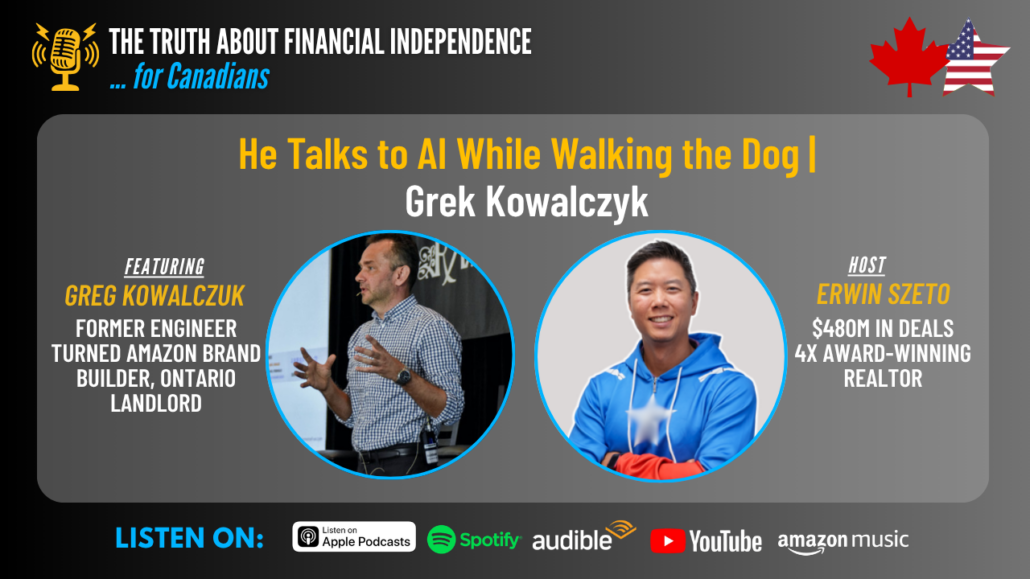
How an Ontario Investor Built Two Apps for $800 With AI
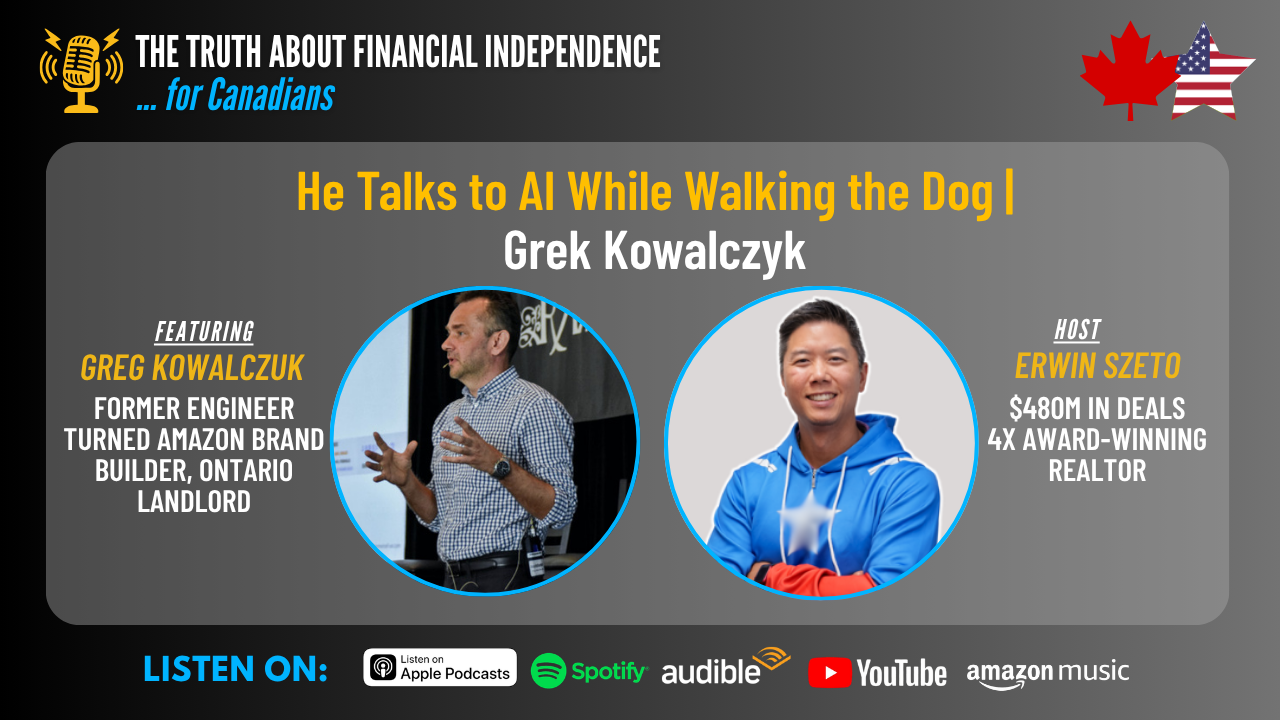
By Erwin Szeto | Co-Founder, iWIN Wealth Planning
Recorded: May 2026
Host: Erwin Szeto, Truth About Financial Independence for Canadians
Guest: Greg Kowalczyk, former design engineer turned full-time entrepreneur.
If you’d told me a year ago that a guy I’ve known for over a decade, an engineer with almost no coding background, would build two fully functional iPhone apps for the price of a nice dinner for four, I’d have nodded politely and changed the subject. This week’s guest on The Truth About Financial Independence for Canadians is Greg Kowalczyk. Greg’s a former design engineer who became an Ontario landlord, then an Amazon brand builder, and over the last twelve months has quietly become one of the most practical AI users I know.
The numbers he’s putting up aren’t theoretical. They’re real, they’re his, and they should change how you think about what’s possible in your own business and your own portfolio.
The $800 question
Greg built two apps that are live on the Apple App Store today. RunMate Pro tracks runs and the mileage on your running shoes. The other is a sun-protection index app for his e-commerce brand Gear Top, which tells you how long it’s safe to be outside.
Built the old way, with a developer? Greg’s estimate: fifty to seventy thousand dollars. Months of meetings. Revisions. Scope creep.
Built the new way, with Greg talking to AI while walking his dog? About eight hundred dollars in tokens. A few months of his time, mostly evenings and weekends, while still running his businesses.
“If you paid developers, you’d probably spend $50,000 to $70,000 just to design those two apps. I calculated what it actually cost me, without my time, at about $800.”
That isn’t a one-off. It’s a pattern that runs through everything Greg’s been doing.
Replacing a $5,000 photo shoot
Greg’s e-commerce brand Gear Top sells sun-protection apparel. Hats, gloves, balaclavas. His original product, a balaclava launched in 2014, still has nearly 7,000 reviews on Amazon. Another hat in the lineup has over 26,000 reviews. To get the product photography for these listings, Greg used to do what every serious Amazon seller does. Rent a studio downtown. Book a photographer. Hire models, sometimes four or five of them at once, including kids. Shoot all day. The going rate? Three to five thousand dollars per session. Plus the photographer’s processing fees. Plus, the time to organize everyone in one place for the twelve hours of shooting.
Today, Greg generates almost all of his product imagery with AI. He uses Gemini’s Nano Banana model for stills and Veo for video. He’ll create a character once, then have the AI reproduce that same character across multiple scenes for a cohesive look. For a recent product launch on a new line of nasal strips, his cousin in Poland used the same approach to produce a thirty-five second animated commercial. Five clips of about eight seconds each, stitched together.
The packaging design for the kids’ version of those nasal strips? Designed with AI. The mascot characters in the videos? AI-generated. The fifteen-second hero clip you’d have paid an agency four or five figures for? Generated overnight.
“We used to pay $3,000 to $5,000 a session for a photographer and models. Now I just talk to AI and get what I want.”
For an Amazon seller, that’s not a productivity gain. That’s a margin expansion.
A website built while you sleep
Greg owns the domain gregkowalczyk.com. He registered it back in 2013. For over a decade, the site sat dormant because building a personal site felt like too much work. Hire a developer, pay them, manage them, get something he didn’t really love, repeat.
One weekend last year, he decided to try something different. He wrote a script telling the AI what he wanted. A personal site with all his projects, all his links, all his work. Then he let it run in a loop, what’s called a “Ralph loop,” overnight. He woke up the next morning to a finished website.
He uses the same approach for the Bronte Harbour Classic, the inaugural 5k race he’s putting on in Oakville this year. The website, the sponsor pages, the registration integrations, all of it built by Greg with AI assistance. When I asked him last week to add a clearer age-range explanation to the kids’ race, he made the change from his desk in about ten minutes. The AI updated multiple pages and even created a new one to host additional details. It also logged into the third-party registration platform and made the matching changes there.
A web developer would have taken a week to do that work and probably missed a spot or two.
Dashboards instead of software subscriptions
Here’s the part that should make your ears perk up if you own any SaaS stocks.
Greg used to pay for QuickBooks’ mileage-logging module. He found it overcomplicated, frustrating, and a bad fit for how he actually wanted to log mileage. So he built his own. Voice-driven, simple, designed around his workflow. He’s already cancelled QuickBooks’ module.
He used to pay for analytics dashboards for his e-commerce businesses. Now he builds his own dashboards. He gets direct access to the underlying data source, pulls the metrics he cares about, and lays them out exactly the way he wants to see them.
“I don’t have to build software anymore. I build dashboards. I just get direct access to the software I need the numbers from, pull out the analytics, and put them the way I want to see them. Once I build it, that’s my software.”
This is a small business owner replacing line items on his monthly P&L with custom-built tools that fit his business better than the off-the-shelf product ever did. Multiply that across millions of small businesses and you start to understand why some software companies are watching their stock prices come down hard from the peak. A lot of my friends I trust think we’re nowhere near the bottom for legacy SaaS.
The Ontario landlord chapter
The real estate sub-thread on this episode is just as interesting, and just as practical. Greg’s been an Ontario landlord since 2012. His first property was an RTO deal in Cambridge that I covered the home inspection on, before I really knew him. He’s owned student rentals in Hamilton and Kitchener, single-family rentals in St. Catharines, and converted two properties into legal duplexes in 2022 and 2023.
Why convert? Cash flow. When his mortgage renewals hit just after COVID, the math on a property charging $1,800 in rent stopped working. So instead of selling, he refinanced two properties and used the equity to build two basement suites. The Hamilton conversion cost about $220,000 because it was a full gut job, complete with the famous (now) discovery of a backyard marijuana plantation he had to chop down and put out with the lawn waste.
He’s still holding the portfolio. But he’s also realistic about the experience.
“Nothing can challenge me anymore. We had eviction, we had flooding, we had fire. Flooded toilet? That’s just Tuesday.”
If you’ve been a Canadian landlord through the last few years, that line lands a little too hard.
His current AI-related side project in the real estate space? Auto-populating LTB forms. Anyone who’s filled out a Landlord and Tenant Board application by hand knows exactly how big a win this would be.
What Greg told the listener who hasn’t started
I asked Greg my standard close-of-show question. If somebody listening hasn’t done anything with AI yet, where should they start?
His answer was characteristically practical. Three steps.
- Step one: install one of the tools. ChatGPT, Claude, Gemini, doesn’t really matter. The regular chat is fine.
- Step two: go deeper than chat. Use the research modes. If there’s a topic you’ve been curious about, ask the AI to do a deep research run on it. Read the result.
- Step three: turn the research into a deliverable. A summary. A slide deck. A one-page PDF. A landing page. The point isn’t the deliverable itself. The point is that by going from raw output to finished asset, you discover the real range of what these tools can do.
“You have almost the smartest agent in the world in your pocket. He’s like a PhD professor, available 24/7. Just ask him whatever you like.”
That’s the soundbite I want every podcast listener to walk away with. Not “AI is the future” in the abstract. Just: there’s a tool in your pocket that knows almost everything, and most people are barely using it.
Where this fits into the bigger picture
The TAFI thesis is that there’s more than one path out of the rat race. Real estate is one. Building or buying a business is another. The stock market is another. Investment loans are another. AI is now one of the most powerful tools you can lay across any of those paths to accelerate the math.
Greg’s the proof. He didn’t pick AI as a new asset class. He picked it as a tool to make every asset class he already plays in cheaper and faster to operate. His e-commerce business runs at a fraction of its previous photo and video budget. and his race event runs with a one-person marketing team. His real estate portfolio is about to have an LTB form filler that none of his competitors will have built for themselves.
If you’re an Ontario investor who’s tired of the landlord life and looking for what’s next, here’s a model: keep what’s still working, get creative on the rest, and use AI to compound everything you build from here. And if part of “what’s next” for you is growing wealth beyond the rentals without buying another property, that’s exactly what I cover in my next free training.
Join the next free training
This Saturday — May 30, 2026 — I’m hosting a free training called the Zero-Down Wealth Strategy. It’s hybrid: in-person at the iWIN office in Oakville, or join on Zoom from anywhere. Hard start at 9:00am Eastern, hard stop at 10:30am.
In those 90 minutes, I’m walking through:
- The complete $100,000 investment loan structure
- The math — what $433/month actually buys you over 5 and 10 years
- Every loss scenario — what happens when the market drops 20%, 30%, 40%
- How this fits alongside (not replacing) a real estate portfolio
- Live Q&A — bring questions, bring skepticism
In-person seats are capped at 40 people and they always go. If you want to be in the room, register today.
Saturday May 30 — Hybrid (Oakville + Zoom): infinitywealth.ca/20260530
Tuesday June 2 — Zoom only at 8pm Eastern: infinitywealth.ca/2026060
Both events cover the same content. Pick whichever fits your schedule.
To Listen:
Audible: https://www.audible.ca/pd/B0H2W56826?source_code=ASSGB149080119000H&share_location=pdp
You’ve Built Wealth. Now It’s Time to Understand It.
You’ve Built Wealth. Now It’s Time to Understand It.
After dozens of consultations, I’ve noticed the same pattern again and again: most investors have built real wealth, but they’re not confident they can retire from it. They’re sitting on $2M–$5M in property but feel cash-flow poor. They’re paying more tax than they should because everything is held in personal names. They have no liquidity, no insurance strategy, and no clear plan for what happens if something happens to them. And almost every single client tells me the same thing: “I don’t actually know what retirement looks like for us.”
Real estate builds equity, but it doesn’t automatically build freedom. Without a coordinated plan for taxes, income, protection, and exit strategy, investors often end up working harder in retirement than they did in their 30s. That’s why I created the Wealth Freedom Blueprint – a simple, practical guide to help you understand where you stand today, what gaps are costing you money, and how to turn the wealth you’ve built into a life you can actually live.
Download your free Wealth Freedom Blueprint
Final Thoughts
Whether you’re building wealth, protecting it, or preparing to transition it, you deserve a clear, tax-smart strategy that works in real life.
That’s what iWIN Wealth Planning is here for.
This is how we’re creating predictable, stress-free wealth for Canadian families…
so you can enjoy the life you’re building.
Book your Wealth Planning Call
Sponsored by… Me!
This episode isn’t sponsored—except by my wife Cherry and me. Real estate investing is our life. It’s helped us build wealth and achieve peace of mind about retirement and our children’s future.
Till next time—just do it. I believe in you.
Erwin Szeto
W: erwinszeto.com
FB: facebook.com/erwin.szeto
IG: @erwinszeto
Disclaimer
As a committed advocate for transparent and responsible investing, I want to disclose that I am an Advisor to SHARE SFR (Single Family Rental). I hold equity in the company and earn referral commissions from clients I refer.
My endorsement of their model—focusing on positive cash flow and direct ownership—is based on personal experience and belief. Still, every investor should do their own due diligence.


Leave a Reply
Want to join the discussion?Feel free to contribute!