
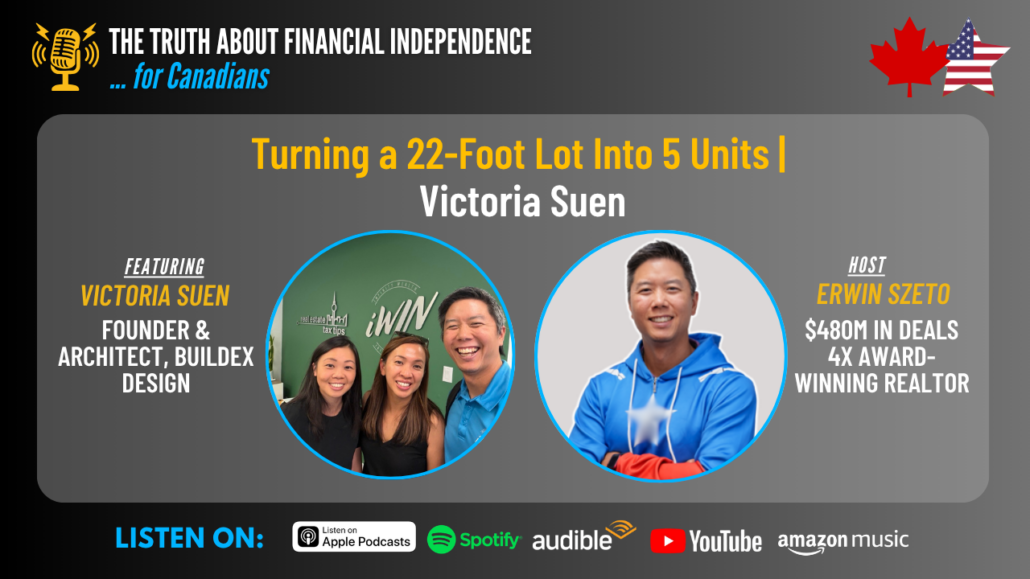
Turning a 22-Foot Lot Into 5 Units: Victoria Suen on the Missing Middle, and What It Actually Costs to Build One
By Erwin Szeto | Co-Founder, iWIN Wealth Planning
Recorded: September 2026
Host: Erwin Szeto, The Truth About Financial Independence for Canadians
Guest Host: Cherry Chan, CPA
Guest: Victoria Suen, Founder, BuildEx Design
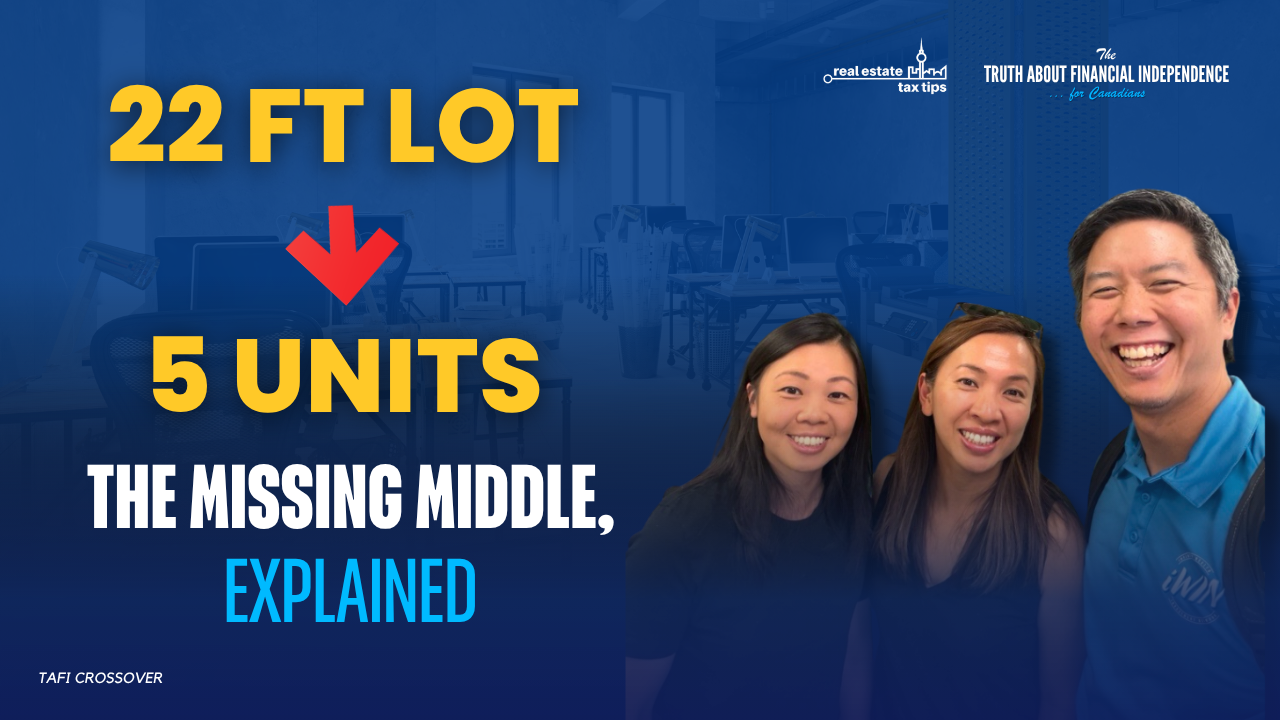
This episode is a bit different. My wife and business partner, Cherry Chan, sat down with this week’s guest for her own channel, Real Estate Tax Tips, and the conversation covered ground I wanted every TAFI listener to hear. Consider this a crossover.
Victoria Suen bought her first investment property in 2011, in Mississauga, at 19 years old. She couldn’t qualify for a mortgage on her own, so her sisters signed for it and she came in as a part investor, contributing the money. The property cost $260,000. She calls it beginner’s luck. It might have been. But 16 years later, she’s a licensed architect and the founder of BuildEx Design, and she’s turned that early real estate interest into a firm that helps investors do exactly what she once needed a mortgage for: build wealth on a piece of land.
What Victoria’s firm does now is different from a typical architecture practice. BuildEx works almost exclusively with what’s called the missing middle, and Cherry asked her to define it from scratch.
What Is the Missing Middle, and Why Did It Disappear
For most of a city’s history, housing came in 2 extremes: single family homes in the suburbs, and high rise condo towers downtown. The middle ground, duplexes, triplexes, fourplexes, and mid-rise apartments, mostly stopped getting built. Not because nobody wanted it. Because zoning stopped allowing it.
That’s changing. Victoria’s explanation is straightforward: continuing to sprawl outward means more roads, more schools, more fire stations, and more water servicing, all for the same number of people. Cities like Tokyo, New York, and London never built that way. They grew inward instead. Canadian cities are now doing the same thing, loosening zoning rules that used to require a single family home on every lot.
22 Feet Wide, 5 Units: What Toronto Allows Now
The specifics surprised even Cherry. In Toronto, Victoria’s team is designing buildings on lots as tight as 22 feet wide by 120 feet deep, and fitting 5 units on them. Nine wards in the city now allow up to 6 units with no special permission required, as long as the building fits the lot through standard setback rules.
There’s no parking requirement in Toronto for these projects, which is what makes the density possible in the first place. Victoria still asks every client whether their tenants will realistically need a parking spot, because building without it in the wrong location backfires at lease-up. Ottawa is going further: the city is eliminating its parking requirement entirely, effective September 2026.
The 3 Moving Parts Investors Get Wrong
Victoria breaks a missing middle project into 3 questions that all move at once: what can be built on the land, what it costs, and who will finance it. That means coordinating an architect, a general contractor, and a mortgage broker simultaneously, and Victoria says getting all 3 people pointed in the same direction is often the hardest part of a first project. BuildEx now offers a feasibility service specifically to solve that coordination problem before a client commits.
From design to permits typically takes about 5 months. Construction runs another 10 to 12 months. All in, Victoria tells clients to budget a year to a year and a half, assuming no surprises.
CMHC’s MLI Select: Where the Real Money Is
The financing detail that stood out most: a fourplex plus a garden suite, 5 units total, or a 6-plex, qualifies for CMHC’s MLI Select program. That unlocks 2 things. First, waived development charges, which Victoria puts at $50,000 to $80,000 per unit. On a 5 unit project, that’s $250,000 or more the city simply doesn’t collect. Second, more favorable financing terms than a conventional commercial mortgage.
On loan-to-value, Victoria was careful to correct a number that gets thrown around: while MLI Select theoretically allows up to 95% loan-to-value, she says almost none of her actual clients get there. The rent numbers don’t support it. Most are landing at 80 to 85% loan-to-value against the appraised value, which still means an investor can put in perhaps $1 million to $1.5 million in construction costs on top of a $1 million lot, end up with a building appraised at $4 million to $5 million, and pull the majority of that capital back out through refinancing. Victoria’s typical client is left with roughly $100,000 still in the deal.
This isn’t a flip. It’s a long-term hold, financed through a 5 or 10 year CMHC mortgage term, with most owners refinancing and holding rather than selling.
The Mistake Investors Keep Making
Ask Victoria for the most common error and she doesn’t point to construction cost. She points to rent. Investors project the top of the market, say $3,500 a month for a 3 bedroom unit, without checking whether tenants in that location will actually need a parking spot they don’t have. When the unit doesn’t rent at that number, it comes down, sometimes to $3,000, and at a 4% capitalization rate that $500 monthly gap moves the building’s valuation significantly.
Cheaper Entry Points Exist Too
Not every missing middle project needs to hit CMHC’s MLI Select thresholds. Victoria is seeing more investors buy properties for $600,000 in Toronto’s outskirts, or in Hamilton and Niagara, and do smaller duplex or triplex conversions that still cash flow without the scale of a full 5 or 6 unit build.
What’s Behind the Walls
The biggest renovation risk, in Victoria’s experience, is what you can’t see until demolition starts. On one project, her team planned to remove a roof and add stories, tying new construction into the existing foundation. Once the walls came down, the foundation turned out to be crumbling and had to be re-engineered from scratch, an unforeseen cost. New construction avoids that risk but comes with its own tradeoff: tearing down a century home means meeting current zoning in full, sometimes on a smaller footprint, and often requires shoring, temporary structural support to hold back the land when a new foundation goes in tight against a neighboring building.
Why She Started Her Own Firm
Cherry closed with a question that had nothing to do with zoning: why start a business at all, given the headaches Victoria had just spent 30 minutes describing? Victoria’s answer traced back to that 2011 property in Mississauga. She had an entrepreneurial itch that architecture school, and traditional architecture firms, didn’t make room for. Starting BuildEx let her combine the technical training with the business instincts she couldn’t exercise inside someone else’s practice.
Her honest answer on the biggest surprise of running it: how much of the job is personal development. Whatever goes wrong in the business tends to trace back to her as the owner, whether she’s ready to admit that or not.
Quick Answers
What is the missing middle in housing?
It’s the housing type between single family homes and high rise condos: duplexes, triplexes, fourplexes, and mid-rise buildings, which zoning rules stopped allowing for decades.
How many units can you build on a Toronto lot?
Some lots as narrow as 22 feet can fit 5 units. Nine wards in Toronto now allow up to 6 units with no special permission required, and there’s no parking requirement.
What is CMHC MLI Select and why does it matter?
It’s a CMHC financing program for projects of 5 or more units. It waives development charges, worth roughly $50,000 to $80,000 per unit, and offers more favorable financing terms than a conventional mortgage.
How much capital do investors typically need to leave in a missing middle project?
Victoria’s clients typically get 80 to 85% loan-to-value after refinancing, and are left with around $100,000 still invested in a project appraised at several million dollars.
Join Me Live: Free Training on the $100,000 Investment Loan Strategy
Victoria’s path started with real estate, but this show has always been about more than one strategy. If you want to see how Cherry and I think about building a second wealth engine alongside — or instead of — property, join me live
Here is exactly what I will walk through in 90 minutes:
- The complete $100,000 investment loan structure
- The math — what $433 a month actually buys you over 5 and 10 years
- Every loss scenario — what happens when the market drops 20%, 30%, 40%
- How this fits alongside, not replacing, a real estate portfolio
- Live Q&A — bring your questions, bring your skepticism
Two dates to choose from. Both cover the same content — pick whichever fits your schedule.
Saturday September 12th, Hybrid (Oakville + Zoom) — 9:00am ET, hard stop 10:30am. In-person seats are capped at 40 and they always go. If you want to be in the room, register today.
Tuesday, September 15th – 8:00pm ET.
The Bottom Line
I didn’t record this one. Cherry did, and I’m glad she brought it back to TAFI. Victoria’s story starts the same way a lot of ours did, a first property bought too young to qualify for the mortgage herself, and ends somewhere none of us could have predicted from that starting point: a firm helping other investors do the same thing at a scale and financing structure that didn’t exist when she started.
The missing middle is one more example of what this show is about now. Not just rentals. Every legitimate path that gets someone out of the rat race, including the one where you learn to read a zoning bylaw.
To Listen
Audible: https://www.audible.ca/pd/B0HHF7J7YR?source_code=ASSGB149080119000H&share_location=pdp
You’ve Built Wealth. Now It’s Time to Understand It.
After dozens of consultations, I’ve noticed the same pattern again and again: most investors have built real wealth, but they’re not confident they can retire from it. They’re sitting on $2M–$5M in property but feel cash-flow poor. They’re paying more tax than they should because everything is held in personal names. They have no liquidity, no insurance strategy, and no clear plan for what happens if something happens to them. And almost every single client tells me the same thing: “I don’t actually know what retirement looks like for us.”
Real estate builds equity, but it doesn’t automatically build freedom. Without a coordinated plan for taxes, income, protection, and exit strategy, investors often end up working harder in retirement than they did in their 30s. That’s why I created the Wealth Freedom Blueprint – a simple, practical guide to help you understand where you stand today, what gaps are costing you money, and how to turn the wealth you’ve built into a life you can actually live.
Download your free Wealth Freedom Blueprint
Disclaimer:
As a committed advocate for transparent and responsible investing, I disclose that I am an Advisor to SHARE SFR (Single Family Rental). I hold equity in the company and earn referral commissions from clients I refer. I am also a licensed insurance agent with Open Concept Financial Group. The investment loan strategies referenced in this post are for educational purposes only and are not a guarantee of approval or performance. Suitability depends on individual income, cash flow, risk tolerance, and goals. Past performance is not indicative of future results. Every investor should do their own due diligence.
Sponsored by… Me!
This episode isn’t sponsored—except by my wife Cherry and me. Real estate investing is our life. It’s helped us build wealth and achieve peace of mind about retirement and our children’s future.
Till next time—just do it. I believe in you.
Erwin Szeto
W: erwinszeto.com
FB: facebook.com/erwin.szeto
IG: @erwinszeto
Disclaimer
As a committed advocate for transparent and responsible investing, I want to disclose that I am an Advisor to SHARE SFR (Single Family Rental). I hold equity in the company and earn referral commissions from clients I refer.
My endorsement of their model—focusing on positive cash flow and direct ownership—is based on personal experience and belief. Still, every investor should do their own due diligence.


Leave a Reply
Want to join the discussion?Feel free to contribute!