He Exited His Ontario Real Estate & Podcast To Build REI Businesses | Andrew Hines
By Erwin Szeto | Co-Founder, iWIN Wealth Planning
Recorded: July 2026
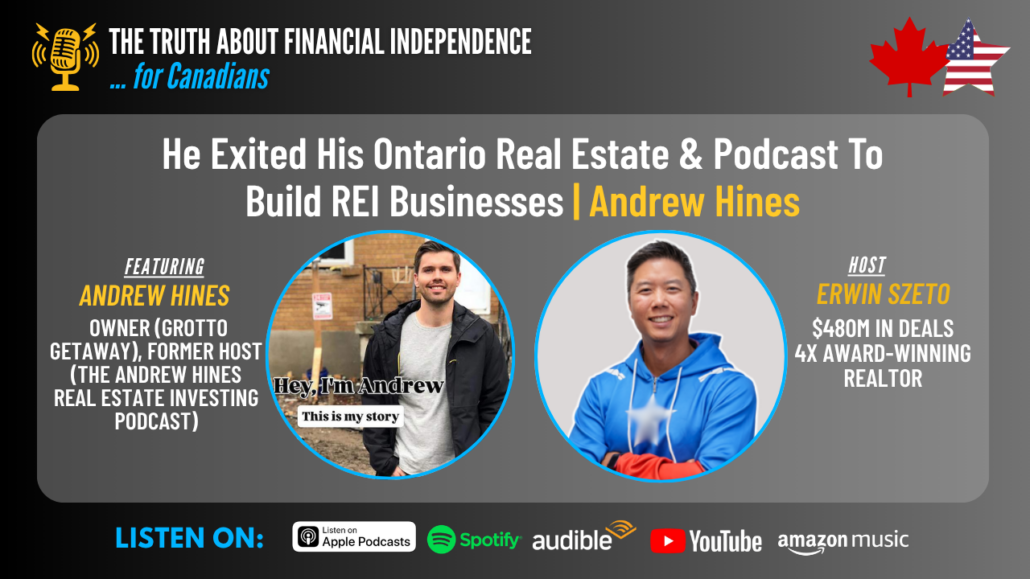
Host: Erwin Szeto, The Truth About Financial Independence for Canadians
Guest: Andrew Hines, co-founder of multiple US-based real estate acquisition companies, owner of Grotto Getaway, former host of The Andrew Hines Real Estate Investing Podcast.
Andrew Hines spent 5 and a half years building one of Canada’s top 3 real estate podcasts, alongside the host’s own show and Break Through Podcast. The Andrew Hines Real Estate Investing Podcast reached nearly 1.3 million downloads. Then, in 2023, at what looked from the outside like its peak, Andrew shut it down.
He joined Erwin on The Truth About Financial Independence for Canadians to explain why, and to talk about what he built next: a US-based real estate business spanning house flips, land flips, and creative finance deals across Florida, Georgia, Texas, North Carolina, and Tennessee, plus Grotto Getaway, a glamping and cottage resort near Tobermory, Ontario, that did $655,000 in sales last year.
Why He Walked Away From the Podcast
For the first 2 and a half years, growth was steady, roughly 33% year over year. Meetups regularly drew 100 to 110 people on a random Wednesday night. Then interest rates rose. Guests stopped returning messages. By April 2023, one meetup that used to draw a full room pulled in 70 to 80 people, a noticeable drop, and interest kept falling from there.
Andrew’s second son was due that November. He made the call to end the podcast in August, recorded a final episode 2 days later, and stepped away.
Andrew hasn’t ruled out doing more, and he’s released occasional US investing episodes since, but the daily grind of the format was costing him money and had stopped being fun. He credits Erwin and Sarah Larbi with continuing to push through the same headwinds.
Selling Everything in Ontario
Andrew’s Ontario portfolio was built around student rentals in London, Ontario, in a neighborhood locally known as Soho. In 2015, he bought a single detached house there for $105,000, the cheapest property he owned. His student rental buys ran around $200,000, and additions expanded them to 900 to 1,100 square feet, pushing their value up to roughly $600,000.
After the 2020 lockdowns, Andrew started rethinking his exposure. He loved student rentals from a management standpoint, but he saw a long-term risk in combining that asset class with the government’s willingness to shut things down. so, he decided Canada wasn’t going to be his long-term investing home, and he sold off the portfolio gradually, redirecting the capital into new construction in Cape Coral, Florida, and into Grotto Getaway.
Andrew and his family are now in the process of establishing US tax residency, a move he’s discussing with his accountant.
Building the US Business
Andrew’s team runs 2 parallel businesses: house and land flips, and a course teaching Canadians how to do the same. Acquisitions agents work inbound seller leads generated through cold calling, Meta ads, and direct mail. Independent contractor realtors help close deals. A project manager and part-time admin round out the flipping side.
His team finds motivated sellers using public US data unavailable in Canada, including tax liens, mechanics liens (any lien from a contractor, not just an auto mechanic), and notices of pending foreclosure. One core target group: tired landlords.
Two deals from the conversation stand out. In Morrow, Georgia, Andrew’s team bought a rundown property for $95,000. Their realtor said she had to shower after walking through it. An $82,000 renovation, mostly cosmetic with no major mechanical work, brought it to market, and it sold to an investor for $237,000.
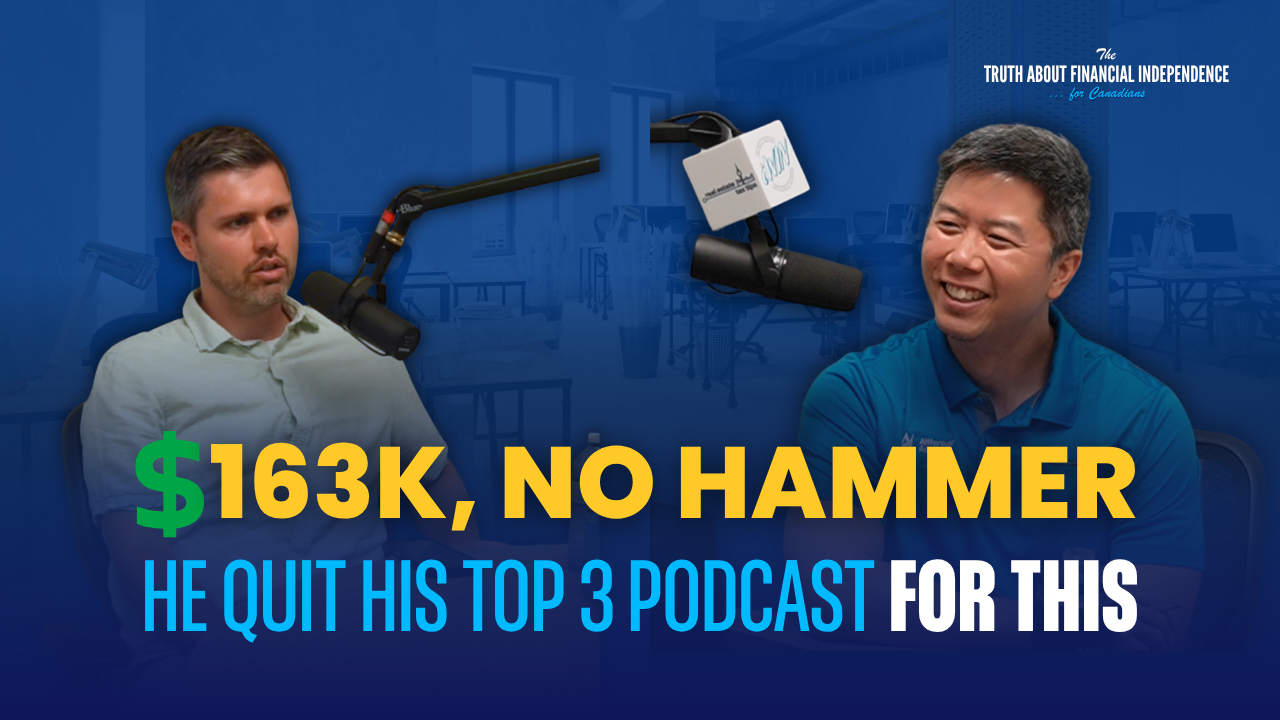
In Jacksonville, Florida, his team bought a 47-acre parcel of land from a motivated seller who had originally purchased it for his daughter’s development plans. They spent just $5,000 clearing junk from the site, held it for about 20 days, and sold it for $478,000. No hammer, no plumber, no utility company calls. Profit: $163,000.
Andrew is careful to note that deal isn’t typical. He estimates his team lands something in that range roughly once every other year.
Why Ontario Real Estate, But Not US Real Estate
Andrew has no interest in buying residential real estate in Ontario again. In the US, he still buys residential, both for flips and for the occasional subject-to deal his team can’t say no to. The difference, he says, comes down to landlord protections. Landlord-friendly US states can move a non-paying tenant out in a couple of months. In Ontario, that same process can take years.
Construction economics tell a similar story. In 2023, Andrew’s team was building new construction in Cape Coral for roughly $105 per square foot in hard costs. Ontario hard costs at the same time ran $200 to $250 per square foot. He estimates Florida costs today sit closer to $125 per square foot, still a fraction of what a comparable garden suite costs to build in Ontario.
The New Rules for Real Estate Investors
Andrew’s read on the current market: the era of buying a cheap duplex, refinancing a year later, and repeating the cycle into a multi-million-dollar portfolio is over. What’s still alive is entrepreneurship. He describes his own flipping business less as real estate investing and more as marketing and business building.
His advice for investors deciding what to do next: don’t go into anything expecting it to be passive from day 1. Build toward passive. Delegate the repetitive parts. Understand the value of your own time. Real estate investors, he says, were always small business owners. The difference now is the down payment isn’t the only thing standing between you and the work.
Grotto Getaway: A Business Built for a Different Kind of Guest
Away from real estate, Andrew owns Grotto Getaway, a glamping and cottage resort near Tobermory, Ontario. It started with prospector-style bell tents costing $10,000 to $12,000 to install. The property is zoned for 70 sites. Andrew’s team has developed 30 of them so far.
Last year, Grotto Getaway did $655,000 in sales, roughly 60% growth over the year before, and that was before the property’s amenities even opened. A single unit typically pays for itself in its first year and generates $20,000 to $25,000 annually once stabilized.
Direct bookings account for 60% to 70% of reservations, sparing the business the 16% to 19% commission charged by platforms like Airbnb, Booking.com, and VRBO. Google reviews sit at 4.8 out of 5 stars. One older trailer, bought for $7,800 and renovated for roughly $10,000, has generated about $25,000 a year for 4 straight years.
The business runs heavily on Instagram, including collaborations with local influencers and occasional giveaways, one of which generated over 1 million views and 45,000 comments. The team currently employs 11 people, with more hiring planned for the summer season, including free trailer accommodation for seasonal staff.
Andrew also notes a recent tailwind: shifting Canadian travel sentiment away from the US has driven more domestic bookings to Grotto Getaway, even as the same exchange rate dynamics raise his Florida construction costs.
Frequently Asked Questions
Why did Andrew Hines shut down his real estate podcast? Guest interest and listenership both dropped sharply starting in 2023. Andrew made the call in August 2023 and recorded his final episode 2 days later.
Does Andrew Hines still own real estate in Ontario? No. He sold his entire student rental portfolio in London, Ontario, after reassessing his risk tolerance following the 2020 lockdowns.
What states does Andrew Hines invest in? His team operates primarily in Florida, Georgia, Texas, North Carolina, and Tennessee, with land business expansion underway in Alabama.
What is Grotto Getaway? A glamping and cottage resort near Tobermory, Ontario, that did $655,000 in sales last year with a team of 11.
Join Me Live: Free Training on the $100,000 Investment Loan Strategy
I’m hosting a free training on the strategy that produced the returns I mentioned above.
Here is exactly what I will walk through in 90 minutes:
Live Q&A — bring your questions, bring your skepticism
The complete $100,000 investment loan structure
The math — what $433 a month actually buys you over 5 and 10 years
Every loss scenario — what happens when the market drops 20%, 30%, 40%
How this fits alongside, not replacing, a real estate portfolio
Register Here: Saturday, September 12th Hybrid: Inperson and Zoom
The Bottom Line
Andrew Hines didn’t wait for Ontario real estate to work again. He read the shift in landlord protections, construction costs, and government risk, and he moved his capital and his business model somewhere friendlier to both. His podcast didn’t survive the same shift in Canadian real estate sentiment that’s driving TAFI’s own rebrand, but his business did, because he stopped treating real estate as something to hold and started treating it as something to build.
For investors weighing whether to keep waiting on Ontario rents to catch up, or to build something new instead, Andrew’s answer is clear: this is the age of the business builder, not the passive landlord.
To Listen
Audible: https://www.audible.ca/pd/B0H8PSNDJZ?
You’ve Built Wealth. Now It’s Time to Understand It.
After dozens of consultations, I’ve noticed the same pattern again and again: most investors have built real wealth, but they’re not confident they can retire from it. They’re sitting on $2M–$5M in property but feel cash-flow poor. They’re paying more tax than they should because everything is held in personal names. They have no liquidity, no insurance strategy, and no clear plan for what happens if something happens to them. And almost every single client tells me the same thing: “I don’t actually know what retirement looks like for us.”
Real estate builds equity, but it doesn’t automatically build freedom. Without a coordinated plan for taxes, income, protection, and exit strategy, investors often end up working harder in retirement than they did in their 30s. That’s why I created the Wealth Freedom Blueprint – a simple, practical guide to help you understand where you stand today, what gaps are costing you money, and how to turn the wealth you’ve built into a life you can actually live.
Download your free Wealth Freedom Blueprint
Disclaimer:
As a committed advocate for transparent and responsible investing, I disclose that I am an Advisor to SHARE SFR (Single Family Rental). I hold equity in the company and earn referral commissions from clients I refer. I am also a licensed insurance agent with Open Concept Financial Group. The investment loan strategies referenced in this post are for educational purposes only and are not a guarantee of approval or performance. Suitability depends on individual income, cash flow, risk tolerance, and goals. Past performance is not indicative of future results. Every investor should do their own due diligence.
Sponsored by… Me!
This episode isn’t sponsored—except by my wife Cherry and me. Real estate investing is our life. It’s helped us build wealth and achieve peace of mind about retirement and our children’s future.
Till next time—just do it. I believe in you.
Erwin Szeto
W: erwinszeto.com
FB: facebook.com/erwin.szeto
IG: @erwinszeto
Disclaimer
As a committed advocate for transparent and responsible investing, I want to disclose that I am an Advisor to SHARE SFR (Single Family Rental). I hold equity in the company and earn referral commissions from clients I refer.
My endorsement of their model—focusing on positive cash flow and direct ownership—is based on personal experience and belief. Still, every investor should do their own due diligence.


Leave a Reply
Want to join the discussion?Feel free to contribute!