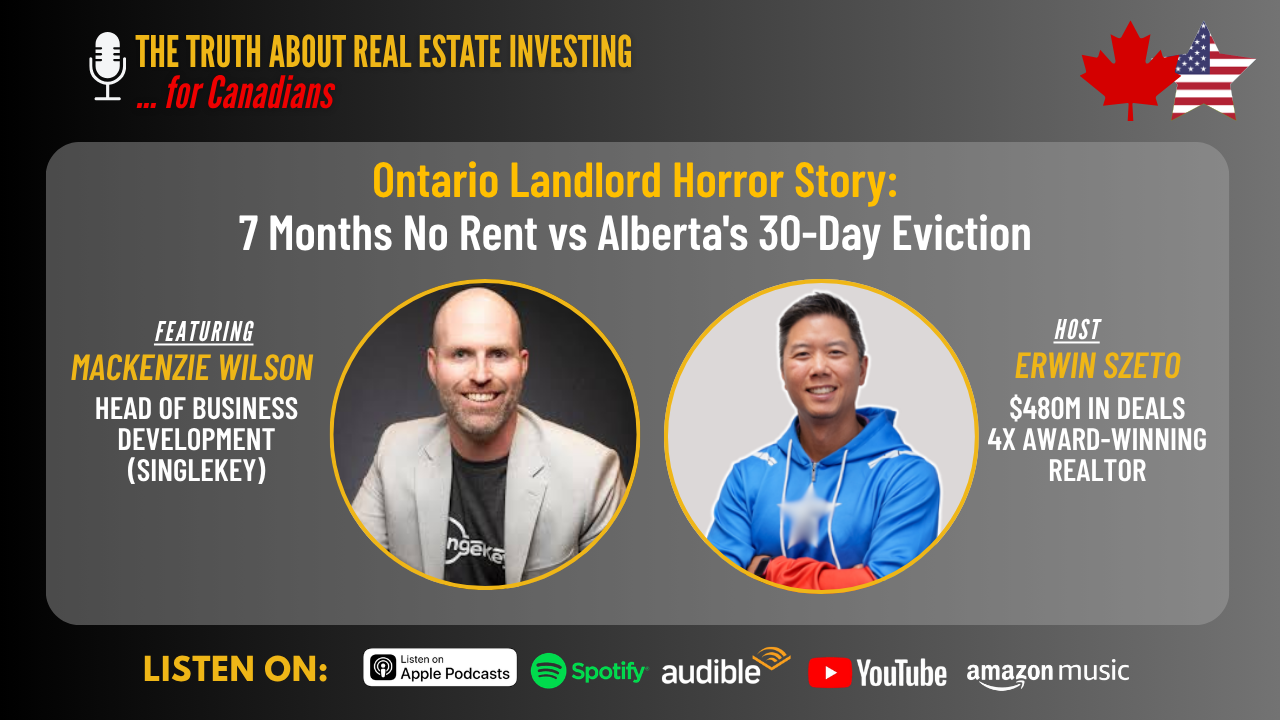
Quitting Government After 22 Years: Luis Rivas’ Journey from Speculator to Real Estate Coach

Recorded: September 2025
Guest: Luis Rivas
Host: Erwin Szeto, The Truth About Real Estate Investing for Canadians Podcast

After 22 years in the federal government, Luis Rivas made a bold move—he retired early, cashed in his pension, and pivoted into real estate investing and coaching. In this episode, Luis shares how he went from speculating on Ottawa condos to building a multifamily portfolio across Canada and the U.S., and eventually becoming a head coach at WealthGenius. 

Luis opens up about the emotional toll of leaving a secure job, the lessons learned during COVID, and the mindset shift required to thrive as an investor. He breaks down his strategy for underwriting multifamily deals, targeting 5–6% cap rates, and why he’s now looking south of the border for better returns and landlord-friendly policies. 

We also dive into the challenges of being a landlord in Ontario, the importance of property management, and why Canadians must invest to secure their retirement. Luis shares his formula for calculating how big your portfolio needs to be to hit your lifestyle goals—and why legacy planning matters more than ever. 

📍 Catch Luis at the Expand Conference in Mississauga, October 31–November 2, where he’ll be speaking alongside top investors. 
🎤 I, Erwin Szeto, will also be speaking at the event. 
📲 Connect with Luis: Instagram & YouTube — @cashflow.rivas 


Real Estate Investing & Coaching with Luis Rivas: Top Questions

  1. How did Luis Rivas transition from government work to real estate investing? 
    He retired early during COVID, cashed in his pension, and began coaching while building a multifamily portfolio. 
  1. What was Luis Rivas’ first real estate investment? 
    Two pre-construction condos in Ottawa, which he later sold due to poor cash flow and lack of appreciation. 
  1. Why does Luis prefer multifamily properties over condos? 
    Multifamily offers better cash flow, scalability, and commercial financing options, especially in secondary markets. 
  1. What cap rate does Luis target in his investments? 
    He aims for 5–6% cap rates, with property management included in the underwriting. 
  1. Why is Luis looking to invest in the U.S. market? 
    U.S. markets offer better cap rates, landlord-friendly laws, and more scalable property management systems. 
  1. What advice does Luis give to new investors? 
    Get educated, join a community, and design your portfolio based on your lifestyle goals—not arbitrary door counts. 
  1. How does Luis calculate the size of a portfolio needed for retirement? 
    He uses a formula based on monthly income goals, cash-on-cash return, and equity share to determine total portfolio value. 
  1. What are the risks of investing in rural or tertiary markets? 
    Limited financing, property management, and appreciation can cripple deals if not properly managed. 
  1. What is Luis’ take on Ontario’s rent control policies? 
    He believes they unfairly burden landlords and discourage investment, pushing many to look outside Ontario. 
  2. What asset classes is Luis exploring next? 
    He’s researching self-storage and care homes, especially in Texas, for their automation potential and lack of rent control. 

📜 Full Transcript

The full, cleaned transcript of my conversation with Luis is available here for anyone who wants to dive deeper into his journey as a real estate investor

To Listen:

On iTunes: https://podcasts.apple.com/ca/podcast/pensions-vs-real-estate-which-really-builds-wealth/id1100488294?i=1000729706240

On Spotify: https://open.spotify.com/episode/7FtMpPavD0xMB8riqiayGc?si=WFCkN9wDTu-GJo8sf8Jhxw&nd=1&dlsi=3d5328e1d2b54a60

Amazon Music: https://music.amazon.ca/podcasts/40fe627d-dec7-4f5d-b7e5-90a550fffe46/episodes/41112347-107b-407a-ab97-b7a674773e7b/the-truth-about-real-estate-investing-for-canadians-pensions-vs-real-estate-which-really-builds-wealth

Audible: https://www.audible.ca/pd/B0FTMP1RMM?source_code=ASSGB149080119000H&share_location=pdp

YouTube: https://youtu.be/mWBef5KN5W4

🦸‍♂️Household Hero? Here’s Your Next Step

If you’re a Canadian investor trying to build wealth safely and sustainably, Adam’s journey has valuable takeaways.

It might be time to revisit your current strategies—real estate, lending, or insurance—and ask:

  • Do your investments match your long-term goals?
  • Do you fully understand how your strategies work?
  • Would a more conservative approach offer better peace of mind?

Real estate remains a powerful tool for building wealth, especially with careful underwriting and due diligence. Insurance can be useful too—but only if it supports your broader financial goals.

Need help with conservative, peace-of-mind investing—backed by Wall Street-style due diligence—plus financial planning with your best interests at heart? 

📅 Book a call

Until next time, happy Canadian and USA Real Estate Investing.

Erwin Szeto,

Your Cross Border Investment Guy

Why I’m Investing in the U.S.

I’ve been investing in Ontario since 2005. It’s been a great run—starting with properties in the $100Ks, now reaching $800K–$1M. How much higher can it go? I don’t know.

The remaining appreciation potential doesn’t justify the risk. That’s why I advise clients to look to the U.S., where rental properties range from $150K–$350K USD, with rents between $1,400–$2,600/month.

These cash-flowing numbers are night and day compared to Canada. Plus, landlords have rights, there’s no rent control, and income is in U.S. dollars—which are stronger than Canadian dollars.

If you don’t believe that U.S. dollars are stronger, ask 100 non-Canadians what they’d prefer to be paid in.

To regain control of your retirement, check out the cash-flow properties at:
👉 iwin.sharesfr.com

How SHARE Makes It Easier

The best part? My U.S. investments are more passive than my Canadian ones. I work with SHARE, an asset manager that guides me through the entire process.

SHARE helps with:

  • Finding quality income properties
  • Structuring the legal and tax side
  • Managing the property manager and insurance provider
  • Saving time and money with preferred rates

They even advise on when to refinance or sell. SHARE supports investors across the U.S., which is why I plan to own in Tennessee, Georgia, and Texas. It’s like having a JV partner—without giving up ownership or control.

Final Thoughts

If increasing cash flow is your goal, I don’t know of a better strategy for most Canadians. Once more: iwin.sharesfr.com is where to see what boring, cash-flowing investing looks like on the path to financial peace.

This is how I’m making real estate investing great again—for my family and hopefully for yours too.


Sponsored by… Me!

This episode isn’t sponsored—except by my wife Cherry and me. Real estate investing is our life. It’s helped us build wealth and achieve peace of mind about retirement and our children’s future.

Interested in our systematic approach to real estate investing—the same one used by most of my podcast guests? Then check out:
📍 infinitywealth.ca/events

Till next time—just do it. I believe in you.

Erwin Szeto
W: erwinszeto.com
FB: facebook.com/erwin.szeto
IG: @erwinszeto


Disclaimer

As a committed advocate for transparent and responsible investing, I want to disclose that I am an Advisor to SHARE SFR (Single Family Rental). I hold equity in the company and earn referral commissions from clients I refer.

My endorsement of their model—focusing on positive cash flow and direct ownership—is based on personal experience and belief. Still, every investor should do their own due diligence.


From Family Crisis to Debt-Free Kids: Holistic Wealth Planning in Action 

Recorded: November 2022
Guest: Arminda Simao
Host: Erwin Szeto, The Truth About Real Estate Investing for Canadians Podcast


Building a Wealth Plan with Student Rentals

When Arminda and her late husband Frank bought two student rentals near McMaster University in 2015, they weren’t chasing a trend. They were building a plan. With guidance from me as their Realtor and investment specialist, they targeted solid properties just outside the campus hot zone—close to transit and groceries—then upgraded them with student-friendly finishes and safety standards. The goal wasn’t door-count bragging rights; it was financial freedom for their family and a path to help their kids through school without debilitating debt.

Cash Flow and Stability Through Real Estate Investing

Within months, they owned two income properties, each configured for multiple student rooms. Rent supported expenses and created net cash flow—about $1,500/month across both houses—while giving their daughter Alexia a safe place to live during undergrad. The plan worked because it balanced fundamentals: quality renovations, conservative financing, and a steady rental niche with built-in turnover (students graduate, rents reset). 

The Role of Insurance and Pensions

Then life changed. Frank—healthy, proactive about checkups—was diagnosed with glioblastoma, an aggressive brain cancer, with a 12–18 month prognosis. Overnight, the plan’s resilience was tested. What carried the family wasn’t just real estate cash flow; it was the right mix of real estate, insurance, and a pension. A $100,000 critical illness payout created breathing room at diagnosis. Life insurance later provided stability. Most importantly, Frank’s union pension continued as survivor income for Arminda—a predictable cash flow for life. For most Canadian investors, that kind of pension is the dividing line between uncertainty and confidence in retirement.  

Insuring the Family vs. Insuring the Mortgage

Arminda also learned the difference between insuring the mortgage and insuring the family. During a refinance, the bank offered mortgage life insurance; they declined. After Frank’s passing, Arminda regretted that decision because the rental mortgages remained. The practical takeaway for Canadian investors: rather than lender-tied mortgage insurance (declining balance, lender as beneficiary), consider adding a death benefit to a personally owned life insurance policy. It’s flexible, portable across lenders, and allows the family—not the bank—to decide whether to retire debt, fund education, or reinvest.  

Student Rentals That Stand the Test of Time

Despite the hardship, the long-term outcomes speak for themselves. Alexia advanced through dental school; Leandro completed denturism and is working in his field. The rentals kept performing—even through the pandemic—thanks to student demand and disciplined operations. Arminda set high standards (safety, cleanliness, responsive maintenance), relied on her network (contractors, landscapers), and empowered tenants to help with showings and referrals. The result: strong retention, smooth turnovers, and market-aligned rents over time.  

Lessons for Canadian Investors 

  • Real estate builds wealth when you buy right, renovate to standard, and price for quality. 
  • Insurance provides liquidity and flexibility when life happens—critical illness and life insurance are not “nice to have”; they’re essential. 
  • Pensions sustain stability. If you don’t have a defined-benefit pension, build your own with positive-cash-flow income properties and pension-style solutions (segregated funds or annuities). 
  • Insure the family, not just the mortgage. Increasing personal life insurance death benefit typically beats mortgage insurance for flexibility and estate efficiency. 
  • Think holistically: real estate + insurance + pension + estate planning = resilience. 

This re-release is perfectly timed with our Wealth Summit 2025 and the launch of iWIN Wealth Planner—a holistic, one-stop shop for wealth planning. If you’ve ever wondered, “Will I have enough to retire—and how much will I leave for my kids?”—Arminda’s story shows how a plan turns those questions into answers. 

Wealth Summit 2025 – September 27th, 2025 | Oakville & Online

We’re bringing back the same energy and insight that made our Wealth Hacker Conferences legendary, where Grant Cardone and Jesse Itzler once took the stage, but this year, the focus is on what really matters for long-term financial freedom:

  • Best practices in financial and estate planning
  • How to build or replace a pension
  • Protecting your wealth and minimizing taxes legally
  • Wills, power of attorney, and intergenerational wealth transfer

This will be an intimate, high-impact event with only 40 in-person seats in Oakville, plus limited online access. If you’re serious about securing your financial future, you won’t want to miss it.

🎟️ Save your spot now
⚡ Don’t wait—seats are already filling up!


10 Essential Q&As on Real Estate, Insurance, and Building Your Own Pension 

1. What’s the safest starting strategy for Canadian real estate investors?

Focus on student rentals near transit and groceries, renovated to a high standard with proper life-safety. This niche offers steady demand and natural turnover for rent resets.

2. How did real estate help Arminda achieve financial freedom?

Two cash-flowing student rentals generated about $1,500/month combined and provided housing for her daughter. That income, plus long-term appreciation, supported her family through a health crisis.

3. What role did insurance play in Arminda’s plan?

Critical illness paid $100,000 at diagnosis and life insurance provided tax-free funds later. Together they gave liquidity and stability when it mattered most.

4. Why is a pension so critical for retirement planning?

Frank’s union pension became lifetime survivor income for Arminda, providing predictable cash flow independent of markets or tenants. For many Canadian investors, a pension is the biggest factor in sustainable retirement.

5. Mortgage insurance vs. personal life insurance—what’s better?

Increasing a personal life insurance death benefit is usually superior to lender mortgage insurance. It’s flexible, portable, level coverage, and your family—not the bank—controls the payout.

6. How can investors without a workplace pension build one?

Combine positive cash-flow income properties with pension-style solutions like segregated funds or annuities. This creates reliable income streams that mimic a defined-benefit pension.

7. Did student rentals hold up during the pandemic?

Arminda had only a brief vacancy period, and demand rebounded strongly, with room rents moving higher. Quality properties in the right micro-market fared well.

8. What makes a student rental competitive?

Clean, safe renovations; responsive maintenance; and proximity to McMaster University, transit, and grocery options. Tenants will pay for quality and convenience.

9. How did estate planning affect Arminda’s outcome?

Wills, POAs, and beneficiary designations simplified decisions during crisis. The family’s existing life insurance and pension coordination made the transition manageable.

10. What’s the biggest takeaway for Canadian investors seeking financial freedom?

Holistic financial planning wins: real estate for growth, insurance for protection, and pensions (or pension replacements) for stability. Don’t just insure the mortgage—insure the family.


📜 Full Transcript

The full, cleaned transcript of my conversation with Arminda is available here for anyone who wants to dive deeper into her family’s journey, the role of real estate, insurance, and pensions, and how holistic wealth planning can reshape your financial future.

To Listen:

On iTunes: https://podcasts.apple.com/ca/podcast/financial-freedom-after-family-crisis-arminda-simaos/id1100488294?i=1000727352534

On Spotify: https://open.spotify.com/episode/51p1yn6DY4Rc6WBxs9wnUZ?si=Cp3P_mNzR0KxK0o3jLpg3A

Amazon Music: https://music.amazon.ca/podcasts/40fe627d-dec7-4f5d-b7e5-90a550fffe46/episodes/be2f2772-fbab-4407-ad48-232ac0eef2d8/the-truth-about-real-estate-investing-for-canadians-financial-freedom-after-family-crisis-arminda-simao%E2%80%99s-holistic-wealth-planning-in-action

Audible: https://www.audible.ca/pd/B0FRN9S517?source_code=ASSGB149080119000H&share_location=pdp

YouTube: https://youtu.be/4yDmdldNkpU

🦸‍♂️Household Hero? Here’s Your Next Step

If you’re a Canadian investor trying to build wealth safely and sustainably, Adam’s journey has valuable takeaways.

It might be time to revisit your current strategies—real estate, lending, or insurance—and ask:

  • Do your investments match your long-term goals?
  • Do you fully understand how your strategies work?
  • Would a more conservative approach offer better peace of mind?

Real estate remains a powerful tool for building wealth, especially with careful underwriting and due diligence. Insurance can be useful too—but only if it supports your broader financial goals.

Need help with conservative, peace-of-mind investing—backed by Wall Street-style due diligence—plus financial planning with your best interests at heart? 

📅 Book a call

Until next time, happy Canadian and USA Real Estate Investing.

Erwin Szeto,

Your Cross Border Investment Guy

Why I’m Investing in the U.S.

I’ve been investing in Ontario since 2005. It’s been a great run—starting with properties in the $100Ks, now reaching $800K–$1M. How much higher can it go? I don’t know.

The remaining appreciation potential doesn’t justify the risk. That’s why I advise clients to look to the U.S., where rental properties range from $150K–$350K USD, with rents between $1,400–$2,600/month.

These cash-flowing numbers are night and day compared to Canada. Plus, landlords have rights, there’s no rent control, and income is in U.S. dollars—which are stronger than Canadian dollars.

If you don’t believe that U.S. dollars are stronger, ask 100 non-Canadians what they’d prefer to be paid in.

To regain control of your retirement, check out the cash-flow properties at:
👉 iwin.sharesfr.com

How SHARE Makes It Easier

The best part? My U.S. investments are more passive than my Canadian ones. I work with SHARE, an asset manager that guides me through the entire process.

SHARE helps with:

  • Finding quality income properties
  • Structuring the legal and tax side
  • Managing the property manager and insurance provider
  • Saving time and money with preferred rates

They even advise on when to refinance or sell. SHARE supports investors across the U.S., which is why I plan to own in Tennessee, Georgia, and Texas. It’s like having a JV partner—without giving up ownership or control.

Final Thoughts

If increasing cash flow is your goal, I don’t know of a better strategy for most Canadians. Once more: iwin.sharesfr.com is where to see what boring, cash-flowing investing looks like on the path to financial peace.

This is how I’m making real estate investing great again—for my family and hopefully for yours too.


Sponsored by… Me!

This episode isn’t sponsored—except by my wife Cherry and me. Real estate investing is our life. It’s helped us build wealth and achieve peace of mind about retirement and our children’s future.

Interested in our systematic approach to real estate investing—the same one used by most of my podcast guests? Then check out:
📍 infinitywealth.ca/events

Till next time—just do it. I believe in you.

Erwin Szeto
W: erwinszeto.com
FB: facebook.com/erwin.szeto
IG: @erwinszeto


Disclaimer

As a committed advocate for transparent and responsible investing, I want to disclose that I am an Advisor to SHARE SFR (Single Family Rental). I hold equity in the company and earn referral commissions from clients I refer.

My endorsement of their model—focusing on positive cash flow and direct ownership—is based on personal experience and belief. Still, every investor should do their own due diligence.
Solving Ontario’s Rental Crisis & Profiting—One Smart Building at a Time 

Recorded: September 2025
Guest: Jimmy La and Kartik Singla, SDG Canada
Host: Erwin Szeto, The Truth About Real Estate Investing for Canadians Podcast


Canada’s housing crisis isn’t going away—and developers like Jimmy La and Kartik Singla are stepping up with bold, scalable solutions. In this episode, I had an insightful conversation with the co-founders of SDG Canada about their ambitious infill development strategy, the benefits of CMHC’s MLI Select financing, and how their Clapperton Village project in Barrie is reshaping the rental landscape.

Key Takeaways

  • SDG Canada is building modular, energy-efficient rental housing tailored for multi-generational families. 
  • Their Clapperton Village development includes 100+ units across nine buildings, with plans to expand to 150. 
  • The project is powered by CMHC’s MLI Select program, allowing 95% financing and long amortization terms. 
  • Amenities include EV chargers, co-working spaces, gyms, and even air/water quality tracking. 
  • The Missing Middle Conference on Sept 12 at the Fairmont Royal York will bring together mayors, ministers, and developers to tackle housing challenges head-on. 

Why It Matters:

With Ontario falling short of its housing targets and immigration numbers rising, the need for smart, scalable rental housing has never been greater. SDG’s approach—low-rise, family-friendly, and financially viable—is a blueprint for the future.

Don’t Miss These Two Game-Changing Events

Missing Middle Conference – September 12th, 2025 | Fairmont Royal York, Toronto

Canada’s housing crisis won’t be solved by chance—it requires bold ideas and collaboration. That’s exactly what the Missing Middle Conference is all about. Hosted by Jimmy La and Kartik Singla of SDG Canada, this one-day event brings together the brightest minds in housing and development, including:

  • Mayor Olivia Chow (Toronto), the Mayor of Burlington, and other city leaders
  • Federal and Provincial Housing Ministers’ teams
  • Top developers, consultants, and investors
  • And of course, Erwin Szeto, host of The Truth About Real Estate Investing for Canadians

If you care about the future of housing, want to understand how to profit from infill development, or are simply seeking to network with leaders driving change, this is where you need to be.

🎟️ Reserve your spot now at themmc.ca
💸 Use code MMC15% for 15% off tickets

Wealth Summit 2025 – September 27th, 2025 | Oakville & Online

After you’ve learned how to create millions through real estate development, it’s time to protect and multiply that wealth. That’s where the Wealth Summit 2025 comes in.

We’re bringing back the same energy and insight that made our Wealth Hacker Conferences legendary, where Grant Cardone and Jesse Itzler once took the stage, but this year, the focus is on what really matters for long-term financial freedom:

  • Best practices in financial and estate planning
  • How to build or replace a pension
  • Protecting your wealth and minimizing taxes legally
  • Wills, power of attorney, and intergenerational wealth transfer

This will be an intimate, high-impact event with only 40 in-person seats in Oakville, plus limited online access. If you’re serious about securing your financial future, you won’t want to miss it.

🎟️ Save your spot now
⚡ Don’t wait—seats are already filling up!


Smart Rental Development in Ontario: What You Need to Know

1. What is the Missing Middle in real estate?

The Missing Middle refers to housing types between single-family homes and high-rise condos—like duplexes, triplexes, and low-rise apartments.

2. Why is SDG Canada focused on infill development?

Infill allows them to add density in existing neighborhoods, using underutilized lots to build 6–60 unit rentals that meet real demand.

3. What is CMHC’s MLI Select program?

MLI Select is a financing program offering up to 95% loan coverage and long amortization for energy-efficient, affordable rental projects. 

4. How many units is SDG Canada currently developing?

They have 100 units in the pipeline across nine buildings, with plans to scale to 150 units in Barrie.

5. Why is Barrie a good market for rental development?

Lower land costs, supportive city planning, and proximity to new university campuses make Barrie ideal for scalable rental housing.

6. What kind of tenants are SDG’s buildings designed for?

Multi-generational families, professionals, and renters are seeking larger units with modern amenities. 

7. What amenities are included in Clapperton Village?

EV chargers, co-working spaces, gyms, saunas, air and water quality tracking, and shared outdoor areas.

8. Will MLI Select still be available in five years?

Yes—projects are grandfathered into the program with 50-year insured mortgages, making refinancing viable long-term.

9. How does modular construction help with sustainability?

It reduces waste, speeds up build time, and enables energy-efficient designs that exceed code by 45%.

10. What’s happening at the Missing Middle Conference?

Mayors, housing ministers, developers, and investors will gather to align on solutions for Canada’s housing crisis. 


📜 Full Transcript

The full, cleaned-up transcript from my conversation with the co-founders of SDG Canada is available here for anyone who wants to dive deeper into their infill development strategy, the role of CMHC’s MLI Select financing, and how Clapperton Village is reshaping the rental landscape in Barrie.

To Listen:

On iTunes: https://podcasts.apple.com/ca/podcast/canadas-housing-crisis-the-missing-middle-conference-2025/id1100488294?i=1000725725920

On Spotify: https://open.spotify.com/episode/7cOMIueDkR3utoSJ8J4UuH?si=IY8j3GTvSli8icVpgvWFvg

Amazon Music:https://music.amazon.ca/podcasts/930a-66d033586541/the-truth-about-real-estate-investing-for-canadians-canada%E2%80%99s-housing-crisis-the-missing-middle-conference-2025

Audible: https://www.audible.ca/podcast/ITEM-NAME/B0FQ4GN8T7?source_code=ASSGB149080119000H&share_location=pdp

YouTube: https://youtu.be/pGa85Erc9us

🦸‍♂️Household Hero? Here’s Your Next Step

If you’re a Canadian investor trying to build wealth safely and sustainably, Adam’s journey has valuable takeaways.

It might be time to revisit your current strategies—real estate, lending, or insurance—and ask:

  • Do your investments match your long-term goals?
  • Do you fully understand how your strategies work?
  • Would a more conservative approach offer better peace of mind?

Real estate remains a powerful tool for building wealth, especially with careful underwriting and due diligence. Insurance can be useful too—but only if it supports your broader financial goals.

Need help with conservative, peace-of-mind investing—backed by Wall Street-style due diligence—plus financial planning with your best interests at heart? 

📅 Book a call

Until next time, happy Canadian and USA Real Estate Investing.

Erwin Szeto,

Your Cross Border Investment Guy

Why I’m Investing in the U.S.

I’ve been investing in Ontario since 2005. It’s been a great run—starting with properties in the $100Ks, now reaching $800K–$1M. How much higher can it go? I don’t know.

The remaining appreciation potential doesn’t justify the risk. That’s why I advise clients to look to the U.S., where rental properties range from $150K–$350K USD, with rents between $1,400–$2,600/month.

These cash-flowing numbers are night and day compared to Canada. Plus, landlords have rights, there’s no rent control, and income is in U.S. dollars—which are stronger than Canadian dollars.

If you don’t believe that U.S. dollars are stronger, ask 100 non-Canadians what they’d prefer to be paid in.

To regain control of your retirement, check out the cash-flow properties at:
👉 iwin.sharesfr.com

How SHARE Makes It Easier

The best part? My U.S. investments are more passive than my Canadian ones. I work with SHARE, an asset manager that guides me through the entire process.

SHARE helps with:

  • Finding quality income properties
  • Structuring the legal and tax side
  • Managing the property manager and insurance provider
  • Saving time and money with preferred rates

They even advise on when to refinance or sell. SHARE supports investors across the U.S., which is why I plan to own in Tennessee, Georgia, and Texas. It’s like having a JV partner—without giving up ownership or control.

Final Thoughts

If increasing cash flow is your goal, I don’t know of a better strategy for most Canadians. Once more: iwin.sharesfr.com is where to see what boring, cash-flowing investing looks like on the path to financial peace.

This is how I’m making real estate investing great again—for my family and hopefully for yours too.


Sponsored by… Me!

This episode isn’t sponsored—except by my wife Cherry and me. Real estate investing is our life. It’s helped us build wealth and achieve peace of mind about retirement and our children’s future.

Interested in our systematic approach to real estate investing—the same one used by most of my podcast guests? Then check out:
📍 infinitywealth.ca/events

Till next time—just do it. I believe in you.

Erwin Szeto
W: erwinszeto.com
FB: facebook.com/erwin.szeto
IG: @erwinszeto


Disclaimer

As a committed advocate for transparent and responsible investing, I want to disclose that I am an Advisor to SHARE SFR (Single Family Rental). I hold equity in the company and earn referral commissions from clients I refer.

My endorsement of their model—focusing on positive cash flow and direct ownership—is based on personal experience and belief. Still, every investor should do their own due diligence.
From Townhomes to Development: Michael Ponte’s Contrarian Take on Real Estate Investing 

Recorded: August 2025
Guest: Michael Ponte, the Founder of Savvy Investor
Host: Erwin Szeto, The Truth About Real Estate Investing for Canadians Podcast


Welcome back to another episode of “The Truth About Real Estate Investing for Canadians.” On this episode, I had the pleasure of welcoming back a four-time guest, my friend and seasoned investor, Michael Ponte. In our chat, he shared his perspective on how real estate investing has changed, his unique take on CMHC MLI Select financing, and the surprising connection between bodybuilding and disciplined investing.

The Evolution of Real Estate Investing

I’ve been in this game for a while, and it’s fascinating to see how the landscape has changed. Michael’s story is a great example. He started back in 2001 with a simple townhome in Edmonton, bought for just $78,000. It was an affordable entry point that offered solid cash flow. But as we discussed, those days are largely gone. That same property is now pushing $300,000, and the rent just hasn’t kept up. As Michael pointed out, the game has shifted. To make a deal work in today’s market, you often need to look at more complex strategies like development and intensive renovations.

A Contrarian View on CMHC MLI Select

In our community, CMHC MLI Select financing has a lot of buzz. But Michael offered a compelling counterpoint. He’s cautious about the trend of overleveraging and relying on government-backed financing to justify what he sees as overpriced deals. His concern is that many of these projects are priced at the very top of the market, leaving little room for error or a way to add value. He stressed that he still believes in the fundamental rule of “making your money on the buy” and prefers to focus on older multifamily properties where he can create value through smart renovations and operational improvements.

Bodybuilding and Real Estate: A Discipline-Driven Parallel

One of the most powerful moments of our conversation was when Michael opened up about his bodybuilding journey. After a serious health scare, he committed to an intense training and nutrition regimen, which led him to place in the top five in multiple competitions. He drew a brilliant parallel between the discipline, sacrifice, and mindset required for bodybuilding and what it takes to succeed in real estate. The lesson? Success isn’t about chasing the next shiny object; it’s about consistency and long-term discipline.

Key Takeaways

Real estate investing has moved beyond simple buy-and-hold strategies to require more complex development and value-add approaches.

  • CMHC MLI Select financing can be risky if used to justify a bad deal.
  • Discipline and long-term thinking are critical for success in both investing and life.
  • Treat your real estate ventures like a business with systems and a focus on scalability.
  • Stability and time are more valuable than chasing quick, flashy opportunities.

Bonus: Savvy Investor Summit

Bonus: Savvy Investor Summit

Before we wrapped up, Michael gave us a sneak peek into the upcoming Savvy Investor Summit, a free two-day virtual conference happening on September 13–14, 2025. It sounds incredible, with speed networking, an exhibitor hall, and over $10,000 in prizes, including a Caribbean cruise for two.

To find out more and register for the event, head over to: https://thesavvyinvestor.ca

Join Cherry Chan and me at the WEALTH SUMMIT 2025 on Saturday morning, September 27th, 2025. Seating is extremely limited, so block off your calendar now. We’ll also be broadcasting the event as a webinar. And yes—lunch is sponsored, so you can stick around and network with fellow investors. Save a spot for yourself now


Real Estate Investing in 2025: Contrarian Insights from Michael Ponte 

1. What is CMHC MLI Select, and why is it controversial among Canadian real estate investors?

CMHC MLI Select is a multifamily mortgage financing program offering high leverage and long amortization for apartment developments. Michael Ponte cautions that many investors rely on it to justify overpriced deals, increasing financing risk if market conditions shift.

2. Why are townhomes no longer a strong investment in the Canadian real estate market?

Townhomes that once offered solid cash flow now suffer from poor rental yields. Prices have surged while rents lag, collapsing the cash flow ratio and making them less viable for new real estate investors.

3. How has Canadian real estate investing evolved over the past two decades?

Investing has shifted from affordable townhomes to large-scale development projects and multifamily conversions. Michael Ponte emphasizes the need for adaptability and a disciplined investing mindset.

4. What are the risks of overleveraging in real estate development?

Overleveraging increases debt exposure and financing risk, especially in volatile markets. Michael warns that relying on aggressive financing structures can leave investors vulnerable to interest rate hikes and market corrections.

5. How does bodybuilding relate to real estate investor discipline?

Michael Ponte’s experience as a competitive bodybuilder taught him the value of consistency, sacrifice, and mental toughness. These traits directly translate to disciplined real estate investing and long-term success.

6. What is the Savvy Investor Summit, and who should attend?

The Savvy Investor Summit is a free Canadian real estate conference happening September 13–14, 2025. It’s designed for investors seeking business systems, networking, and expert insights across multifamily, development, and property management.

7. How can investors identify low ROI properties in their portfolio?

Michael recommends reviewing your portfolio for properties with poor cash flow or high management demands. Selling these underperforming assets can free up time and capital for stronger investments.

8. Why does Michael Ponte prefer older multifamily buildings over new developments?

Older multifamily properties offer better value-add opportunities through renovations and operational improvements. Michael believes they provide stronger returns and lower risk than high-priced new builds.

9. What mindset mistakes do new real estate investors often make?

New real estate investors often chase door count or flashy strategies without understanding business fundamentals. Michael stresses the importance of systems, scalability, and treating real estate as a long-term business.

10. Is the Canadian real estate market still viable for investors in 2025?

Yes, but strategies must evolve. Michael advises focusing on fundamentals, avoiding hype, and adapting to changing conditions in the Canadian real estate market in 2025.


📜 Full Transcript

The full, cleaned-up transcript from my conversation with Michael is available here for anyone who wants to dive deeper into the nuances of protecting themselves as an Ontario landlord and building a stress-free investment portfolio.

To Listen:

On iTunes: https://podcasts.apple.com/ca/podcast/from-bodybuilding-to-real-estate-investing-michaels/id1100488294?i=1000725002855

On Spotify: https://open.spotify.com/episode/1gkYYhLHSFDZZr6ddVsnxM?si=4GA2cXr2QNeoC21mpARscA

Amazon Music:https://music.amazon.ca/podcasts/the-truth-about-real-estate-investing-for-canadians-from-bodybuilding-to-real-estate-investing-michael%E2%80%99s-24-year-investor-journey-lessons-learned

Audible: https://www.audible.ca/podcast/ITEM-NAME/B0FM8J4HPY?source_code=ASSGB149080119000H&share_location=pdp

YouTube: https://youtu.be/4o4Vo0RVZ7w

🦸‍♂️Household Hero? Here’s Your Next Step

If you’re a Canadian investor trying to build wealth safely and sustainably, Adam’s journey has valuable takeaways.

It might be time to revisit your current strategies—real estate, lending, or insurance—and ask:

  • Do your investments match your long-term goals?
  • Do you fully understand how your strategies work?
  • Would a more conservative approach offer better peace of mind?

Real estate remains a powerful tool for building wealth, especially with careful underwriting and due diligence. Insurance can be useful too—but only if it supports your broader financial goals.

Need help with conservative, peace-of-mind investing—backed by Wall Street-style due diligence—plus financial planning with your best interests at heart? 

📅 Book a call

Until next time, happy Canadian and USA Real Estate Investing.

Erwin Szeto,

Your Cross Border Investment Guy

Why I’m Investing in the U.S.

I’ve been investing in Ontario since 2005. It’s been a great run—starting with properties in the $100Ks, now reaching $800K–$1M. How much higher can it go? I don’t know.

The remaining appreciation potential doesn’t justify the risk. That’s why I advise clients to look to the U.S., where rental properties range from $150K–$350K USD, with rents between $1,400–$2,600/month.

These cash-flowing numbers are night and day compared to Canada. Plus, landlords have rights, there’s no rent control, and income is in U.S. dollars—which are stronger than Canadian dollars.

If you don’t believe that U.S. dollars are stronger, ask 100 non-Canadians what they’d prefer to be paid in.

To regain control of your retirement, check out the cash-flow properties at:
👉 iwin.sharesfr.com

How SHARE Makes It Easier

The best part? My U.S. investments are more passive than my Canadian ones. I work with SHARE, an asset manager that guides me through the entire process.

SHARE helps with:

  • Finding quality income properties
  • Structuring the legal and tax side
  • Managing the property manager and insurance provider
  • Saving time and money with preferred rates

They even advise on when to refinance or sell. SHARE supports investors across the U.S., which is why I plan to own in Tennessee, Georgia, and Texas. It’s like having a JV partner—without giving up ownership or control.

Final Thoughts

If increasing cash flow is your goal, I don’t know of a better strategy for most Canadians. Once more: iwin.sharesfr.com is where to see what boring, cash-flowing investing looks like on the path to financial peace.

This is how I’m making real estate investing great again—for my family and hopefully for yours too.


Sponsored by… Me!

This episode isn’t sponsored—except by my wife Cherry and me. Real estate investing is our life. It’s helped us build wealth and achieve peace of mind about retirement and our children’s future.

Interested in our systematic approach to real estate investing—the same one used by most of my podcast guests? Then check out:
📍 infinitywealth.ca/events

Till next time—just do it. I believe in you.

Erwin Szeto
W: erwinszeto.com
FB: facebook.com/erwin.szeto
IG: @erwinszeto


Disclaimer

As a committed advocate for transparent and responsible investing, I want to disclose that I am an Advisor to SHARE SFR (Single Family Rental). I hold equity in the company and earn referral commissions from clients I refer.

My endorsement of their model—focusing on positive cash flow and direct ownership—is based on personal experience and belief. Still, every investor should do their own due diligence.
The Shocking Truth About Landlords in Ontario: 10 Fast Facts Every Investor Should Know

Recorded: August 2025
Guest: Boubah, Co-Founder of the Small Ownership Landlords of Ontario (SOLO)
Host: Erwin Szeto, The Truth About Real Estate Investing for Canadians Podcast


I’ll never forget our first non-paying tenant back in 2007.

The property was over 100 years old—charming in its own way—and brand new to us as owners. It was only our third investment property, and looking back… we really didn’t know what we were doing.

We missed obvious red flags, like the tenant’s SIN number being wrong. The two roommates were new to town, desperate for a place to rent, and we were too nice. We signed a lease. We accepted a personal cheque for the first and last month’s rent. And yes, we even handed over the keys before the cheque cleared. You know where this is going.

It was 2007, so expenses weren’t as brutal as they are today, but the ordeal still cost us around $10,000—including legal fees. The worst part? My partners were family. We were all upset, confused, and completely unprepared.

None of us even knew what an N4 was (a notice for eviction due to non-payment of rent). But our tenant sure did. When my family member handed him the notice at his workplace—Boston Pizza—he yelled at us to never come back.

Meanwhile, this same tenant was busy making himself at home—he even installed a heavy bag (the kind boxers use), drilled right into the living room ceiling. All while never paying a single dollar in rent. That was our introduction to Ontario’s rental system.

What no one told us in the early days was just how stacked the system is against landlords. How could I not change the locks on my own property when the tenant hadn’t even paid first and last month’s rent? Because if I did, the tenants could simply call the police—and in my experience, the police would side with them. The tenant. WTF?!

Fast Forward to Today…

It’s been nearly 20 years since that first painful lesson. Since then, I’ve coached more than 350 investor clients through their own journeys, and as a licensed Realtor since 2010, I’ve truly seen it all. And I can say with confidence: things have only gotten worse for landlords in Ontario.

That’s why I invited the co-founder of S.O.L.O. (Small Ontario Landlords Organization) onto my podcast. In this episode, we dive into the harsh realities of being a landlord in Ontario, where the system knows what’s broken, yet continues to side against landlords.

We talk about eviction parties, fraud teams, and how S.O.L.O. has grown into a 9,000-member grassroots movement. We also explore why so many Canadian investors are now looking south to landlord-friendly U.S. states—where the laws are clearer, the cash flow is stronger, and the risks are lower.

📅 Save the Date!

Cherry Chan and I are co-hosting an in-person meetup at our Oakville offices on Saturday morning, September 27th, 2025. Seating is extremely limited, so block off your calendar now. We’ll also be broadcasting the event as a webinar. And yes—lunch is sponsored, so you can stick around and network with fellow investors. Save a spot for yourself now

If you’re a landlord in Ontario—or thinking about becoming one—this episode is a must-listen. And if you’ve ever felt alone in the trenches, know this: you’re not. Tune in, learn, and let’s keep fighting the good fight… or, like me and so many frustrated landlords, consider taking the easier way out. 😊


🧠 10 Fast Facts Every Ontario Landlord Needs to Know

1. What is SOLO and who does it help?
SOLO (Small Ontario Landlords Organization) is a nonprofit that supports small landlords navigating Ontario’s rental system. It offers education, advocacy, and peer support to landlords facing tenant issues. 

2. Why is being a landlord in Ontario considered high risk?
Ontario landlords face long eviction timelines, limited legal recourse, and tenant-friendly laws that often delay resolution. The system is widely seen as stacked against property owners. 

3. How long does it take to evict a non-paying tenant in Ontario?
Evicting a non-paying tenant in Ontario can take 8 to 11 months, factoring in hearings, decisions, and sheriff scheduling. Professional tenants can stretch this process even longer. 

4. What is an N4 notice in Ontario real estate?
An N4 is a formal notice used by Ontario landlords to begin eviction proceedings for non-payment of rent. Many first-time landlords are unaware of this essential legal tool. 

5. Can landlords change the locks if rent isn’t paid in Ontario? 
No, Ontario law prohibits landlords from changing locks without a formal eviction order, even if rent hasn’t been paid. This legal restriction often surprises new landlords. 

6. What are eviction parties and why does SOLO organize them?
Eviction parties are community support events where volunteers help landlords clean up and emotionally recover after a tenant eviction. They reinforce that landlords are not alone. 

7. What is a professional tenant and why are they a problem? 
Professional tenants exploit Ontario’s rental laws to live rent-free for months by delaying hearings and abusing legal loopholes. They target small landlords who lack screening systems. 

8. Why are Ontario landlords investing in the U.S. instead? 
Many Ontario landlords are shifting to landlord-friendly U.S. states like Texas and Georgia for better cash flow, faster evictions, and stronger property rights. The risk-reward ratio is more favorable. 

9. What role does SOLO play in landlord advocacy?  
SOLO lobbies government officials, educates media, and supports legal reform to protect small landlords. It has met with the Premier and Minister of Housing multiple times. 

10. Is Ontario the worst jurisdiction for landlords in North America?
According to SOLO, Ontario is the only jurisdiction in North America where tenants can remain in a property without paying rent for extended periods. This makes it uniquely challenging for landlords. 


📜 Full Transcript

The full cleaned-up transcript from my conversation with Boubah is available here for anyone who wants to dive deeper into the nuances of protecting yourself as an Ontario landlord, navigating legal hurdles, and building a stress-free investment portfolio.

To Listen:

On iTunes: https://podcasts.apple.com/ca/podcast/ontario-landlord-crisis-tenant-fraud-evictions-solo/id1100488294?i=1000724039750

On Spotify: https://open.spotify.com/episode/1gkYYhLHSFDZZr6ddVsnxM?si=4GA2cXr2QNeoC21mpARscA

Amazon Music: https://music.amazon.ca/podcasts/40fe627d-dec7-4f5d-b7e5-90a550fffe46/episodes/0186684c-5f4a-48ab-bc77-637c9138dfec/the-truth-about-real-estate-investing-for-canadians-ontario-landlord-crisis-tenant-fraud-evictions-solo-ca-solutions

Audible: https://www.audible.ca/pd/B0FP5NFL51?source_code=ASSGB149080119000H&share_location=pdp

Youtube: https://youtu.be/M_wHsRgi50Y

🦸‍♂️Household Hero? Here’s Your Next Step

If you’re a Canadian investor trying to build wealth safely and sustainably, Adam’s journey has valuable takeaways.

It might be time to revisit your current strategies—real estate, lending, or insurance—and ask:

  • Do your investments match your long-term goals?
  • Do you fully understand how your strategies work?
  • Would a more conservative approach offer better peace of mind?

Real estate remains a powerful tool for building wealth, especially with careful underwriting and due diligence. Insurance can be useful too—but only if it supports your broader financial goals.

Need help with conservative, peace-of-mind investing—backed by Wall Street-style due diligence—plus financial planning with your best interests at heart? 

📅 Book a call

Until next time, happy Canadian and USA Real Estate Investing.

Erwin Szeto,

Your Cross Border Investment Guy

Why I’m Investing in the U.S.

I’ve been investing in Ontario since 2005. It’s been a great run—starting with properties in the $100Ks, now reaching $800K–$1M. How much higher can it go? I don’t know.

The remaining appreciation potential doesn’t justify the risk. That’s why I advise clients to look to the U.S., where rental properties range from $150K–$350K USD, with rents between $1,400–$2,600/month.

These cash-flowing numbers are night and day compared to Canada. Plus, landlords have rights, there’s no rent control, and income is in U.S. dollars—which are stronger than Canadian dollars.

If you don’t believe that U.S. dollars are stronger, ask 100 non-Canadians what they’d prefer to be paid in.

To regain control of your retirement, check out the cash-flow properties at:
👉 iwin.sharesfr.com

How SHARE Makes It Easier

The best part? My U.S. investments are more passive than my Canadian ones. I work with SHARE, an asset manager that guides me through the entire process.

SHARE helps with:

  • Finding quality income properties
  • Structuring the legal and tax side
  • Managing the property manager and insurance provider
  • Saving time and money with preferred rates

They even advise on when to refinance or sell. SHARE supports investors across the U.S., which is why I plan to own in Tennessee, Georgia, and Texas. It’s like having a JV partner—without giving up ownership or control.

Final Thoughts

If increasing cash flow is your goal, I don’t know of a better strategy for most Canadians. Once more: iwin.sharesfr.com is where to see what boring, cash-flowing investing looks like on the path to financial peace.

This is how I’m making real estate investing great again—for my family and hopefully for yours too.


Sponsored by… Me!

This episode isn’t sponsored—except by my wife Cherry and me. Real estate investing is our life. It’s helped us build wealth and achieve peace of mind about retirement and our children’s future.

Interested in our systematic approach to real estate investing—the same one used by most of my podcast guests? Then check out:
📍 infinitywealth.ca/events

Till next time—just do it. I believe in you.

Erwin Szeto
W: erwinszeto.com
FB: facebook.com/erwin.szeto
IG: @erwinszeto


Disclaimer

As a committed advocate for transparent and responsible investing, I want to disclose that I am an Advisor to SHARE SFR (Single Family Rental). I hold equity in the company and earn referral commissions from clients I refer.

My endorsement of their model—focusing on positive cash flow and direct ownership—is based on personal experience and belief. Still, every investor should do their own due diligence.
Painting for Profit: Maximizing Renovation ROI with Brian Young of Home Painters Toronto

Painting for Profit: Maximizing Renovation ROI with Brian Young of Home Painters Toronto

Recorded: August 2025
Guest: Brian Young, Founder and CEO of Home Painters Toronto
Host: Erwin Szeto, The Truth About Real Estate Investing for Canadians Podcast


When it comes to getting top dollar for your property—whether selling or renting—painting is one of the highest-ROI renovations you can make. This week on The Truth About Real Estate Investing for Canadians, I sat down with Brian Young, founder and CEO of Home Painters Toronto, the city’s top-rated painting company.

With over 37 years in business, $3M+ in annual revenue, and more than 17,000 completed projects, Brian has mastered the art (and science) of delivering quality renovations quickly and profitably. His client list includes homeowners, landlords, and real estate agents who know that first impressions sell homes.

From Student Painter to Industry Leader

Brian launched Home Painters Toronto in 1987 while still a student at York University. What began as a summer job quickly evolved into a thriving business. Over the decades, Brian adapted to changing markets, shifting from cold-calling to a sophisticated online marketing machine, complete with SEO, social media, and review optimization.

Investor-Friendly Renovations That Pay Off

For real estate investors, every dollar counts. Brian recommends:

  • Prioritizing walls: Light, neutral colors like Decorator’s White, Cloud Cover, or Silver Satin appeal to the widest audience.
  • Targeting first impressions: Focus on the front door, entryway, kitchen, and main living spaces before secondary rooms.
  • Avoiding over-customization: Skip accent walls and bold colors when prepping for sale or rent.

Considering vinyl plank flooring over laminate for rentals—durable, water-resistant, and cost-effective.

Mistakes to Avoid

Brian has seen it all. Among the most common investor missteps:

  • Spending money where there’s no ROI, like removing stucco ceilings unnecessarily.
  • Neglecting small but impactful repairs, such as damaged trim or worn door handles.
  • Hiring trades without clear expectations or inspection schedules.

The Systems Behind a $3M Business

Incredibly, Brian has 8X’d his business while cutting his hours. His keys:

  • Switching from subcontractors to in-house crews for better quality control.
  • Using SOPs (Standard Operating Procedures) for every job.
  • Leveraging virtual assistants and overseas talent for admin work.
  • Holding team members accountable with daily photo updates and weekly calls.

Why Now is the Time to Renovate

With material and labor costs back to pre-pandemic levels, Brian says investors with cash should act now. “During COVID, costs were up 30–40% across the board. Now we’re back to 2018–2019 pricing—if you can renovate now, you’ll save.”

Learn More

If you’re in the GTA and want a free quote, visit HomePaintersToronto.com or call 416-494-9095. Even if you’re outside the area, Brian is happy to share advice from his 37 years in business.


🧠 8 Renovation Q&As Every Real Estate Investor Should Know

1. What is the highest-ROI renovation for selling a home?
Painting is often the best return-on-investment renovation, especially when focusing on main living areas, kitchens, and the front entrance.

2. Which paint colors appeal most to buyers?
Light, neutral shades like Decorator’s White, Cloud Cover, and Silver Satin work best for broad market appeal.

3. Should I replace or paint my kitchen cabinets?
Painting or spraying cabinets can cost 70–80% less than replacing them, making it the smarter choice in most cases.

4. What’s the best flooring for rental properties?
Vinyl plank flooring is durable, water-resistant, and more cost-effective than laminate or hardwood for rentals.

5. How can investors control renovation quality?
Set clear expectations in writing, inspect key milestones, and require photo updates from contractors.

6. What renovations should investors avoid before selling?
Skip personal design touches, unnecessary stucco removal, and painting rarely-seen spaces like closets.

7. Are renovation costs lower now than during COVID?
Yes—labor and materials have largely returned to pre-pandemic prices, making now a good time to renovate.

8. Why switch from subcontractors to employees in a renovation business?
Employees allow for more consistent quality control, easier implementation of SOPs, and stronger accountability.


📜 Full Transcript

The full cleaned-up transcript from my conversation with Brian Young is available here for anyone who wants to dive deeper into the nuances of painting for profit, building a successful business, and investor-friendly renovations

To Listen:

On iTunes: https://itunes.apple.com/ca/podcast/truth-about-real-estate-investing…/id1100488294

On Spotify: https://open.spotify.com/show/6Z8yd37AQfQI5DK0J0Xwzz

Amazon Music: https://music.amazon.ca/podcasts/40fe627d-dec7-4f5d-b7e5-90a550fffe46/the-truth-about-real-estate-investing-for-canadians

Audible: https://www.audible.ca/podcast/The-Truth-About-Real-Estate-Investing-for-Canadians/B08JJS91WR

Youtube: https://youtu.be/ro2A_7ds-ao

🦸‍♂️Household Hero? Here’s Your Next Step

If you’re a Canadian investor trying to build wealth safely and sustainably, Adam’s journey has valuable takeaways.

It might be time to revisit your current strategies—real estate, lending, or insurance—and ask:

  • Do your investments match your long-term goals?
  • Do you fully understand how your strategies work?
  • Would a more conservative approach offer better peace of mind?

Real estate remains a powerful tool for building wealth, especially with careful underwriting and due diligence. Insurance can be useful too—but only if it supports your broader financial goals.

Need help with conservative, peace-of-mind investing—backed by Wall Street-style due diligence—plus financial planning with your best interests at heart? 

📅 Book a call

Until next time, happy Canadian and USA Real Estate Investing.

Erwin Szeto,

Your Cross Border Investment Guy

Why I’m Investing in the U.S.

I’ve been investing in Ontario since 2005. It’s been a great run—starting with properties in the $100Ks, now reaching $800K–$1M. How much higher can it go? I don’t know.

The remaining appreciation potential doesn’t justify the risk. That’s why I advise clients to look to the U.S., where rental properties range from $150K–$350K USD, with rents between $1,400–$2,600/month.

These cash-flowing numbers are night and day compared to Canada. Plus, landlords have rights, there’s no rent control, and income is in U.S. dollars—which are stronger than Canadian dollars.

If you don’t believe that U.S. dollars are stronger, ask 100 non-Canadians what they’d prefer to be paid in.

To regain control of your retirement, check out the cash-flow properties at:
👉 iwin.sharesfr.com

How SHARE Makes It Easier

The best part? My U.S. investments are more passive than my Canadian ones. I work with SHARE, an asset manager that guides me through the entire process.

SHARE helps with:

  • Finding quality income properties
  • Structuring the legal and tax side
  • Managing the property manager and insurance provider
  • Saving time and money with preferred rates

They even advise on when to refinance or sell. SHARE supports investors across the U.S., which is why I plan to own in Tennessee, Georgia, and Texas. It’s like having a JV partner—without giving up ownership or control.

Final Thoughts

If increasing cash flow is your goal, I don’t know of a better strategy for most Canadians. Once more: iwin.sharesfr.com is where to see what boring, cash-flowing investing looks like on the path to financial peace.

This is how I’m making real estate investing great again—for my family and hopefully for yours too.


Sponsored by… Me!

This episode isn’t sponsored—except by my wife Cherry and me. Real estate investing is our life. It’s helped us build wealth and achieve peace of mind about retirement and our children’s future.

Interested in our systematic approach to real estate investing—the same one used by most of my podcast guests? Then check out:
📍 infinitywealth.ca/events

Till next time—just do it. I believe in you.

Erwin Szeto
W: erwinszeto.com
FB: facebook.com/erwin.szeto
IG: @erwinszeto


Disclaimer

As a committed advocate for transparent and responsible investing, I want to disclose that I am an Advisor to SHARE SFR (Single Family Rental). I hold equity in the company and earn referral commissions from clients I refer.

My endorsement of their model—focusing on positive cash flow and direct ownership—is based on personal experience and belief. Still, every investor should do their own due diligence.
From False Start to 5 Duplexes, a Ski Chalet, and Ground-Up Development: How Increasing Complexity Drives Returns Today


In 2003, a Canadian couple was eager to invest in real estate. They joined REIN, took the quick start weekend course, and learned the basics. But like many would-be investors, they stalled before buying their first property. The perceived barriers felt too high. Looking back, they admit that 2003 was an incredible buying opportunity — one they completely missed.

Not Understanding Hard, Scarce Assets and the Monetary System

By 2009, they finally took the plunge, buying a two-bedroom townhouse in Windsor. But their understanding of real estate was incomplete.
They knew about cash flow and mortgage paydown, but they didn’t grasp the third wealth driver: equity appreciation — especially how it’s tied to monetary policy and money printing.

After the 2008–2009 financial crisis, central banks responded with massive money creation. This was the starting gun for one of the greatest real estate bull runs in history. But at the time, they didn’t see it. Nervous about prices and the economy, they sold the townhouse for a small loss. Today, that same property would likely be worth four times as much.

The Comeback: Five Duplex Conversions in 15 Months

It wasn’t until 2017 that they committed fully. Inspired by re-reading Real Estate Investing in Canada while on vacation, they bought five single-family homes in Cobourg, Ontario, and converted them into duplexes — all in just 15 months.

The strategy worked. They targeted “awesome assets in awesome locations” — downtown, near the beach, and within walking distance to top schools. At the time, purchase prices of $420K plus $60–80K in renovations could be refinanced for $550K, enabling them to recycle capital quickly.

When the Math No Longer Works

Fast forward to today: those Cobourg properties are still owned, but high interest rates and today’s pricing have changed the picture. Two are cash-flow positive; four are not. With purchase prices now in the $750K–$850K range and renovations easily hitting $150K, new acquisitions simply don’t make sense.

The conclusion is blunt: If the spreadsheet doesn’t show positive cash flow after all costs, it’s not worth doing.

Pivoting to Lifestyle-Driven, Scarce Asset Investing

The answer wasn’t to quit real estate — it was to pivot.
The focus shifted to properties that are not only financially sound but also scarce and personally meaningful. That led to purchasing a luxury six-bedroom, ski-in/ski-out short-term rental in Mont-Tremblant.

Why Tremblant? Regulatory clarity, year-round demand, and true scarcity. There are only about 25 six-bedroom-plus STR properties on the mountain. The property commands up to $5,000 a night during peak season, and underwriting ensures it breaks even after all costs — property management, maintenance, and repairs — while serving as a vacation home.

The Next Step: Ground-Up Development

With the numbers no longer working for simple buy-and-hold rentals, the next logical move was into more complex, higher-return projects. The latest venture is a ground-up commercial development in Southwestern Ontario — a leap that combines market knowledge, a trusted partnership, and years of experience managing risk.

It’s part of a broader investment philosophy: as markets change, so must the investor. Where once a basic duplex conversion could deliver solid returns, today’s environment often requires greater complexity, higher risk, and more creativity to make the math work.

Looking Ahead: More Complexity, More Opportunity

The portfolio now spans:

  1. Five duplex conversions in prime Cobourg locations
  2. A luxury ski-in/ski-out short-term rental in Mont-Tremblant
  3. A ground-up commercial development project underway

There’s also an eye on U.S. real estate for its landlord-friendly laws, better cash flow potential, and diversification benefits.

The core philosophy remains the same: own hard, scarce, uncorrelated assets — a private business, quality real estate in prime locations, and Bitcoin.

In a market where the easy wins are gone, this journey is a reminder that the math matters, scarcity wins, and adaptability is the real competitive edge.

Or… You Could Skip the Complexity Entirely

Not everyone wants to take on $2-million luxury ski rentals or ground-up development projects that require years of work, carry substantial risk, and often feel like another full-time job.

That’s why there’s SHARE — the alternative for Canadian investors who want:

  • Positive cash flow from day one
  • Low-interest financing
  • Passive, done-for-you investing in landlord-friendly U.S. markets

With SHARE, you get the benefits of owning income property without the headaches of sourcing deals, managing renovations, or dealing with tenants. Your investment works for you from day one — simply, securely, and profitably.

Learn more and get started today at http://iwin.sharesfr.com

To Listen:

🦸‍♂️Household Hero? Here’s Your Next Step

If you’re a Canadian investor trying to build wealth safely and sustainably, Adam’s journey has valuable takeaways.

It might be time to revisit your current strategies—real estate, lending, or insurance—and ask:

  • Do your investments match your long-term goals?

  • Do you fully understand how your strategies work?

  • Would a more conservative approach offer better peace of mind?

Real estate remains a powerful tool for building wealth, especially with careful underwriting and due diligence. Insurance can be useful too—but only if it supports your broader financial goals.

Need help with conservative, peace-of-mind investing—backed by Wall Street-style due diligence—plus financial planning with your best interests at heart? 

📅 Book a call

Until next time, happy Canadian and USA Real Estate Investing.

Erwin Szeto,

Your Cross Border Investment Guy

Why I’m Investing in the U.S.

I’ve been investing in Ontario since 2005. It’s been a great run—starting with properties in the $100Ks, now reaching $800K–$1M. How much higher can it go? I don’t know.

The remaining appreciation potential doesn’t justify the risk. That’s why I advise clients to look to the U.S., where rental properties range from $150K–$350K USD, with rents between $1,400–$2,600/month.

These cash-flowing numbers are night and day compared to Canada. Plus, landlords have rights, there’s no rent control, and income is in U.S. dollars—which are stronger than Canadian dollars.

If you don’t believe that U.S. dollars are stronger, ask 100 non-Canadians what they’d prefer to be paid in.

To regain control of your retirement, check out the cash-flow properties at:
👉 iwin.sharesfr.com

How SHARE Makes It Easier

The best part? My U.S. investments are more passive than my Canadian ones. I work with SHARE, an asset manager that guides me through the entire process.

SHARE helps with:

  • Finding quality income properties
  • Structuring the legal and tax side
  • Managing the property manager and insurance provider
  • Saving time and money with preferred rates

They even advise on when to refinance or sell. SHARE supports investors across the U.S., which is why I plan to own in Tennessee, Georgia, and Texas. It’s like having a JV partner—without giving up ownership or control.

Final Thoughts

If increasing cash flow is your goal, I don’t know of a better strategy for most Canadians. Once more: iwin.sharesfr.com is where to see what boring, cash-flowing investing looks like on the path to financial peace.

This is how I’m making real estate investing great again—for my family and hopefully for yours too.


Sponsored by… Me!

This episode isn’t sponsored—except by my wife Cherry and me. Real estate investing is our life. It’s helped us build wealth and achieve peace of mind about retirement and our children’s future.

Interested in our systematic approach to real estate investing—the same one used by most of my podcast guests? Then check out:
📍 infinitywealth.ca/events

Till next time—just do it. I believe in you.

Erwin Szeto
W: erwinszeto.com
FB: facebook.com/erwin.szeto
IG: @erwinszeto


Disclaimer

As a committed advocate for transparent and responsible investing, I want to disclose that I am an Advisor to SHARE SFR (Single Family Rental). I hold equity in the company and earn referral commissions from clients I refer.

My endorsement of their model—focusing on positive cash flow and direct ownership—is based on personal experience and belief. Still, every investor should do their own due diligence.
Legal Landmines in Real Estate JVs – with Shawn Quigg

Recorded: June 2025
Guest: Shawn Quigg, Co-Founder of Cardinal Law
Host: Erwin Szeto, The Truth About Real Estate Investing for Canadians Podcast


If you’ve ever structured or invested in a joint venture, lent privately, or raised capital in Canadian real estate — this episode is essential listening. My guest, real estate and corporate lawyer Shawn Quigg, specializes in cleaning up deals gone wrong. And in this conversation, we unpack how to structure your partnerships, protect yourself legally, and raise capital the right way — without setting off securities alarms.

Here’s what we cover:

  • Why so many real estate joint ventures fail in 2024–2025
  • The difference between safe JV structures vs. risky shortcuts
  • How registered funds (RRSPs, TFSAs) can be legally used to invest in real estate
  • What lenders need to know before offering private mortgages
  • The rising popularity — and complexity — of CMHC’s MLI Select program

If you’re in the business of borrowing money, managing investor funds, or buying in partnerships — this episode is for you.


🧠 5 Real Estate Law Q&As for Canadian Investors

1. What is the most common legal mistake in real estate joint ventures?
Failing to have a detailed, lawyer-reviewed JV agreement is the top mistake. Verbal or vague contracts lead to expensive disputes when expectations aren’t aligned.

2. Can I legally raise money from friends or family to buy real estate in Canada?
Yes — but you must follow securities exemptions like the friends/family/business associate rule, and ideally work with an exempt market dealer. Always document everything with proper legal agreements.

3. Are RRSPs and TFSAs allowed in real estate investing?
Yes, but only through a limited partnership or mutual fund trust structure. You’ll also need an exempt market dealer if raising capital from the public.

4. What legal risks should private lenders watch for?
Private lenders should secure their loans with a registered mortgage, assignment of rents, and possibly a general security agreement (GSA). Legal remedies like power of sale can only help if the deal is structured properly.

5. How can I legally protect myself in a Canadian real estate JV?
Use a joint venture agreement or shareholders agreement that includes roles, dispute resolution, and an exit clause. Think of it as “deal insurance” that only costs a few thousand dollars — but saves tens of thousands later.


📜 Full Transcript

The full cleaned-up transcript from my conversation with Shawn Quigg is available here for anyone who wants to dive deeper into the nuances of deal structure, legal protection, and capital raising.

Ready to stop silent risks from wrecking your real estate business? Cardinal Law is offering Erwin’s listeners a free 1-on-1 corporate structure review ($500–$1,000 value) to help you lock down your asset protection and scale smartly. Just use code ERWIN. Click here to get started.

To Listen:

On iTunes: https://itunes.apple.com/ca/podcast/truth-about-real-estate-investing…/id1100488294

On Spotify: https://open.spotify.com/show/6Z8yd37AQfQI5DK0J0Xwzz

Amazon Music: https://music.amazon.ca/podcasts/40fe627d-dec7-4f5d-b7e5-90a550fffe46/the-truth-about-real-estate-investing-for-canadians

Audible: https://www.audible.ca/podcast/The-Truth-About-Real-Estate-Investing-for-Canadians/B08JJS91WR

Youtube: https://youtu.be/ro2A_7ds-ao

🦸‍♂️Household Hero? Here’s Your Next Step

If you’re a Canadian investor trying to build wealth safely and sustainably, Adam’s journey has valuable takeaways.

It might be time to revisit your current strategies—real estate, lending, or insurance—and ask:

  • Do your investments match your long-term goals?
  • Do you fully understand how your strategies work?
  • Would a more conservative approach offer better peace of mind?

Real estate remains a powerful tool for building wealth, especially with careful underwriting and due diligence. Insurance can be useful too—but only if it supports your broader financial goals.

Need help with conservative, peace-of-mind investing—backed by Wall Street-style due diligence—plus financial planning with your best interests at heart? 

📅 Book a call

Until next time, happy Canadian and USA Real Estate Investing.

Erwin Szeto,

Your Cross Border Investment Guy

Why I’m Investing in the U.S.

I’ve been investing in Ontario since 2005. It’s been a great run—starting with properties in the $100Ks, now reaching $800K–$1M. How much higher can it go? I don’t know.

The remaining appreciation potential doesn’t justify the risk. That’s why I advise clients to look to the U.S., where rental properties range from $150K–$350K USD, with rents between $1,400–$2,600/month.

These cash-flowing numbers are night and day compared to Canada. Plus, landlords have rights, there’s no rent control, and income is in U.S. dollars—which are stronger than Canadian dollars.

If you don’t believe that U.S. dollars are stronger, ask 100 non-Canadians what they’d prefer to be paid in.

To regain control of your retirement, check out the cash-flow properties at:
👉 iwin.sharesfr.com

How SHARE Makes It Easier

The best part? My U.S. investments are more passive than my Canadian ones. I work with SHARE, an asset manager that guides me through the entire process.

SHARE helps with:

  • Finding quality income properties
  • Structuring the legal and tax side
  • Managing the property manager and insurance provider
  • Saving time and money with preferred rates

They even advise on when to refinance or sell. SHARE supports investors across the U.S., which is why I plan to own in Tennessee, Georgia, and Texas. It’s like having a JV partner—without giving up ownership or control.

Final Thoughts

If increasing cash flow is your goal, I don’t know of a better strategy for most Canadians. Once more: iwin.sharesfr.com is where to see what boring, cash-flowing investing looks like on the path to financial peace.

This is how I’m making real estate investing great again—for my family and hopefully for yours too.


Sponsored by… Me!

This episode isn’t sponsored—except by my wife Cherry and me. Real estate investing is our life. It’s helped us build wealth and achieve peace of mind about retirement and our children’s future.

Interested in our systematic approach to real estate investing—the same one used by most of my podcast guests? Then check out:
📍 infinitywealth.ca/events

Till next time—just do it. I believe in you.

Erwin Szeto
W: erwinszeto.com
FB: facebook.com/erwin.szeto
IG: @erwinszeto


Disclaimer

As a committed advocate for transparent and responsible investing, I want to disclose that I am an Advisor to SHARE SFR (Single Family Rental). I hold equity in the company and earn referral commissions from clients I refer.

My endorsement of their model—focusing on positive cash flow and direct ownership—is based on personal experience and belief. Still, every investor should do their own due diligence.

Private Lending Gone Bad & Is the Infinite Banking Concept a Scam?


If You’ve Ever Wondered…

  • “Is whole life insurance actually a good investment?”
  • “Can I trust private lending deals that promise 10–12% returns?”
  • “How do I protect my money in a risky market?”

…you’re not alone. Adam Niman asked the same questions—and after more than 15 years in financial services and real estate investing, he’s got answers that might surprise you.

In a recent episode of The Truth About Real Estate Investing for Canadians, Adam pulled back the curtain on some of the most misunderstood—and oversold—financial strategies in Canada.

THREE Lessons for Canadian Investors

1. Be Skeptical of Anything That Sounds “Too Safe”

Participating life insurance is not a magic bullet. If someone promises guaranteed growth, tax-free wealth, flexible borrowing, and high returns—pause. Ask who benefits and follow the money. Like anything, do your own due diligence.

For transparency: my wife Cherry and I own participating whole life insurance for diversification and estate planning. Several of our friends and family do too. I agree with Adam—it’s not suitable for everyone. Just like investment properties or private lending, it depends on your situation.

Cherry and I invest directly in real estate—divesting from Ontario and growing in the U.S.—to build wealth. We use whole life insurance to diversify and for estate planning. It offers flexibility, conservative returns, and—most importantly—a way to cover the tax bill when we pass, helping preserve intergenerational wealth.

2. Don’t Lend Money Unless You’re Willing to Take Over the Property

This was a massive mistake I saw friends make in small-town Saskatoon and Northern Ontario. If you wouldn’t want to operate the property, don’t lend on it. That includes crack houses, boarded-up buildings, or sketchy, low-income neighbourhoods.

Always underwrite deals assuming the worst. If you’re not prepared to carry first, second, or third mortgages, renovate, refinance, or manage the property—you’re not a true lender. You’re a hopeful speculator.

3. It’s Okay to Fail—Just Learn Fast

Anyone who says they’ve never lost money hasn’t invested enough—or is lying. I’ve lost plenty, so I’m safe to trust :). For example, I have two Hamilton tenants behind on rent. One owes $10K, I’ve paid for paralegals, and both places had costly air conditioning issues.

Adam lost money on a Fortress Syndicate deal early on. But he didn’t quit. He took responsibility, tightened his criteria, used his own lawyers, and built better systems.

To Listen:

🦸‍♂️Household Hero? Here’s Your Next Step

If you’re a Canadian investor trying to build wealth safely and sustainably, Adam’s journey has valuable takeaways.

It might be time to revisit your current strategies—real estate, lending, or insurance—and ask:

  • Do your investments match your long-term goals?

  • Do you fully understand how your strategies work?

  • Would a more conservative approach offer better peace of mind?

Real estate remains a powerful tool for building wealth, especially with careful underwriting and due diligence. Insurance can be useful too—but only if it supports your broader financial goals.

Need help with conservative, peace-of-mind investing—backed by Wall Street-style due diligence—plus financial planning with your best interests at heart? 

📅 Book a call

Until next time, happy Canadian and USA Real Estate Investing.

Erwin Szeto,

Your Cross Border Investment Guy

Why I’m Investing in the U.S.

I’ve been investing in Ontario since 2005. It’s been a great run—starting with properties in the $100Ks, now reaching $800K–$1M. How much higher can it go? I don’t know.

The remaining appreciation potential doesn’t justify the risk. That’s why I advise clients to look to the U.S., where rental properties range from $150K–$350K USD, with rents between $1,400–$2,600/month.

These cash-flowing numbers are night and day compared to Canada. Plus, landlords have rights, there’s no rent control, and income is in U.S. dollars—which are stronger than Canadian dollars.

If you don’t believe that U.S. dollars are stronger, ask 100 non-Canadians what they’d prefer to be paid in.

To regain control of your retirement, check out the cash-flow properties at:
👉 iwin.sharesfr.com

How SHARE Makes It Easier

The best part? My U.S. investments are more passive than my Canadian ones. I work with SHARE, an asset manager that guides me through the entire process.

SHARE helps with:

  • Finding quality income properties
  • Structuring the legal and tax side
  • Managing the property manager and insurance provider
  • Saving time and money with preferred rates

They even advise on when to refinance or sell. SHARE supports investors across the U.S., which is why I plan to own in Tennessee, Georgia, and Texas. It’s like having a JV partner—without giving up ownership or control.

Final Thoughts

If increasing cash flow is your goal, I don’t know of a better strategy for most Canadians. Once more: iwin.sharesfr.com is where to see what boring, cash-flowing investing looks like on the path to financial peace.

This is how I’m making real estate investing great again—for my family and hopefully for yours too.


Sponsored by… Me!

This episode isn’t sponsored—except by my wife Cherry and me. Real estate investing is our life. It’s helped us build wealth and achieve peace of mind about retirement and our children’s future.

Interested in our systematic approach to real estate investing—the same one used by most of my podcast guests? Then check out:
📍 infinitywealth.ca/events

Till next time—just do it. I believe in you.

Erwin Szeto
W: erwinszeto.com
FB: facebook.com/erwin.szeto
IG: @erwinszeto


Disclaimer

As a committed advocate for transparent and responsible investing, I want to disclose that I am an Advisor to SHARE SFR (Single Family Rental). I hold equity in the company and earn referral commissions from clients I refer.

My endorsement of their model—focusing on positive cash flow and direct ownership—is based on personal experience and belief. Still, every investor should do their own due diligence.

Subject-To + Seller Leasebacks: The Secret Playbook Canadians Need for Passive U.S. Real Estate


🎧Podcast: The U.S. Real Estate Strategy No One Is Talking About in Canada

Featuring the Andrew Kims – The Secret Playbook

🎙️ [Listen to the episode here — https://youtu.be/DyvEbYkl6hg?si=bel1ldCGIiEnKmX5]

Back on the podcast for his third appearance is my friend and U.S. business partner, Andrew Kim. And let me tell you—this episode hits different.

Why?

Because we’re dropping fresh, high-impact knowledge on a U.S. real estate strategy that I’ve never seen used in Canada but is gaining serious traction across the States.

 What the Heck Is “Subject-To”?

In simple terms, a subject-to deal lets you take over a seller’s mortgage, without going through traditional financing. That means:

  • No banks
  • Lower interest rates
  • Faster closings
  • Tens of thousands in savings

Now combine that with a seller leaseback—where the seller becomes the tenant—and you’ve got a win-win for cash flow, control, and freedom.

Andrew’s Portfolio: 20+ Properties, 4 States, 0 Headaches

Andrew is not just talking theory. He’s living proof that Canadians can invest across the border without lifting a finger. With his company, SHARE, he manages over 20 properties in four U.S. states.

How?

By blending:

  • Silicon Valley-grade tech
  • Institutional property management
  • Creative deal structures

It’s real estate that runs like a tech company—and it’s built for freedom-seeking Canadians who want passive income and full ownership.

Inside This Week’s Episode: Here’s What You’ll Learn

Subject-To + Leasebacks = Passive Cash Flow

How these creative deals work in real life and why they’re perfect for Canadians entering the U.S. market.

Why Big Property Managers Say “No” to Some Deals

Understand what institutional managers avoid—and how that unlocks hidden gems for you.

Breaking Down the Big Fears for Canadians

We tackle the biggest objections:

  • “What about taxes?”
  • “What if the dollar shifts?”
  • “Isn’t U.S. investing risky?”

Andrew clears the air with real facts, plus how SHARE simplifies every step.

Want the Full Playbook?

 Grab your free guide:
How Canadians can invest in U.S. real estate passively with full ownership and no headaches.
👉 www.sharesfr.com

Final Word: Wealth Is More Than Money

This episode isn’t just about real estate.

It’s about using what we know to:

  • Build freedom
  • Live intentionally
  • And retire earlier than anyone told us was possible

If that’s what you’re after, then hit play and let this be your blueprint.


📞 Ready to build wealth with purpose? Book a call with me: https://iwin.sharesfr.com/

To Listen:

On Spotify: 

On YouTube: 

On Apple Podcasts: 

📜 Click to read the full transcript (Andrew Kim – U.S. Real Estate for Canadians)

How Canadians Are Investing in U.S. Real Estate With Institutional Tools — Featuring Andrew Kim of Share

From Frustration to Innovation: Why Share Was Born

Andrew Kim began his journey in U.S. real estate in 2011, buying properties in Florida. But as his portfolio grew, he noticed a gap: property managers were reactive, not growth-oriented. That insight led him to create Share, a tech-powered platform that helps Canadians invest passively in U.S. properties.

“I needed someone to build my portfolio, not just maintain it. So we built Share to act as an asset manager for everyday investors,” says Andrew.

How Andrew Grew to 20 Properties With Kids at Home

Managing properties across four U.S. states while raising three kids sounds impossible—but Andrew uses Share himself. The platform handles everything: sourcing, due diligence, tax planning, and even leasing and maintenance. Investors get scale and ease with minimal effort.

“I get my monthly report, see positive cash flow, and that’s it. It’s the best real estate experience I’ve had.”

AI and Data Are Changing the Investment Game

Share leverages big data and AI to give clients institutional-level insights and operations. From crime rates and school rankings to lease renewal schedules and franchise tax filings—everything is automated or monitored with precision.

  • Connects to national service providers that normally only serve billion-dollar firms
  • Uses AI to manage filings, taxes, and compliance across multiple states
  • Enables one person to oversee 1,000+ properties with tech-assisted workflows

Investing With $100K and Accessing Low-Interest Mortgages

Worried about 7%+ mortgage rates in the U.S.? Share helps clients secure “subject-to” deals, where they take over the seller’s existing low-rate mortgage—often with the seller staying on as a tenant.

With as little as $100,000 CAD, Canadians can invest in cash-flowing U.S. homes with built-in tenants, deferred renovation costs, and strong rental demand.

Why Now Is the Time

Despite high interest rates, rent demand in the U.S. remains strong. With home appreciation slowing, now is the window to buy before prices rise again.

“In the U.S., we’re still seeing low double-digit IRRs. The same can’t be said for most of Canada.”

Why the U.S. Is Better for Passive Real Estate Investing

  • Institutional property managers handle thousands of units with standard processes
  • Lease renewals are enforced annually—no indefinite tenants like in Ontario
  • States like Texas and Georgia remain landlord-friendly
  • U.S. properties often cost half or less per square foot compared to Canadian counterparts

“Where else can you buy a new single-family home for $245,000 USD next to a $65B Samsung chip plant?”

Don’t Wait on FX—You’ll Lose More to Appreciation

Many Canadians hesitate over the exchange rate. But Andrew advises acting now. “Waiting for a better FX rate might save 6%, but rising U.S. property values can easily outpace that in a few months.”

Want to Learn More?

👉 Visit: sharestates.com

👉 Book a free consult: Talk to Share

If you’re looking for hands-off U.S. real estate investing with institutional quality—this is your moment.

BEFORE YOU GO…

Before you go, if you’re interested in what kind of properties I am looking at in the landlord friendly states of the USA please go to iwin.sharesfr.com for what I consider the best investment for most Canadians, most of the time.

I’ve been investing in Ontario since 2005 and while it’s been a great, great run. I started out buying properties in the 100,000s and now it’s $800,000 to $1,000,000.  How much higher can it go? I don’t know

To me, the remaining potential for appreciation does not match the risk hence I’m advising my clients to look to where one can find rental properties that are affordable range of $150,000 to $350,000 US$, with rents that range from $1,400 to 2,600/month plus utilities.   As many Canadians recognize, these numbers will be positive cash flow and are night and day compared to anything locally. Plus the landlord has all of the rights, no rent control, and income is US dollars which are better than Canadian dollars.

If you don’t believe me, US dollars are better than Canadian dollars, go ask 100 non-Canadians which currency they prefer to be paid in.

So to regain control of your retirement planning.  Go to iwin.sharesfr.com and check out what great cash flow properties are available in the USA.  

The best part is, my US investments will be much more passive compared to by local investments as I’m hiring an asset manager called SHARE to hand hold me through the entire process.  As their client and shareholder, Share will source me quality income properties, help me with legal structure and taxes, they manage the property manager and insurance provider while passing down to me preferred rates so I save both time and money.  

Share will even tell me when to strategically refinance or sell.  SHARE can even support investors all over the country for proper diversification hence my plan is to own in Tennessee, Georgia, and Texas.  Share is like my joint venture partner but I only have to pay them fees while I keep 100% ownership and control.

If your goal in investing is to increase cash flow, I don’t know of a better strategy for most Canadians most of the time.  One last time that’s iwin.sharesfr.com to see what boring, cash flowing real estate investing can look like on your path towards financial peace.

This is how I’m going to make real estate investing great again for my family and hope you choose the same.  Till next time!

Sponsored by:

This episode is brought to you by me! We don’t have sponsors for this show. I only share with you services owned by my wife Cherry and me.  Real estate investing is a staple in my life and allowed me to build wealth and, more importantly, achieve financial peace about the future, knowing our retirement is taken care of and my kids will be able to afford a home when they grow up.  If you, too, are interested in my systematic strategy to implement the #1 investment strategy, the same one pretty much all my guests are doing themselves, then go visit www.infinitywealth.ca/events and register for our next event.

Till next time, just do it because I believe in you.

Erwin

W: erwinszeto.com
FB: https://www.facebook.com/erwin.szeto
IG: https://www.instagram.com/erwinszeto/

Disclaimer:
As a committed advocate for transparent and responsible real estate investment, I want to openly share my involvement with SHARE SFR (Single Family Rental) as an Advisor. I hold an equity position in this company and receive a referral commission for clients I introduce to their services. My endorsement of their business model – focusing on direct ownership of positive cash flow income properties – is consistent with my own personal investing since 2005, is based not only on a professional assessment but also on my personal experience and belief in their approach. Please note that while I stand behind my recommendations, it is crucial for each individual to conduct their own due diligence and consider their unique circumstances before making any investment decisions. As always, my priority is to provide you with honest, insightful, and practical real estate investment education.