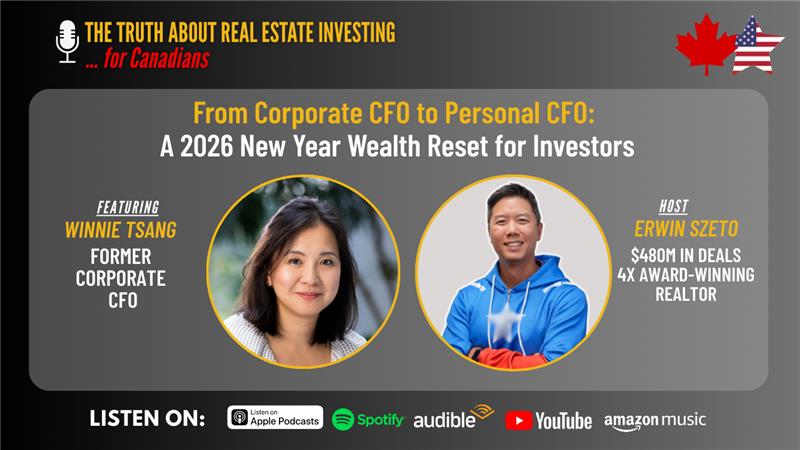
From Corporate CFO to Personal CFO: A 2026 Wealth Reset (And Why I’m Buying Less Real Estate)
Recorded: January 2026
Host: Erwin Szeto, The Truth About Real Estate Investing for Canadians Podcast
Guest: Winnie Tsang, Former CFO
Folks, welcome back to the show.
If you’ve been listening to me for a while, you know I am a die-hard real estate guy. I’ve built an 8-figure portfolio, I’ve been a landlord for 20 years, and I’ve coached hundreds of investors.
But recently, I’ve been asking myself and my clients a hard question: Is the return on investment worth the return on hassle?
I’m currently dealing with a broken washer that’s only three months old but costing me $300 to fix, plus a non-paying tenant. For high-energy entrepreneurs, active real estate is still a goldmine. But for me, with a young family, I want my investments to be boring, passive, and profitable.
That is why I brought Winnie Tsang on the show. Winnie is a former corporate CFO for massive companies like Rogers and Accenture who made a pivot. She’s now a partner at Open Concept Financial Group, acting as a “Personal CFO” for families.
We talk about “financial jujitsu”—strategies like leveraged segregated funds and corporate-owned life insurance that allow you to build wealth without unclogging a single toilet.
If you are sitting on retained earnings in your corporation or you’re tired of being a landlord, you need to read this.
🎧 Listen to the full episode here
10 Money Questions Answered in This Episode (That Your Bank Won’t Tell You)
1. Why are everyday investors diversifying away from local real estate? It’s about income diversification and resilience. Winnie notes that for many, real estate has turned cash-flow negative. By diversifying into other asset classes, you gain liquidity and options—allowing you to buy time, which is the only non-renewable resource.
2. What is the “Corporate Owned Life Insurance” tax hack? This is a game-changer for business owners (doctors, realtors, consultants). Instead of investing retained earnings in GICs (taxed at ~50%), you buy a whole life policy inside the corp. The death benefit eventually pays out to your shareholders (family) tax-free via the Capital Dividend Account. It transfers business wealth to personal wealth with massive tax efficiency.
3. Why do people choose “inaction” when it comes to their wealth? Fear and a lack of clarity. Winnie explains that people often feel overwhelmed by choices (the “burden of choice”), so they do nothing. But inaction is a choice with consequences. A good plan gives you the clarity to make a move.
4. What are “Leveraged Segregated Funds”? This is the strategy I wish I started 10 years ago. It involves using a smaller amount of cash (e.g., $2,500) to access a much larger loan (e.g., $50,000) to invest in the market. Because it’s a segregated fund, it often comes with downside protection, and the interest on the loan is tax-deductible. It amplifies the upside, similar to a mortgage on a house, but without the tenants.
5. Why leave a high-paying Corporate CFO job to help families? Winnie spent years maximizing shareholder value for big companies, but the pandemic made her rethink her purpose. She realized that regardless of wealth level, families struggle with financial management, especially as they age. She wanted to apply that high-level strategy to everyday people.
6. Why is an independent financial firm better than a bank advisor? No quotas. Winnie notes that independent firms don’t have to push “Product X” just because it’s the flavor of the month. They can assemble a bespoke solution using the best products from multiple institutions to actually serve the client’s goal, not the bank’s sales target.
7. Is real estate actually “passive” income? No. We discuss how real estate is actually an active business, not a passive investment. True passive investing shouldn’t add stress to your life or take time away from your family. If you have to manage a property manager, it’s still work.
8. Why is Estate Planning the most overlooked aspect of wealth? We avoid talking about death, but it’s the one certainty. Winnie points out that insurance is bought with your health and age; if you wait until you retire to plan your estate, it’s often too expensive or too late. Optimizing this early creates an exponential curve of growth for your legacy.
9. How do cognitive biases hurt our investment returns? We suffer from “familiarity bias”—we buy real estate because our parents did, or because we made money on it once before. But doing the same thing when market conditions have changed (like high interest rates) leads to losses. You have to look at the objective data, not just what feels comfortable.
10. What is the “Financial Jujitsu” approach? It’s about finding joy in figuring out how to make more money, work less, and pay less tax. It’s using the rules of the system (like the Capital Dividend Account or leverage) to maximize your returns with the least amount of effort.
🎧 Listen to the full episode here
My Final Thoughts
Folks, life is short. I want to spend my weekends with my kids, making slime and listening to Taylor Swift (don’t ask), not chasing rent payments.
Real estate is a fantastic way to build wealth, but it isn’t the only way. If you are ready to look at your wealth holistically—insurance, investments, and estate planning—reach out to us.
If you want to meet Winnie and hear more about these strategies, come to our Wealth Summit 2025. She’ll be there, and trust me, she’s way smarter than I am.
Save the date
Wealth Summit 2026 · Hybrid (In-Person + Online) | Saturday, January 31st · 9:00 AM EST

Ready to make 2026 your smartest financial year yet? Join us for Wealth Summit 2026, where real estate, tax, and wealth-planning experts break down the proven blueprint for protecting and multiplying your wealth.
Early-bird registration is now open — save 40% when you secure your spot early. Seats for the in-person experience are limited and always sell out fast.
Discover the frameworks, tax strategies, and legacy tools top performers use to stay ahead — no matter the market.
To Listen:
Amazon Music: https://music.amazon.ca/podcasts/40fe627d-dec7-4f5d-b7e5-90a550fffe46/episodes/ae98b6ad-0ce8-463d-b88d-1c2bb2939ecc/the-truth-about-real-estate-investing-for-canadians-from-corporate-cfo-to-personal-cfo-a-2026-new-year-wealth-reset-for-investors
Audible: https://www.audible.ca/pd/B0GK9ZJS13?source_code=ASSGB149080119000H&share_location=pdp
YouTube: https://youtu.be/T-ULjlsjqrI
You’ve Built Wealth. Now It’s Time to Understand It.
You’ve Built Wealth. Now It’s Time to Understand It.
After dozens of consultations, I’ve noticed the same pattern again and again: most investors have built real wealth, but they’re not confident they can retire from it. They’re sitting on $2M–$5M in property but feel cash-flow poor. They’re paying more tax than they should because everything is held in personal names. They have no liquidity, no insurance strategy, and no clear plan for what happens if something happens to them. And almost every single client tells me the same thing: “I don’t actually know what retirement looks like for us.”
Real estate builds equity, but it doesn’t automatically build freedom. Without a coordinated plan for taxes, income, protection, and exit strategy, investors often end up working harder in retirement than they did in their 30s. That’s why I created the Wealth Freedom Blueprint – a simple, practical guide to help you understand where you stand today, what gaps are costing you money, and how to turn the wealth you’ve built into a life you can actually live.
Download your free Wealth Freedom Blueprint
Final Thoughts
Whether you’re building wealth, protecting it, or preparing to transition it, you deserve a clear, tax-smart strategy that works in real life.
That’s what iWIN Wealth Planning is here for.
This is how we’re creating predictable, stress-free wealth for Canadian families…
so you can enjoy the life you’re building.
Book your Wealth Planning Call
Sponsored by… Me!
This episode isn’t sponsored—except by my wife Cherry and me. Real estate investing is our life. It’s helped us build wealth and achieve peace of mind about retirement and our children’s future.
Till next time—just do it. I believe in you.
Erwin Szeto
W: erwinszeto.com
FB: facebook.com/erwin.szeto
IG: @erwinszeto
Disclaimer
As a committed advocate for transparent and responsible investing, I want to disclose that I am an Advisor to SHARE SFR (Single Family Rental). I hold equity in the company and earn referral commissions from clients I refer.
My endorsement of their model—focusing on positive cash flow and direct ownership—is based on personal experience and belief. Still, every investor should do their own due diligence.


Leave a Reply
Want to join the discussion?Feel free to contribute!