
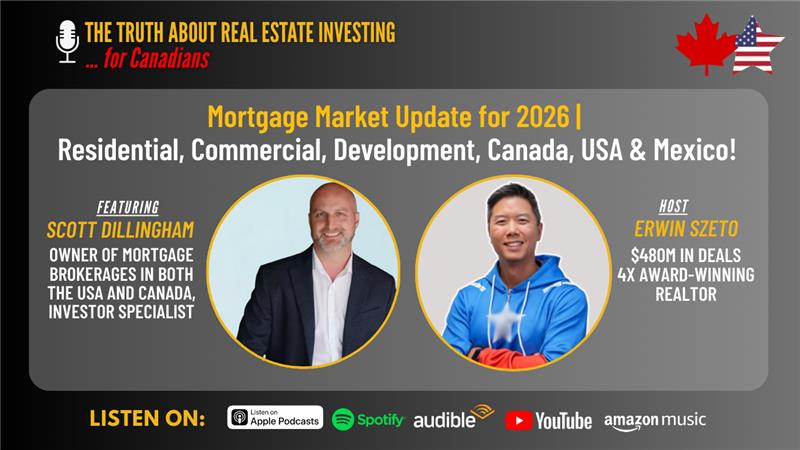
The Mortgage Masterclass: Why 2026 is the Year to Buy (and How to Hack CMHC Financing)
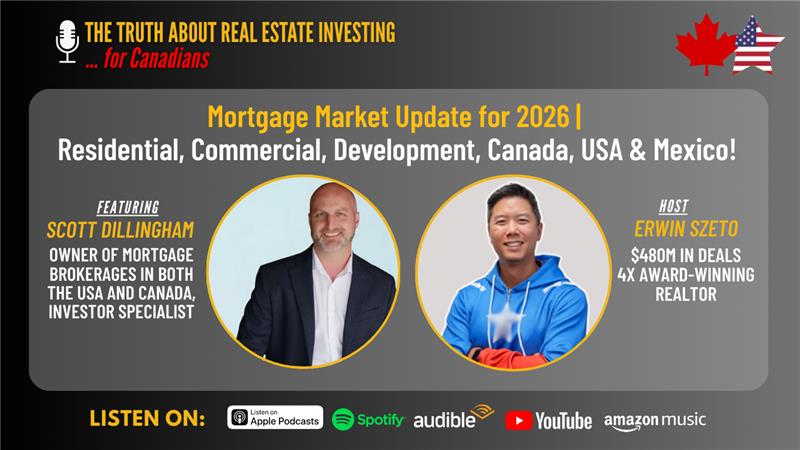
Recorded: January 2026
Host: Erwin Szeto, The Truth About Real Estate Investing for Canadians Podcast
Guest: Scott Dillingham, founder of LendCity
Welcome back to the show. I’ll be honest with you—I had some selfish questions today.
Like many of you, I have mortgages coming up for renewal. I have variable rate mortgages that have been painful for the last couple of years. I wanted to know: Is this the bottom? And if I want to invest in the U.S., how hard is it really compared to the brain damage we deal with in Canada?
To get the answers, I brought back the man who holds the record for the most appearances on this show: Scott Dillingham of LendCity. Scott is a rare breed—he owns mortgage brokerages in both Canada and the U.S., so he sees the data from both sides of the border without the fluff.
We get into the weeds on interest rate predictions, the absolute carnage happening in the pre-construction condo market, and a massive “hack” for developers using the CMHC MLI Select program that I honestly hadn’t heard before.
If you are sitting on the sidelines waiting for rates to drop further, or you’re tired of Canadian red tape and looking south, you need to read this.
🎧 Listen to the full episode here
10 Real Estate Financing Questions Answered in This Episode
1. Is it time to lock in a Fixed or Variable mortgage in 2026?
Scott suggests sticking to the 5-year fixed or 5-year variable. He warns against the “3-year fixed specials” lenders are pushing right now. Why? Because banks want you renewing sooner when they anticipate rates might be higher again. If you want safety, lock in the 5-year fixed now while it’s in the high 3s or low 4s.
2. Are interest rates going to drop further this year?
Likely not much. Scott believes we are at the bottom. In fact, major banks are predicting rates might actually creep up by 0.25% by the end of the year,. If you are waiting for rock bottom, you’re probably standing on it right now.
3. Why are pre-construction condo buyers in trouble right now?
It is ugly out there. Scott is seeing appraisals come in drastically lower than the purchase price—e.g., bought for 900k∗∗,appraisedat∗∗700k,. Lenders won’t bridge that gap; the buyer has to come up with that $200k cash difference. If you can’t, you’re in a tough spot.
4. What is the “Smart Developer Hack” for CMHC MLI Select financing?
This is pure gold for developers. Instead of forcing affordable rents (which kills your cash flow in Ontario due to rent control), savvy investors are skipping the affordability criteria entirely. They focus on energy efficiency and accessibility instead. You get a 45-year amortization (instead of 50), but you get to charge market rents,.
5. How much easier is it to get a mortgage in the U.S. vs. Canada?
Scott says it is “infinitely” easier . In Canada, you provide tax returns, T4s, and blood samples. In the U.S., you can use DSCR (Debt Service Coverage Ratio) loans, where the property qualifies for the mortgage based on its rental income, not your personal income, .
6. Is there a risk of U.S. banks failing?
We hear about U.S. bank failures in the news, but for a borrower, it doesn’t matter. U.S. banks sell their mortgages on the secondary market almost immediately . If your bank fails, your loan is just sold to another lender. Your terms don’t change .
7. Why are investors pivoting to Commercial Mortgages for residential properties?
If you are hitting a “brick wall” with residential lending limits (e.g., hitting your debt-to-service ratio cap), commercial lenders have no limit . You can buy unlimited properties as long as the deal makes sense. Rates are similar (mid-4s to 5s), though fees are slightly higher , .
8. Should you be wary of “B-Lender” fees?
Yes. B-lenders offer easier qualification (using up to 60% of income for ratios), but the costs add up. You are looking at rates from 4.8% to 6.5%, plus a 1-2% lender fee and a broker fee, . It’s a tool, but it’s not cheap.
9. How does the current U.S. political climate affect real estate?
Love him or hate him, Trump is pushing for lower borrowing costs. He has authorized Fannie Mae and Freddie Mac to buy bonds to drive interest rates down , . This flood of liquidity is expected to drive U.S. housing prices up, making now a strategic time to buy before that appreciation hits .
10. Why invest in U.S. properties through a Canadian brokerage?
Scott owns brokerages on both sides of the border, meaning there are no “middleman” fees . Many Canadian brokers just refer you to a U.S. partner and take a cut. Working with a direct access broker saves you money and streamlines the chaos .
🎧 Listen to the full episode here
My Final Thoughts
Folks, the data is clear: the waiting game is over. Whether you are looking at distressed pre-con deals in Toronto (if you have the cash) or cash-flowing rentals in the U.S., the window to buy at the bottom is closing.
Scott’s insight on the MLI Select program, taking a 45-year amortization to keep market rents, is exactly the kind of pragmatic, number-focused strategy we love on this show. Don’t let the government discount your cash flow if you don’t have to.
If you want to reach out to Scott and his team for financing in Canada or the U.S., head over to LendCity.ca and check out their investor resources.
As always, thanks for listening (all 17 of you!), and keep hustling.
Save the date
Wealth Summit 2026 · Hybrid (In-Person + Online) | Saturday, January 31st · 9:00 AM EST

Ready to make 2026 your smartest financial year yet? Join us for Wealth Summit 2026, where real estate, tax, and wealth-planning experts break down the proven blueprint for protecting and multiplying your wealth.
Early-bird registration is now open — save 40% when you secure your spot early. Seats for the in-person experience are limited and always sell out fast.
Discover the frameworks, tax strategies, and legacy tools top performers use to stay ahead — no matter the market.
To Listen:
On Spotify: https://open.spotify.com/episode/48ISuXhSJMguNaxK3d6Edy?si=bDedAZnXS3iQ9FyBP82CVw
YouTube: https://youtu.be/CO36McC9rFo
You’ve Built Wealth. Now It’s Time to Understand It.
You’ve Built Wealth. Now It’s Time to Understand It.
After dozens of consultations, I’ve noticed the same pattern again and again: most investors have built real wealth, but they’re not confident they can retire from it. They’re sitting on $2M–$5M in property but feel cash-flow poor. They’re paying more tax than they should because everything is held in personal names. They have no liquidity, no insurance strategy, and no clear plan for what happens if something happens to them. And almost every single client tells me the same thing: “I don’t actually know what retirement looks like for us.”
Real estate builds equity, but it doesn’t automatically build freedom. Without a coordinated plan for taxes, income, protection, and exit strategy, investors often end up working harder in retirement than they did in their 30s. That’s why I created the Wealth Freedom Blueprint – a simple, practical guide to help you understand where you stand today, what gaps are costing you money, and how to turn the wealth you’ve built into a life you can actually live.
Download your free Wealth Freedom Blueprint
Final Thoughts
Whether you’re building wealth, protecting it, or preparing to transition it, you deserve a clear, tax-smart strategy that works in real life.
That’s what iWIN Wealth Planning is here for.
This is how we’re creating predictable, stress-free wealth for Canadian families…
so you can enjoy the life you’re building.
Book your Wealth Planning Call
Sponsored by… Me!
This episode isn’t sponsored—except by my wife Cherry and me. Real estate investing is our life. It’s helped us build wealth and achieve peace of mind about retirement and our children’s future.
Till next time—just do it. I believe in you.
Erwin Szeto
W: erwinszeto.com
FB: facebook.com/erwin.szeto
IG: @erwinszeto
Disclaimer
As a committed advocate for transparent and responsible investing, I want to disclose that I am an Advisor to SHARE SFR (Single Family Rental). I hold equity in the company and earn referral commissions from clients I refer.
My endorsement of their model—focusing on positive cash flow and direct ownership—is based on personal experience and belief. Still, every investor should do their own due diligence.


Leave a Reply
Want to join the discussion?Feel free to contribute!