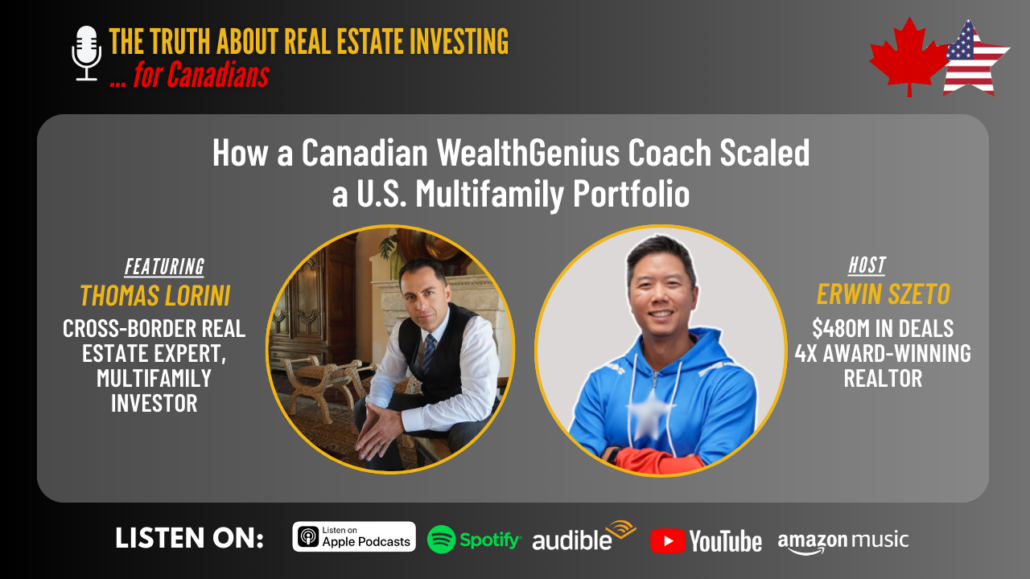
How a Canadian WealthGenius Coach Scaled a U.S. Multifamily Portfolio
Recorded: January 2026
Host: Erwin Szeto, The Truth About Real Estate Investing for Canadians Podcast
Canadian real estate investors are facing a harsh reality: rising prices, capped rents, and prolonged eviction timelines have fundamentally changed the risk profile of being a landlord in provinces like Ontario and British Columbia.
In this episode, U.S. multifamily investor Thomas Lorini explains why he shifted capital from Canadian rentals to U.S. markets — particularly Ohio — and how landlord-friendly laws, DSCR financing, and value-add multifamily strategies have restored predictability and cash flow.
Ohio offers a combination of affordability, population density, diversified employment, and strong landlord rights. Properties that would cost over $1 million in Ontario can still be acquired for under $100,000 in parts of the Midwest, with eviction timelines measured in weeks rather than years.
Thomas also breaks down common Canadian concerns:
- Cross-border taxation and entity structuring
- Financing without Canadian income limits
- Section 8 housing myths vs reality
- Currency risk and U.S. dollar income
For investors seeking boring, predictable real estate again, this conversation outlines why many Canadians are quietly diversifying into U.S. residential and multifamily assets.
🎧 Listen to the full episode here
Fast Facts on USA Investing for Canadians
Why are Canadians investing in U.S. real estate instead of Canada?
Because U.S. markets offer stronger landlord rights, lower prices, and faster legal resolution compared to rent-controlled Canadian provinces.
What is DSCR financing and why does it matter for Canadians?
DSCR loans are based on property cash flow rather than personal income, allowing Canadians to scale portfolios without income caps.
Why is Ohio attractive for real estate investors?
Ohio combines affordability, population scale, diversified employment, and landlord-friendly laws with strong cash-flow potential.
How long does an eviction take in Ohio?
Most non-payment evictions are resolved in 3–6 weeks, compared to 8–18 months in Ontario.
Is Section 8 housing risky for investors?
It can be profitable when managed correctly, but outcomes depend heavily on location, property management, and tenant mix.
Do Canadians need U.S. credit to invest in U.S. properties?
No. Many lenders underwrite the property itself rather than the investor’s personal credit history.
Are U.S. interest rates higher than Canada’s?
Yes, but U.S. loans often allow repeat financing and scalability that Canadian lenders restrict.
Does the exchange rate hurt Canadian investors?
While entry costs are higher, income is earned in U.S. dollars, often offsetting currency risk over time.
Is multifamily better than single-family investing?
Multifamily offers operational scale, professional management, and forced appreciation through value-add strategies.
🎧 Listen to the full episode here
Save the date
How to Sell Investment Property for Maximum ROI. Online-Only Live Masterclass | Tuesday, January 13th · 8:00 PM EST

If you’re thinking about selling in 2026, join us on January 13th at 8 p.m. Eastern for our free IWIN training: “How to Sell an Investment Property for Maximum ROI.”
We’ll walk through:
- Real examples of deals that sold vs. deals that pivoted to Plan B.
- How to price properly in a market full of bank sales and estate sales.
- Tenant strategies that make your property more attractive — or at least not a liability — when you hit MLS.
In this market, you don’t have to get crushed. You just have to be smarter than the average seller.
Wealth Summit 2026 · Hybrid (In-Person + Online) | Saturday, January 31st · 9:00 AM EST

Ready to make 2026 your smartest financial year yet? Join us for Wealth Summit 2026, where real estate, tax, and wealth-planning experts break down the proven blueprint for protecting and multiplying your wealth.
Early-bird registration is now open — save 40% when you secure your spot early. Seats for the in-person experience are limited and always sell out fast.
Discover the frameworks, tax strategies, and legacy tools top performers use to stay ahead — no matter the market.
To Listen:
On Spotify: https://open.spotify.com/episode/3tjfSgCpuC8m9bsslhyZYw?si=hObKhKMVQCyec2I7uexaxA
YouTube: https://www.youtube.com/watch?v=TJoOCVoGnzA
You’ve Built Wealth. Now It’s Time to Understand It.
You’ve Built Wealth. Now It’s Time to Understand It.
After dozens of consultations, I’ve noticed the same pattern again and again: most investors have built real wealth, but they’re not confident they can retire from it. They’re sitting on $2M–$5M in property but feel cash-flow poor. They’re paying more tax than they should because everything is held in personal names. They have no liquidity, no insurance strategy, and no clear plan for what happens if something happens to them. And almost every single client tells me the same thing: “I don’t actually know what retirement looks like for us.”
Real estate builds equity, but it doesn’t automatically build freedom. Without a coordinated plan for taxes, income, protection, and exit strategy, investors often end up working harder in retirement than they did in their 30s. That’s why I created the Wealth Freedom Blueprint – a simple, practical guide to help you understand where you stand today, what gaps are costing you money, and how to turn the wealth you’ve built into a life you can actually live.
Download your free Wealth Freedom Blueprint
Final Thoughts
Whether you’re building wealth, protecting it, or preparing to transition it, you deserve a clear, tax-smart strategy that works in real life.
That’s what iWIN Wealth Planning is here for.
This is how we’re creating predictable, stress-free wealth for Canadian families…
so you can enjoy the life you’re building.
Book your Wealth Planning Call
Sponsored by… Me!
This episode isn’t sponsored—except by my wife Cherry and me. Real estate investing is our life. It’s helped us build wealth and achieve peace of mind about retirement and our children’s future.
Till next time—just do it. I believe in you.
Erwin Szeto
W: erwinszeto.com
FB: facebook.com/erwin.szeto
IG: @erwinszeto
Disclaimer
As a committed advocate for transparent and responsible investing, I want to disclose that I am an Advisor to SHARE SFR (Single Family Rental). I hold equity in the company and earn referral commissions from clients I refer.
My endorsement of their model—focusing on positive cash flow and direct ownership—is based on personal experience and belief. Still, every investor should do their own due diligence.


Leave a Reply
Want to join the discussion?Feel free to contribute!