
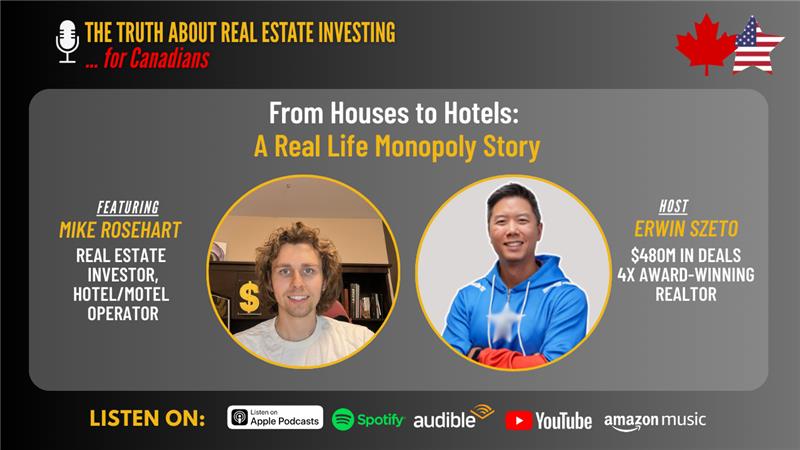
From Lending Nightmares to Hotel Millions: Mike Rosehart’s Ultimate Pivot
Recorded: January 2026
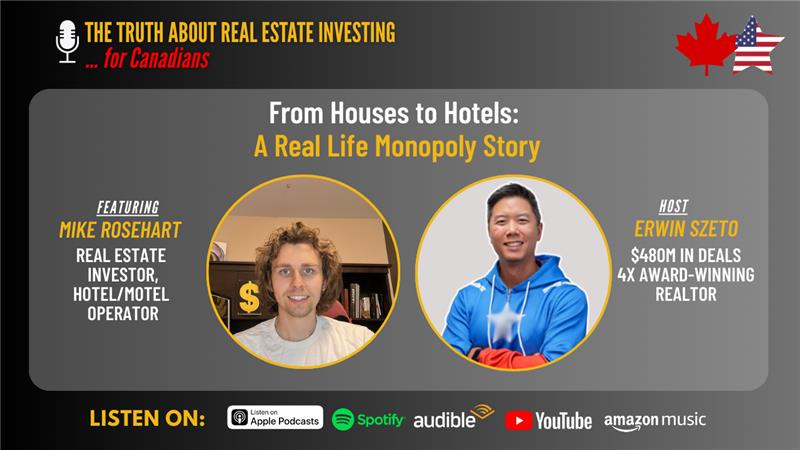
Host: Erwin Szeto, The Truth About Real Estate Investing for Canadians Podcast
Guest: Mike Rosehart, Real Estate Analyst and Investor
Welcome back to the show. We had a returning guest on, and honestly, if you’re looking for a masterclass on how to pivot when the market punches you in the face, this is it.
Mike Rosehart is back, and he’s not just doing student rentals in London anymore. We’re talking about a massive shift. He’s acquired a couple of hundred units in the last 12 to 18 months, pushing his portfolio north of $50 million.
But it wasn’t a straight line up. We get into the messy stuff—the private lending deals that went south, the foreclosures, and how he turned those disasters into a goldmine in the hospitality space. Mike openly shares the challenges, admitting he had lending deals where borrowers stopped paying for 11 months and he waited too long to take legal action.
If you are serious about scaling or you’re stuck trying to make the numbers work in this high-interest environment, you need to pay attention to the “Hotel to Apartment” conversion strategy Mike breaks down. It is absolute fire.
🎧 Listen to the full episode here
10 Real Estate Questions Answered in This Episode
1. Why are smart investors pivoting from residential rentals to hotels and motels?
The margins in residential multifamily are tight right now. Mike explains that in markets like Ontario, you might pay $180,000 to $200,000 per door for a multifamily unit. However, you can buy a hotel or motel for $60,000 to $70,000 per key. That is half or a third of the cost for the same physical square footage, offering a massive arbitrage opportunity.
2. Can you convert a motel into a long-term residential apartment?
Yes, and it’s a massive value to add. Mike notes that many motels already have kitchenettes or the infrastructure for them. By spending $10,000 to $15,000 per unit on renovations and getting a simple change of use zoning (often around $5,000), you can convert them into residential apartments that qualify for CMHC financing.
3. What are the dangers of private lending in a correcting market?
We talk about the ugly side of lending. Mike shares how he had lending deals go sideways where he was in a second mortgage position during a market correction. The lesson? If you are in a second or third mortgage position or holding a promissory note, your capital might be worthless because the first mortgage and legal fees eat up all the equity.
4. How do you automate a hotel operation to slash costs?
Mike isn’t running these like it’s 1990. He fires the expensive staff and cuts the franchise flags immediately. He uses AI bots for front desk operations, automated digital locks with codes that expire, and independent contractors for cleaning. This cuts costs by 50% compared to traditional operators.
5. Why would an investor buy a property in cash right now?
While leverage is king, cash is speed. Mike recently bought a 50-unit property in Sarnia (The Village Inn) with cash because lender fees were too high and the timeline was too tight for environmental assessments and appraisals. The goal isn’t to stay in cash, but to secure the deal, stabilize it over 6-12 months, and then refinance to pull the capital back out.
6. How does the “Lifetime Capital Gains Exemption” apply to hotels?
This is a huge tax nugget. Because hotels are considered “active businesses” rather than passive rentals, you can potentially utilize the Lifetime Capital Gains Exemption (LCGE) when you sell the shares of the corporation. If structured correctly with a family trust, you could shelter millions in profit tax-free,.
7. Is it easier to evict a non-paying guest in a hotel vs. a tenant?
Mike highlights that in a hotel/motel environment, if a guest doesn’t pay, you can simply disable their door code or call the police for removal. You avoid the 8-11 month delays typical of the Landlord and Tenant Board (LTB) in Ontario.
8. What should you look for when taking over a distressed property?
You want absentee owners or tired operators. Mike bought a hotel from a 92-year-old operator who had zero online presence—no Booking.com, no Expedia, just a phone number. By simply modernizing the marketing and operations, the revenue lift is instant.
9. Is the BRRRR method still alive in Ontario?
It is, but you have to buy deep. Mike mentions that detached houses in London, Ontario, have fallen significantly—sometimes trading at half of what they were in 2022. If you can buy a detached house for land value (e.g., $240k), add a unit, and create a duplex, the numbers start to make sense again.
10. Is real estate investing scalable without a massive team?
Mike argues that bigger deals are actually easier to scale than small ones. He puts a “mentee” or operating partner into his larger hotel deals to live on-site and manage operations in exchange for equity. This allows him to scale to hundreds of units without personally managing every toilet fix.
🎧 Listen to the full episode here
My Final Thoughts
Folks, the market has changed. What worked in 2017 isn’t working today. You can’t just buy a pre-con condo and hope it goes up. You have to force appreciation.
Mike is showing us that there is opportunity in the ashes of this correction. Whether it’s buying distressed notes, taking over foreclosures, or converting motels into housing, the deals are there for the people willing to do the work. He’s proving that “active business” income is the new path to cash flow in 2025.
If you want to see what Mike is up to, check him out on Instagram at @mikerosheart or search for The Village Inn Sarnia to see his latest project.
Save the date
Wealth Summit 2026 · Hybrid (In-Person + Online) | Saturday, January 31st · 9:00 AM EST

Ready to make 2026 your smartest financial year yet? Join us for Wealth Summit 2026, where real estate, tax, and wealth-planning experts break down the proven blueprint for protecting and multiplying your wealth.
Early-bird registration is now open — save 40% when you secure your spot early. Seats for the in-person experience are limited and always sell out fast.
Discover the frameworks, tax strategies, and legacy tools top performers use to stay ahead — no matter the market.
To Listen:
On Spotify: https://open.spotify.com/episode/48ISuXhSJMguNaxK3d6Edy?si=bDedAZnXS3iQ9FyBP82CVw
Audible: https://www.audible.ca/pd/B0GH8LCLTB?source_code=ASSGB149080119000H&share_location=pdp
YouTube:https://youtu.be/5slXpuy5YV8
You’ve Built Wealth. Now It’s Time to Understand It.
You’ve Built Wealth. Now It’s Time to Understand It.
After dozens of consultations, I’ve noticed the same pattern again and again: most investors have built real wealth, but they’re not confident they can retire from it. They’re sitting on $2M–$5M in property but feel cash-flow poor. They’re paying more tax than they should because everything is held in personal names. They have no liquidity, no insurance strategy, and no clear plan for what happens if something happens to them. And almost every single client tells me the same thing: “I don’t actually know what retirement looks like for us.”
Real estate builds equity, but it doesn’t automatically build freedom. Without a coordinated plan for taxes, income, protection, and exit strategy, investors often end up working harder in retirement than they did in their 30s. That’s why I created the Wealth Freedom Blueprint – a simple, practical guide to help you understand where you stand today, what gaps are costing you money, and how to turn the wealth you’ve built into a life you can actually live.
Download your free Wealth Freedom Blueprint
Final Thoughts
Whether you’re building wealth, protecting it, or preparing to transition it, you deserve a clear, tax-smart strategy that works in real life.
That’s what iWIN Wealth Planning is here for.
This is how we’re creating predictable, stress-free wealth for Canadian families…
so you can enjoy the life you’re building.
Book your Wealth Planning Call
Sponsored by… Me!
This episode isn’t sponsored—except by my wife Cherry and me. Real estate investing is our life. It’s helped us build wealth and achieve peace of mind about retirement and our children’s future.
Till next time—just do it. I believe in you.
Erwin Szeto
W: erwinszeto.com
FB: facebook.com/erwin.szeto
IG: @erwinszeto
Disclaimer
As a committed advocate for transparent and responsible investing, I want to disclose that I am an Advisor to SHARE SFR (Single Family Rental). I hold equity in the company and earn referral commissions from clients I refer.
My endorsement of their model—focusing on positive cash flow and direct ownership—is based on personal experience and belief. Still, every investor should do their own due diligence.


Leave a Reply
Want to join the discussion?Feel free to contribute!