From Zero to Full-Time Trader: How Anderson Carter-Griffith Built the Skill, Then Built the Wealth
Recorded: March 2026
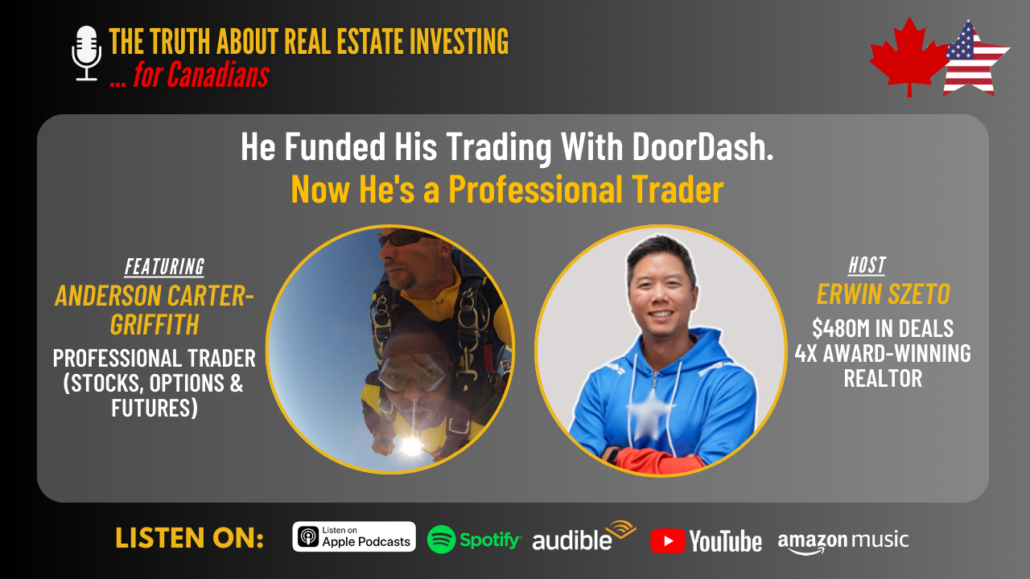
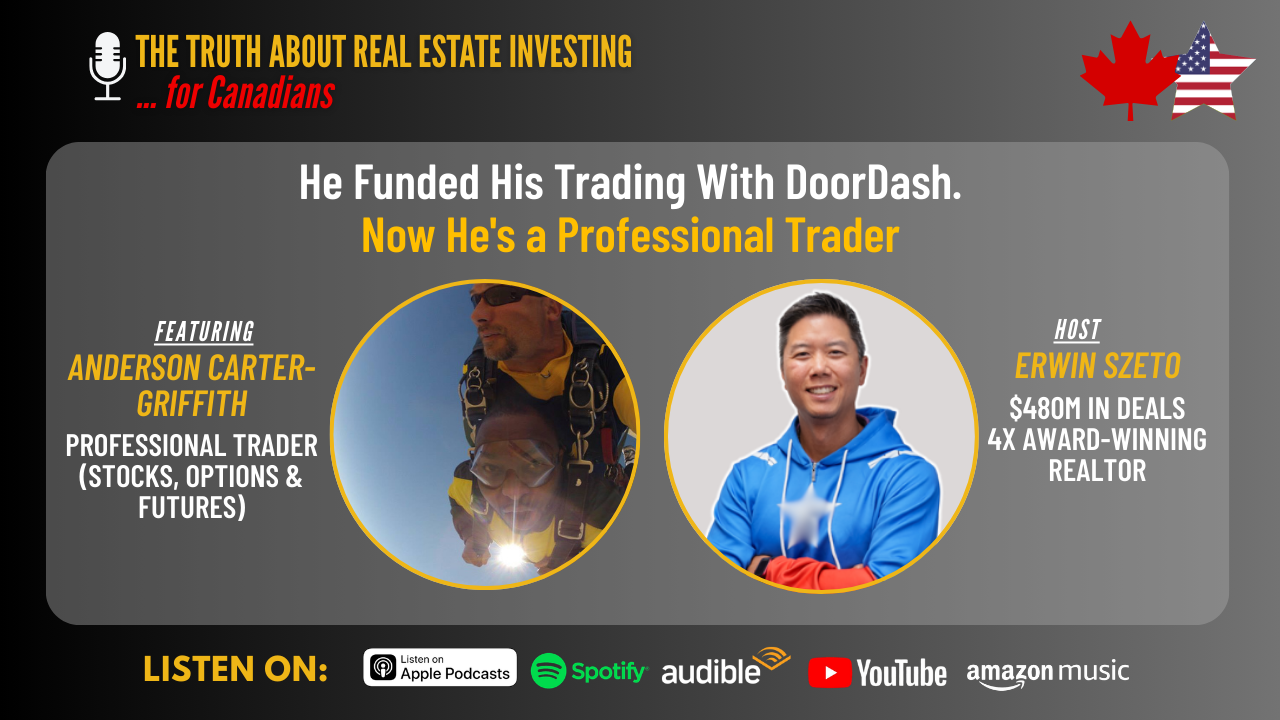
Host: Erwin Szeto, The Truth About Real Estate Investing for Canadians Podcast
Guest: Anderson Carter-Griffith
Anderson Carter-Griffith had never bought a stock when he arrived in Canada.
He came over from Barbados on a hotel recruitment program—one of 100 selected from thousands who showed up for the chance. He worked hospitality, went to culinary school, ran a catering business out of Scotiabank Arena, and eventually started delivering DoorDash on the side.
The DoorDash gig was not an accident. It was a strategy.
Today, Anderson gets paid full-time to trade. He manages a professional trading desk, coaches everyday investors on options strategies, and parks his market gains into a family real estate portfolio in Barbados—which is why he is a guest on a real estate show. But the story worth telling is the trading journey. Because it started from nothing, and it followed a path almost anyone can take.
The Rule That Changed Everything: Never Trade Your Own Income
When Anderson decided to learn trading seriously, he made one non-negotiable rule for himself: the money going into his brokerage account could not be money he needed to live.
So he delivered DoorDash—every day, winter and summer—and used only those earnings to fund his trading account.
“I recommend you come to trading with what I call disposable income. It’s crazy to me that people use their rent money.”
That discipline kept him in the game long enough to actually learn it. Most people who blow up their trading accounts do so because a losing trade isn’t just a financial loss—it’s a crisis. When the money you are trading is money you can afford to lose, you make clearer decisions.
It’s the same principle veteran investors apply to leveraged investing: you don’t use capital you cannot afford to work with. The position size has to let you sleep at night.
Step 1: ETFs First. Always.
Anderson didn’t start by picking stocks. He started with ETFs—broad, diversified funds that track entire sectors.
The reason is simple: ETFs teach you how sectors move without the noise of individual company risk. And once you understand that, you can lift the hood.
“I started with ETFs. Then I dug deeper under the hood, looked at the top 10 holdings, and as my capital and experience grew, I started picking up those individual companies.”
Today his long-term portfolio reflects that progression:
- 40% Tech: Apple, Microsoft, Tesla, Nvidia, Palantir
- 60% Diversified: Johnson & Johnson, Eli Lilly, UnitedHealth, Enbridge, TD, Royal Bank
He also uses “covered calls” on top of those holdings—a strategy that generates income from stocks you already own, effectively turning any position into a dividend-paying asset. For investors who want their money working without constant attention, this is worth understanding.
Step 2: Swing Trading — Investing That Fits Around a Job
Before Anderson was trading full-time, he was swing trading on his phone in thirty-minute windows—before work and at market close.
A swing trade is a position held anywhere from overnight to a few months. It is slower, less stressful, and far more appropriate for someone who still has a job, a family, and a life.
“If you sit and watch charts every minute and you’re not trained for it, your emotional and mental bandwidth is toast in about half an hour.”
This is where Anderson started coaching others. His company, The Trader Desk, teaches six core options strategies built around this model: put on a trade in the morning, check your phone mid-day, and let it run. No screen-watching. No emotional rollercoaster.
The first strategy he teaches is option spreads—not naked puts. The distinction matters. With an option spread, you know exactly how much you can lose before you enter the trade. Your downside is defined. For someone trading with genuinely disposable income, that structure makes the learning process feel manageable instead of terrifying.
The goal he sets for new students: replace one day’s income per month from trading. Not quit your job. Not get rich fast. One day. Then build from there.
Step 3: Professional Trading — Getting Paid to Trade Someone Else’s Capital
The final stage in Anderson’s journey was joining a trading firm as a professional—meaning the firm provides the capital, Anderson trades it, and he earns a percentage of the returns.
He now trades during New York Stock Exchange hours (9:30 a.m. to 4:00 p.m.) from a seven-monitor setup, and also trades futures in the early morning when the London and New York sessions overlap—a window he calls “the switch-on,” when institutional money floods the market and volatility spikes.
The firm’s rule: be “flat” by the end of every day. No overnight positions. It is a discipline that eliminates the risk of waking up to a tweet or a headline that has moved the market against you while you slept.
“I had to go to work for a week in Barbados to make what I can make in a couple of hours here. Once I got a taste of it, I couldn’t believe people made money like this.”
Where the Money Goes: The Real Estate Connection
Anderson’s philosophy on trading profits is simple: get the fast-paced money out of the market as quickly as possible and park it somewhere safe and boring.
For him, that means real estate. His family owns eight buildings—16 apartments—in Barbados. It is a mix of long-term tenants and short-term Airbnb units (where rates run $300 to $1,000 USD/night depending on unit size). A property manager handles operations, and Anderson doesn’t touch it.
It’s the same logic successful business owners use: fast income funds patient assets. Trading cash flow—like employment income—gets deployed into stable real estate, a dividend portfolio, or insurance products that compound over decades.
The vehicle is less important than the principle: active income should be building passive assets, not just paying for lifestyle.
10 Questions Answered on Trading, Options, and Building Wealth
1. What is the safest way for a beginner to start trading?
Anderson recommends starting with ETFs (Exchange-Traded Funds) rather than trying to pick individual stocks. By looking “under the hood” of ETFs, beginners can learn how different sectors move without the high risk of single-company exposure.
2. What is the biggest mistake new traders make?
Trading their rent or grocery money. Anderson built his initial trading account by delivering for DoorDash every single day. Using strictly disposable income removes the emotional panic of losing essential funds, which is when most new traders blow up their accounts.
3. What is “swing trading” and is it good for people with 9-to-5 jobs?
Swing trading involves holding a trade anywhere from overnight to several months. Anderson highly recommends this for people with full-time jobs because it doesn’t require watching the screen all day—you can simply check your positions for 30 minutes in the morning and 30 minutes at the close.
4. Why do professional day traders close all their positions by the end of the day?
Professional prop traders are required to be “flat” (holding zero positions) at the end of the day to eliminate overnight risk. This ensures they don’t wake up to massive losses caused by unexpected after-hours news, geopolitical events, or sudden market shifts.
5. Why are “option spreads” safer than selling “naked puts”?
While some strategies teach selling naked puts, Anderson warns against this because it requires massive upfront capital and exposes you to assignment risk if the trade goes against you. Option spreads, on the other hand, have a strictly defined, limited downside risk so you know exactly what your maximum loss is before entering the trade.
6. Can you turn a non-dividend stock into a cash-flowing asset?
Yes. Anderson uses an options strategy called “covered calls” to generate income on regular stocks he holds in his long-term portfolio. This effectively turns any standard stock into a dividend-producing asset.
7. How much money do you need to start trading options?
You can realistically start trading with as little as $1,000. The mechanics and core strategies of options trading are exactly the same whether you are trading a $1,000 account or a $10 million account; it simply becomes a matter of scaling the number of contracts you buy.
8. What is the “crossover” in the stock market?
The crossover is a highly volatile, volume-heavy period around 8:00 AM to 9:30 AM EST when the London trading session overlaps with the pre-market New York session. This is when institutional money (the “whales” and hedge funds) flood the market, creating prime opportunities for professional traders.
9. What should day traders do with their market profits?
Anderson’s core philosophy is to pull fast-paced money out of the market as quickly as possible and park it in safe, boring assets. He moves his trading gains into a stable dividend portfolio and hard real estate to preserve his wealth.
10. How does trading income complement real estate investing?
Trading is active income, while real estate is a patient, long-term asset. Anderson uses his active trading profits to expand and support his family’s real estate portfolio of 16 long-term and short-term rental apartments in Barbados, creating a diversified, multi-generational wealth engine.
Connect with Anderson
Anderson offers one-on-one coaching through The Trader Desk. Sessions are tailored to your pace and your level — whether you’re starting with $1,000 or $100,000, the strategies are the same.
Email: thetraderdesk@outlook.com — include your name and phone number and he’ll get back to you.
F
To Listen:
Audible: https://www.audible.ca/pd/B0GSGWXJQZ?source_code=ASSGB149080119000H&share_location=pdp
YouTube: https://youtu.be/hsvpNLnabHg
You’ve Built Wealth. Now It’s Time to Understand It.
You’ve Built Wealth. Now It’s Time to Understand It.
After dozens of consultations, I’ve noticed the same pattern again and again: most investors have built real wealth, but they’re not confident they can retire from it. They’re sitting on $2M–$5M in property but feel cash-flow poor. They’re paying more tax than they should because everything is held in personal names. They have no liquidity, no insurance strategy, and no clear plan for what happens if something happens to them. And almost every single client tells me the same thing: “I don’t actually know what retirement looks like for us.”
Real estate builds equity, but it doesn’t automatically build freedom. Without a coordinated plan for taxes, income, protection, and exit strategy, investors often end up working harder in retirement than they did in their 30s. That’s why I created the Wealth Freedom Blueprint – a simple, practical guide to help you understand where you stand today, what gaps are costing you money, and how to turn the wealth you’ve built into a life you can actually live.
Download your free Wealth Freedom Blueprint
Final Thoughts
Whether you’re building wealth, protecting it, or preparing to transition it, you deserve a clear, tax-smart strategy that works in real life.
That’s what iWIN Wealth Planning is here for.
This is how we’re creating predictable, stress-free wealth for Canadian families…
so you can enjoy the life you’re building.
Book your Wealth Planning Call
Sponsored by… Me!
This episode isn’t sponsored—except by my wife Cherry and me. Real estate investing is our life. It’s helped us build wealth and achieve peace of mind about retirement and our children’s future.
Till next time—just do it. I believe in you.
Erwin Szeto
W: erwinszeto.com
FB: facebook.com/erwin.szeto
IG: @erwinszeto
Disclaimer
As a committed advocate for transparent and responsible investing, I want to disclose that I am an Advisor to SHARE SFR (Single Family Rental). I hold equity in the company and earn referral commissions from clients I refer.
My endorsement of their model—focusing on positive cash flow and direct ownership—is based on personal experience and belief. Still, every investor should do their own due diligence.

Leave a Reply
Want to join the discussion?Feel free to contribute!